


Maturation of the Coordination Between Respiration and Deglutition with and Without Recurrent Laryngeal Nerve Lesion in an Animal Model
- PMID: 29476275
- PMCID: PMC6108960
- DOI: 10.1007/s00455-018-9881-z
Maturation of the Coordination Between Respiration and Deglutition with and Without Recurrent Laryngeal Nerve Lesion in an Animal Model
Abstract
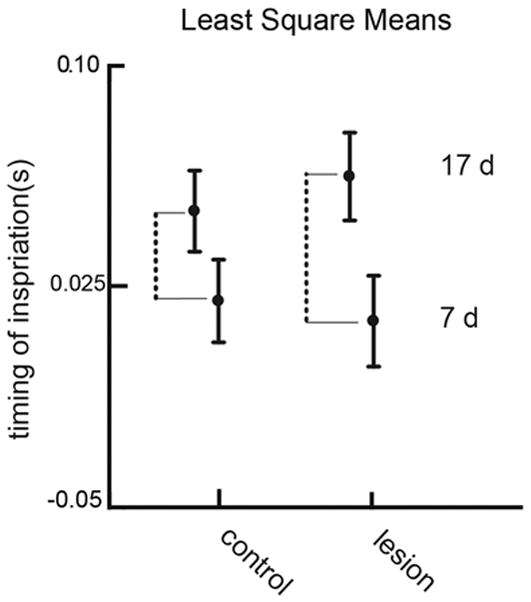
The timing of the occurrence of a swallow in a respiratory cycle is critical for safe swallowing, and changes with infant development. Infants with damage to the recurrent laryngeal nerve, which receives sensory information from the larynx and supplies the intrinsic muscles of the larynx, experience a significant incidence of dysphagia. Using our validated infant pig model, we determined the interaction between this nerve damage and the coordination between respiration and swallowing during postnatal development. We recorded 23 infant pigs at two ages (neonatal and older, pre-weaning) feeding on milk with barium using simultaneous high-speed videofluoroscopy and measurements of thoracic movement. With a complete linear model, we tested for changes with maturation, and whether these changes are the same in control and lesioned individuals. We found (1) the timing of swallowing and respiration coordination changes with maturation; (2) no overall effect of RLN lesion on the timing of coordination, but (3) a greater magnitude of maturational change occurs with RLN injury. We also determined that animals with no surgical intervention did not differ from animals that had surgery for marker placement and a sham procedure for nerve lesion. The coordination between respiration and swallowing changes in normal, intact individuals to provide increased airway protection prior to weaning. Further, in animals with an RLN lesion, the maturation process has a larger effect. Finally, these results suggest a high level of brainstem sensorimotor interactions with respect to these two functions.
Keywords: Animal model; Deglutition; Development; Infant; Recurrent laryngeal nerve; Respiration; Sensorimotor.
Figures
References
-
- Abu-Shaweesh JM. Maturation of respiratory reflex responses in the fetus and neonate. Semin Neonatol. 2004;9(3):169–80. - PubMed
-
- Bautista TG, Xing T, Fong AY, Pilowsky PM. Recurrent laryngeal nerve activity exhibits a 5-HT-mediated long-term facilitation and enhanced response to hypoxia following acute intermittent hypoxia in rat. J Appl Physiol (1985) 2012;112(7):1144–56. - PubMed
Publication types
MeSH terms
Grants and funding
LinkOut - more resources
Full Text Sources
Other Literature Sources
