Comparison of Monthly vs Treat-and-Extend Regimens for Individuals With Macular Edema Who Respond Well to Anti-Vascular Endothelial Growth Factor Medications: Secondary Outcomes From the SCORE2 Randomized Clinical Trial
- PMID: 29476687
- PMCID: PMC5876862
- DOI: 10.1001/jamaophthalmol.2017.6843
Comparison of Monthly vs Treat-and-Extend Regimens for Individuals With Macular Edema Who Respond Well to Anti-Vascular Endothelial Growth Factor Medications: Secondary Outcomes From the SCORE2 Randomized Clinical Trial
Abstract
Importance: Comparisons of monthly vs treat-and-extend anti-vascular endothelial growth factor (anti-VEGF) regimens for macular edema from central retinal vein occlusion or hemiretinal vein occlusion is needed.
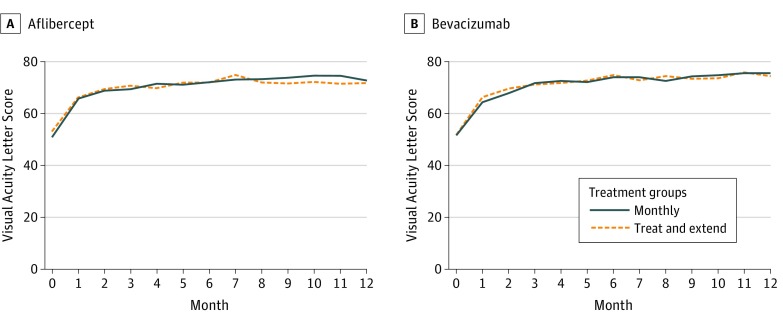
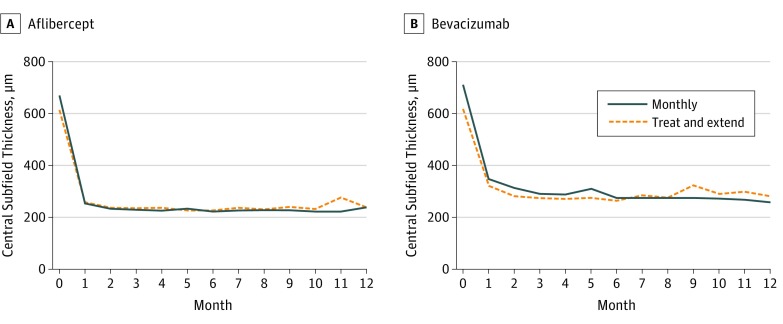
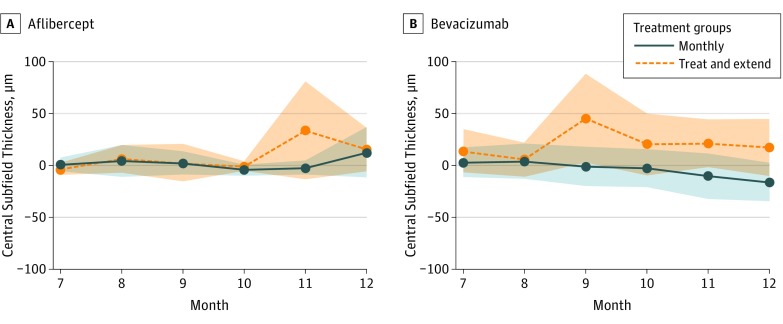
Objective: To compare visual acuity letter score and central subfield thickness outcomes of participants in the Study of Comparative Treatments for Retinal Vein Occlusion 2 (SCORE2) trial who then received either monthly injections or treat-and-extend (TAE) regimens of aflibercept or bevacizumab after a good response at month 6.
Design, setting, and participants: This randomized clinical trial enrolled participants from 66 private practice or academic centers in the United States. All participants had macular edema associated with central retinal vein occlusion or hemiretinal vein occlusion, had enrolled in the SCORE2 trial, and had a protocol-defined good response to monthly injections in the first 6 months of the trial. Participants initially assigned to receive monthly aflibercept were randomized to aflibercept on a monthly or TAE schedule, and participants initially assigned to receive monthly injections of bevacizumab were randomized to receive bevacizumab on a monthly or TAE schedule. The first participant was randomized in the SCORE2 trial on September 17, 2014, and the last month 12 visit occurred on October 24, 2016.
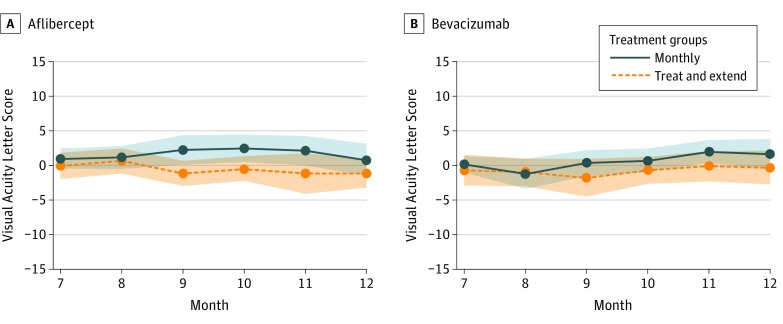
Main outcomes and measures: Change from month 6 to month 12 in best-corrected electronic visual acuity letter score (per the Early Treatment Diabetic Retinopathy Study).
Results: The 293 participants had a mean (SD) age of 68.9 (11.9) years; 127 (43.3%) were female. Of these, 79 were randomized to aflibercept on a monthly schedule, 80 to aflibercept on a TAE schedule, 67 to monthly bevacizumab, and 67 to bevacizumab on a TAE schedule. Mean treatment group difference (the change in visual acuity letter score in the monthly group minus the change in the TAE group) from month 6 to month 12 was 1.88 (97.5% CI, -1.07 to 4.83; P = .15) for aflibercept and 1.98 (97.5% CI, -1.08 to 5.03; P = .15) for bevacizumab. In the aflibercept arm, the mean number of injections between months 6 and 11 was 5.8 in the monthly injection group (95% CI, 5.6 to 5.9) and 3.8 in the TAE group (95% CI, 3.5 to 4.1; P < .001); in the bevacizumab arm, the mean number of injections was 5.8 (95% CI, 5.6 to 5.9) in the monthly group and 4.5 in the TAE group (95% CI, 4.2 to 4.8; P < .001).
Conclusions and relevance: One to 2 fewer injections of aflibercept or bevacizumab were given to the TAE groups than the monthly groups in months 6 to 12 for macular edema associated with central retinal or hemiretinal vein occlusion. Because of wide confidence intervals on the differences between the groups, caution is warranted before concluding that the regimens are associated with similar vision outcomes.
Trial registration: www.clinicaltrials.gov identifier: NCT01969708.
Conflict of interest statement
Figures
Comment in
-
The SCORE2 Comparison of Treat-and-Extend vs Monthly Anti-Vascular Endothelial Growth Factor Dosing: Short-term Similarities and Longer-term Questions.JAMA Ophthalmol. 2018 Apr 1;136(4):346-347. doi: 10.1001/jamaophthalmol.2017.6855. JAMA Ophthalmol. 2018. PMID: 29476686 No abstract available.
References
-
- Brown DM, Campochiaro PA, Singh RP, et al. ; CRUISE Investigators . Ranibizumab for macular edema following central retinal vein occlusion: six-month primary end point results of a phase III study. Ophthalmology. 2010;117(6):1124-1133.e1. - PubMed
-
- Boyer D, Heier J, Brown DM, et al. Vascular endothelial growth factor Trap-Eye for macular edema secondary to central retinal vein occlusion: six-month results of the phase 3 COPERNICUS study. Ophthalmology. 2012;119(5):1024-1032. - PubMed
-
- Holz FG, Roider J, Ogura Y, et al. VEGF Trap-Eye for macular oedema secondary to central retinal vein occlusion: 6-month results of the phase III GALILEO study. Br J Ophthalmol. 2013;97(3):278-284. - PubMed
Publication types
MeSH terms
Substances
Associated data
Grants and funding
LinkOut - more resources
Full Text Sources
Other Literature Sources
Medical