


Recent Improvement in the Long-term Survival of Breast Cancer Patients by Age and Stage in Japan
- PMID: 29479003
- PMCID: PMC6143379
- DOI: 10.2188/jea.JE20170103
Recent Improvement in the Long-term Survival of Breast Cancer Patients by Age and Stage in Japan
Abstract
Background: Recent improvements in 5-year survival of breast cancer have been reported in Japan and other countries. Though the number of long-term breast cancer survivors has been increasing, recent improvements in 10-year survival have not been reported. Moreover, the degree of improvement according to age and disease stage remains unclear.
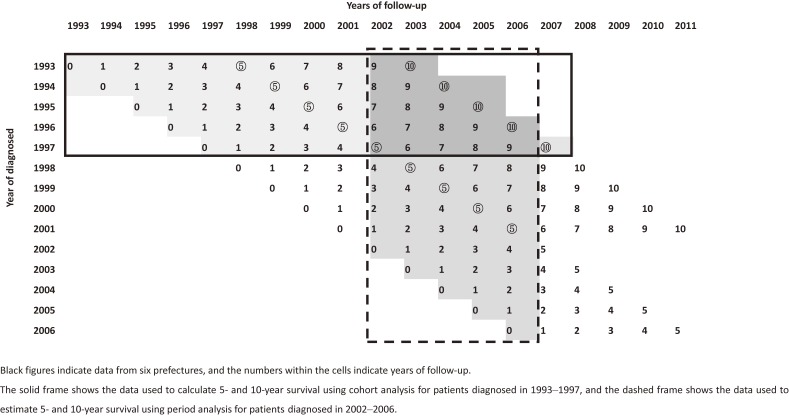
Methods: We calculated long-term survival using data on breast cancer diagnosed from 1993 through 2006 from six prefectural population-based cancer registries in Japan. The recent increase in 10-year relative survival was assessed by comparing the results of period analysis in 2002-2006 with the results of cohort analysis in 1993-1997. We also conducted stratified analyses by age group (15-34, 35-49, 50-69, and 70-99 years) and disease stage (localized, regional, and distant).
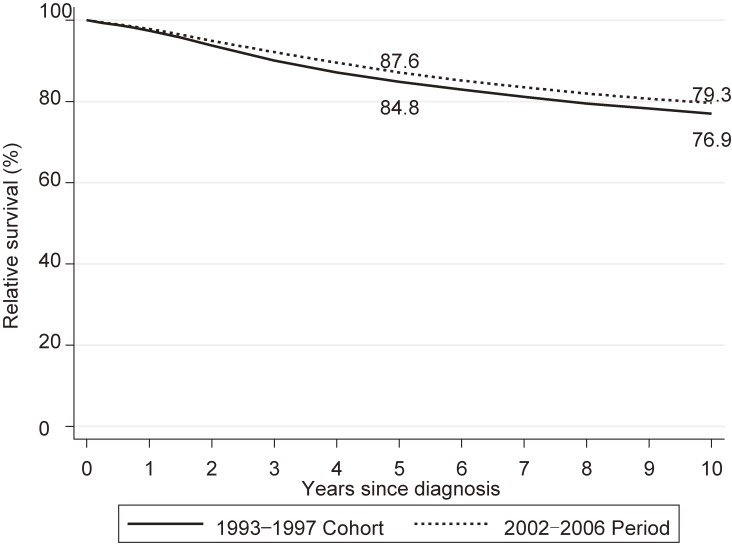
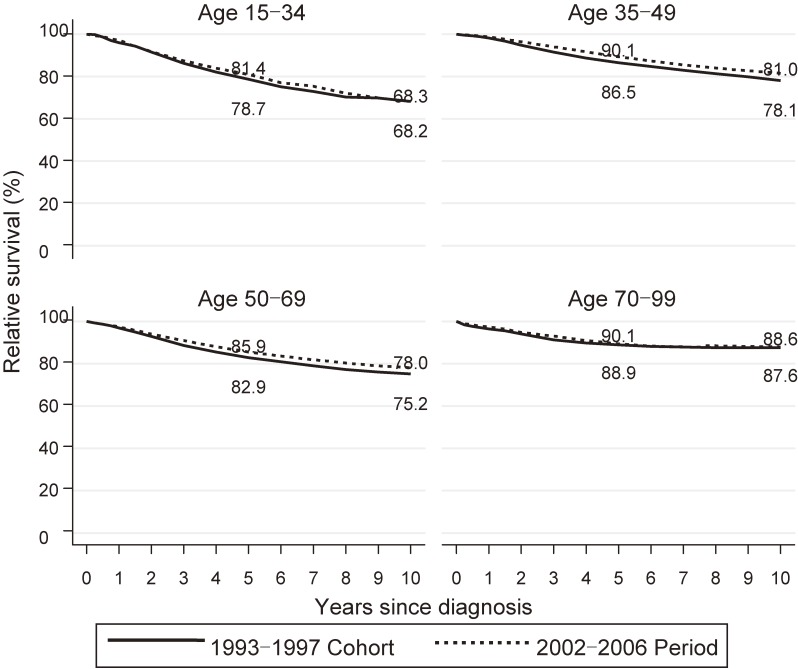
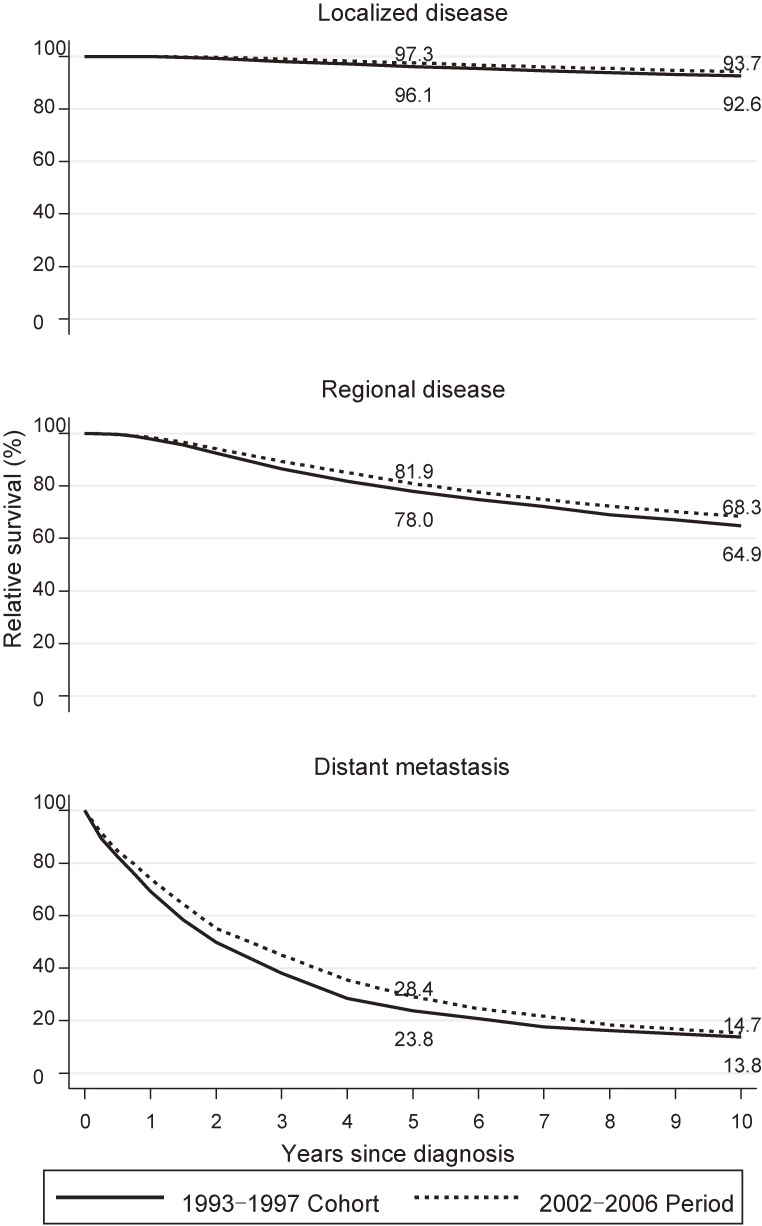
Results: A total of 63,348 patients were analysed. Ten-year relative survival improved by 2.4% (76.9% vs 79.3%) from 1993 through 2006. By age and stage, 10-year relative survival clearly improved in the age 35-49 years (+2.9%; 78.1% vs 81.0%), 50-69 years (+2.8%; 75.2% vs 78.0%) and regional disease (+3.4%; 64.9% vs 68.3%). In contrast, the degree of improvement was small in the age 15-34 years (+0.1%; 68.2% vs 68.3%), 70-99 years (+1.0%; 87.6% vs 88.6%), localized disease (+1.1%; 92.6% vs 93.7%) and distant metastasis (+0.9%; 13.8% vs 14.7%).
Conclusions: These population-based cancer registry data show that 10-year relative survival improved 2.4% over this period in Japan. By age and stage, improvement in the age 15-34 years and distant metastasis was very small, which suggests the need for new therapeutic strategies in these patients.
Keywords: breast cancer; cancer registration; long-term survival; period analysis; relative survival.
Figures
References
-
- Hori M, Matsuda T, Shibata A, Katanoda K, Sobue T, Nishimoto H; Japan Cancer Surveillance Research Group . Cancer incidence and incidence rates in Japan in 2009: a study of 32 population-based cancer registries for the Monitoring of Cancer Incidence in Japan (MCIJ) project. Jpn J Clin Oncol. 2015;45:884–891. 10.1093/jjco/hyv088 - DOI - PubMed
-
- Cancer Information Service NCC, Japan. Cancer Statistics White Papar 2012. 2012.
-
- Matsuda T, Ajiki W, Marugame T, Ioka A, Tsukuma H, Sobue T; Research Group of Population-Based Cancer Registries of Japan . Population-based survival of cancer patients diagnosed between 1993 and 1999 in Japan: a chronological and international comparative study. Jpn J Clin Oncol. 2011;41:40–51. 10.1093/jjco/hyq167 - DOI - PubMed
-
- Cancer Information Service NCC, Japan. Monitoring of Cancer Incidence in Japan—Survival 2006–2008 Report. 2016.
MeSH terms
LinkOut - more resources
Full Text Sources
Other Literature Sources
Medical
