Review
. 2018 May;19(5):311-325.
doi: 10.1038/nrg.2018.9. Epub 2018 Feb 26.

Stretching the limits: from homeostasis to stem cell plasticity in wound healing and cancer

Affiliations
Review

Stretching the limits: from homeostasis to stem cell plasticity in wound healing and cancer

Yejing Ge et al. Nat Rev Genet. 2018 May.

Abstract

Stem cells (SCs) govern tissue homeostasis and wound repair. They reside within niches, the special microenvironments within tissues that control SC lineage outputs. Upon injury or stress, new signals emanating from damaged tissue can divert nearby cells into adopting behaviours that are not part of their homeostatic repertoire. This behaviour, known as SC plasticity, typically resolves as wounds heal. However, in cancer, it can endure. Recent studies have yielded insights into the orchestrators of maintenance and lineage commitment for SCs belonging to three mammalian tissues: the haematopoietic system, the skin epithelium and the intestinal epithelium. We delineate the multifactorial determinants and general principles underlying the remarkable facets of SC plasticity, which lend promise for regenerative medicine and cancer therapeutics.


Conflict of interest statement

Competing interests

The authors declare no competing interests.

Figures
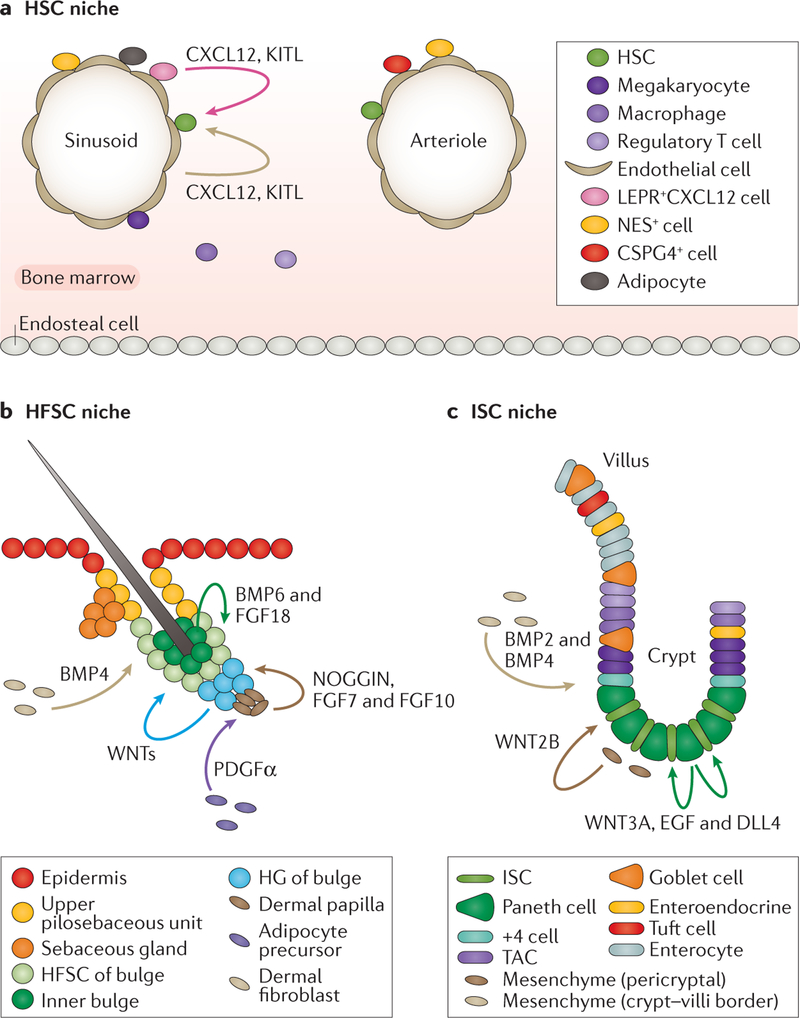
Figure 1 |
Figure 1 |. Stem cell heterogeneity in space and in time.
a | Perivascular niches described for adult haematopoietic stem cells (HSCs) in the bone marrow. Niche cell types include endothelial cells and leptin receptor (LEPR)-positive cells at the sinusoids (which secrete C-X-C motif chemokine 12 (CXCL12) and stem cell factor/KIT ligand (KITL)), chondroitin sulfate proteoglycan 4 (CSPG4)-positive cells at the arterioles and nestin (NES)-expressing cells at both locations. In addition, adipocytes and HSC progenies (megakaryocytes, macrophages and regulatory T cells) are important for HSC expansion and maintenance. b | With each new adult hair cycle, the hair follicle and its SCs transition from a resting (telogen) to an activation (anagen) state. The interfollicular epidermis is maintained by its own basal SCs. Contiguous with the epidermis are hair follicles, whose stem cells (HFSCs) sit at the base of the resting follicle, a region called the bulge. HFSCs reside in the outermost bulge layer and are kept quiescent by bone morphogenetic proteins (BMPs) from dermal fibroblasts and BMP6 and fibroblast growth factor 18 (FGF18) from inner bulge cells. Basement membrane components, including laminin and collagen‑α1(XVII) chain (COL17A1) (not depicted), have also been reported to contribute to HFSC quiescence. HFSCs at the bulge base, the hair germ (HG), are in close proximity to a specialized mesenchymal stimulus known as the dermal papilla. Upon transition to the anagen state, inhibitory signals are replaced by activation signals, including WNTs from the dermis and/or the HG, NOGGIN (BMP inhibitor) and FGFs from the dermal papilla, facilitated by platelet-derived growth factor-α (PDGFα) from adipocyte precursors. c | In the small intestine, fast-cycling crypt base columnar (CBC) cells expressing high levels of leucine-rich repeat-containing G protein coupled receptor 5 (LGR5) are intestinal stem cells (ISCs). The quiescent +4 cells (counting from the base of the crypt) can also regenerate crypt and villi upon stress. ISCs are sandwiched between niche secretory Paneth cells, which secrete high levels of WNTs, epidermal growth factor (EGF) and the Notch ligand δ-like protein 4 (DLL4) to maintain self-renewal. WNTs may also originate from the pericryptal mesenchyme. Mesenchymal cells at the crypt–villus border secrete BMPs, which might be important to restrict WNT signalling and ISC proliferation. TAC, transit-amplifying cells.
Figure 2 |
Figure 2 |. Stem cell plasticity under stress.
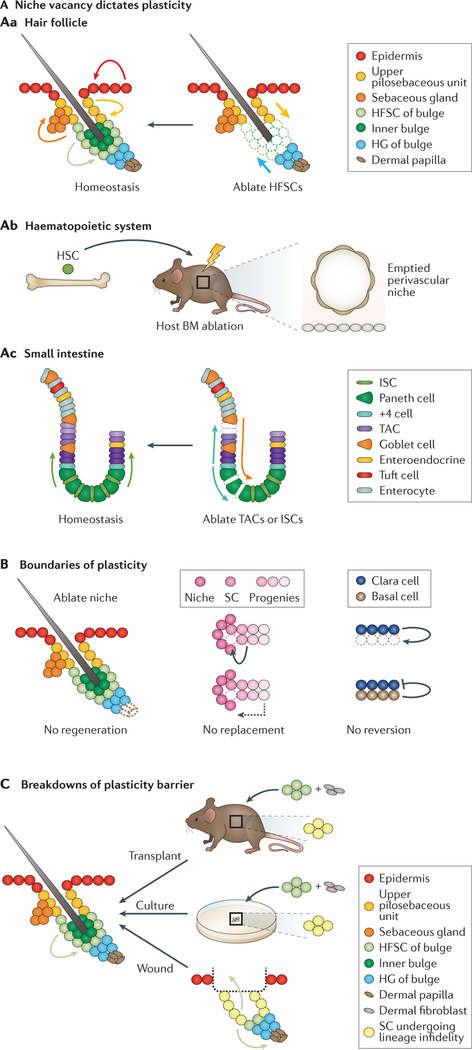
A | In the hair follicle (part Aa), under homeostasis, each stem cell (SC) compartment is maintained by corresponding resident SCs (curved arrows). By contrast, ablated bulge cells (emptied circles) are replenished by both the upper pilosebaceous unit and the hair germ (HG) (straight arrows). In the haematopoietic system (part Ab), ablating host bone marrow haematopoietic stem cells (HSCs) allows transplanted HSCs (green cell) to successfully engraft. In the small intestine (part Ac), while intestinal stem cells (ISCs) maintain homeostatic turnover, quiescent +4 cells, secretory progenitors (curved arrows), enteroendocrine cells and enterocytes are all competent to mediate repair upon irradiation damage (emptied circles). B | Plasticity has boundaries. When the dermal papilla of the murine hair follicle SC niche is ablated (emptied circles), hair regeneration is defective (left panel). In the Drosophila melanogaster gonad, SC progenies immediately juxtaposed to the niche are competent (curved arrows) to replace lost SCs (emptied circle), whereas cells just a short distance away do not participate in repair (dashed arrow) (middle panel). In the lung, feedback regulation from basal cells limits plasticity from Clara cells (right panel). C | SC plasticity is broadened upon transplantation and culturing and during wound repair. Hair follicle SCs (HFSCs) fuel hair regeneration under steady state but regenerate both hair follicle and epidermis upon transplantation and during wound repair. In culture, HFSCs also undergo lineage infidelity (yellow circles) and become epidermis-like, which can be resolved once they are grafted onto an immunosuppressed host, resulting in the regeneration of both interfollicular epidermis and hair follicles. BM, bone marrow; TAC, transit-amplifying cells.
Figure 3 |
Figure 3 |. Stem cell plasticity in cancer.
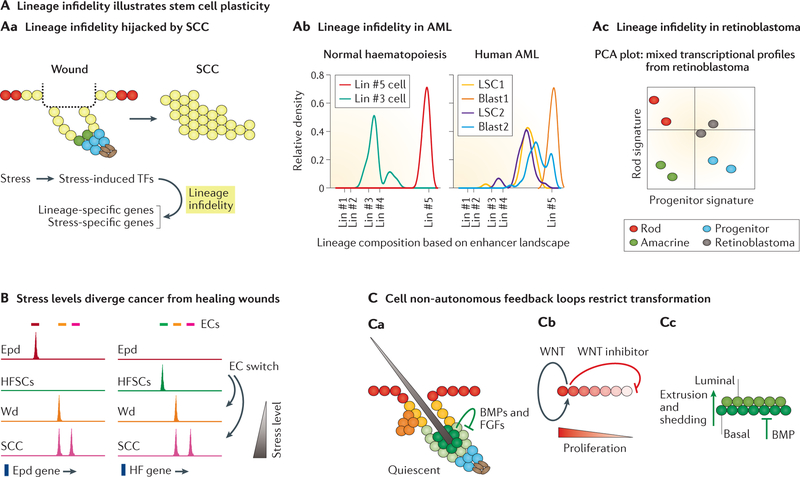
A | Stem cell (SC) lineage infidelity is a unique manifestation of plasticity. Aa | Transient in wound repair and sustained in squamous cell carcinoma (SCC), lineage infidelity is driven by stress-induced transcription factors, which activate stress-specific and lineage-specific gene expression. Ab | Based upon enhancer landscaping at the whole-genome level, normal haematopoiesis has a defined lineage (Lin) profile (Lin #3 or #5 cell), whereas human acute myeloid leukaemia (AML) exhibits mixed lineage profiles in either leukaemia stem cells (LSCs) or leukaemic blasts at the single-cell level. Ac | Principle component analysis (PCA) based on transcriptional profiles also reveals mixed lineage profiles in retinoblastoma. B | Stress levels are likely to be a key parameter that diverges cancer from wound repair. Upon wounding (Wd), hair follicle SCs (HFSCs) sense stress and activate epidermis (Epd) genes as HFSC homeostatic regulatory epicentres (ECs) collapse and stress ECs emerge to transiently dominate chromatin regulation. As stress levels elevate in tumorigenesis, new tumour ECs driven by high levels of stress-induced transcription factors work together with wound-induced ECs to make lineage infidelity a permanent state. C | Feedback controls the return of SCs to dormancy to restrict unscheduled plasticity in normal homeostasis. Ca | Progeny of HFSCs home back to their niche to confer inhibitory signals, such as bone morphogenetic proteins (BMPs) and fibroblast growth factors (FGFs), that keep HFSCs in quiescence. Cb | Epidermal SCs generate a short-range stimulatory WNT signal for self-renewal and a longer-range WNT inhibitor that limits the zone of proliferative activity. Cc | In airway epithelia wound repair, basal cells sense their local density and respond by extrusion and shedding to limit the proliferative response, in addition to inhibition by mesenchymal BMP signals. TFs, transcription factors. Part Ab is adapted from REF. , Macmillan Publishers Limited. Part Ac is adapted with permission from REF. , Elsevier. Part B is adapted with permission from REF. , Elsevier.

References

    1. Schofield R The relationship between the spleen colony-forming cell and the haemopoietic stem cell. Blood Cells 4, 7–25 (1978).

      In this paper, the SC niche concept is coined and formally elaborated upon.

    1. Till JE & McCulloch EA A direct measurement of the radiation sensitivity of normal mouse bone marrow cells. Radiat. Res 14, 213–222 (1961).

      This article presents the discovery of spleen colony-forming units, clonogenic bone marrow precursors that give rise to macroscopic spleen colonies after transplantation into irradiated recipient mice, a work directly leading to the definition of a SC.

    1. Dick JE, Magli MC, Huszar D, Phillips RA & Bernstein A Introduction of a selectable gene into primitive stem cells capable of long-term reconstitution of the hemopoietic system of W/Wv mice. Cell 42, 71–79 (1985). - PubMed
    1. Lemischka IR, Raulet DH & Mulligan RC Developmental potential and dynamic behavior of hematopoietic stem cells. Cell 45, 917–927 (1986). - PubMed
    1. Muller-Sieburg CE, Whitlock CA & Weissman IL Isolation of two early B lymphocyte progenitors from mouse marrow: a committed pre-pre-B cell and a clonogenic Thy-1-lo hematopoietic stem cell. Cell 44, 653–662 (1986). - PubMed

Publication types