


Cd20 Expression and Effects on Outcome of Relapsed/ Refractory Diffuse Large B Cell Lymphoma after Treatment with Rituximab
- PMID: 29479962
- PMCID: PMC5980916
- DOI: 10.22034/APJCP.2018.19.2.331
Cd20 Expression and Effects on Outcome of Relapsed/ Refractory Diffuse Large B Cell Lymphoma after Treatment with Rituximab
Abstract
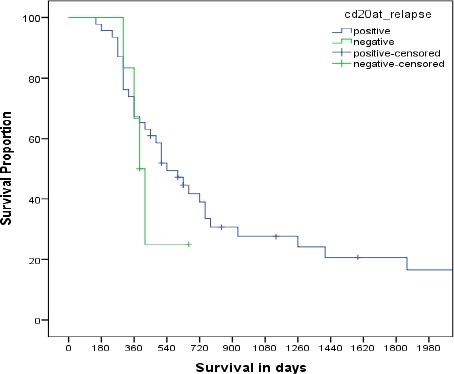
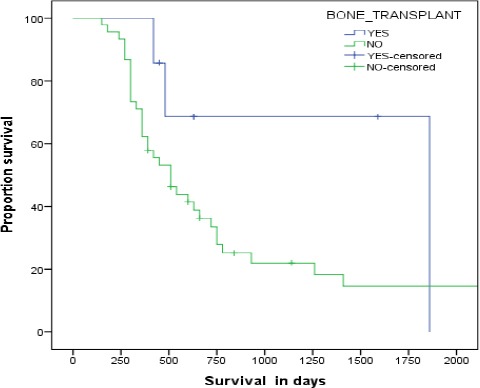
Introduction: Down regulation of CD20 expression has been reported in diffuse large B cell lymphoma (DLBCL)). Therefore, it is important to determine whether chemotherapy with rituximab induces CD20 down regulation and effects survival. Objectives: To determine the incidence of down regulation of CD20 expression in relapsed DLBCL after treatment with rituximab and to compare outcomes and assess pattern of relapse between CD20 negative and CD20 positive cases. Methodology: We retrospectively reviewed patients with relapsed DLBCL who received rituximab in the first line setting at Aga Khan University Hospital between January 2007 and December 2014. Data were recorded on predesigned questionnaires, with variables including demographics, details regarding date of diagnosis and relapse, histology, staging, international prognostic index, treatment and outcomes at initial diagnosis and at relapse. The Chi square test was applied to determine statistical significance between categorical variables. Survival curves were generated by the Kaplan–Meier method. Results: A total of 54 patients with relapsed DLBCL were included in our study, 38 (70 %) males and 16(30%) females. Some 23 (43%) patients were at stage IV at the time of diagnosis and 34 (63%) had B symptoms. The most frequent R-IPI at diagnosis was II in 24 (44%) patients. Only 6 (11%) did not show CD20 expression on re-biopsy for relapsed/refractory disease, 2 with CD20 negative DLBCL responding to second line chemotherapy. A complete response after salvage chemotherapy was noted in 16 (29.6%) cases with relapsed/refractory DLBCL. Seven (13%) patients underwent an autologous bone marrow transplant as consolidation after second line treatment. Median overall survival was 18 months in CD20 positive vs. 13 months in CD20 negative patients. Conclusion: This study demonstrated that a small percentage of patients treated with rituximab lose their CD20 expression at the time of relapse. However, it is unclear whether this is associated with an inferior outcome.
Keywords: DLBCL; diffuse large B cell lymphoma; R−IPI; revised international prognostic index; chemotherapy.
Creative Commons Attribution License
Figures
References
-
- Alvaro-Naranjo T, Jaen-Martinez J, Guma-Padro J, et al. CD20-negative DLBCL transformation after rituximab treatment in follicular lymphoma:a new case report and review of the literature. Ann Hematol. 2003;82:585–8. - PubMed
-
- Berinstein N, Grillo-Lopez A, White, et al. Association of serum Rituximab (IDEC-C2B8) concentration and anti-tumor response in the treatment of recurrent low-grade or follicular non-Hodgkin's lymphoma. Ann Oncol. 1998;9:995–1001. - PubMed
-
- Chu PG, Loera S, Huang Q, et al. Weiss LM, editor. lineage determination of CD20–B-Cell neoplasms. Am J Clin Pathol. 2006;126:534–44. - PubMed
-
- Czuczman MS, Olejniczak S, Gowda A, et al. Acquirement of rituximab resistance in lymphoma cell lines is associated with both global CD20 gene and protein down-regulation regulated at the pretranscriptional and posttranscriptional levels. Clin Cancer Res. 2008;14:1561–70. - PubMed
MeSH terms
Substances
LinkOut - more resources
Full Text Sources
Other Literature Sources
Miscellaneous
