


The concept of alpha-synuclein as a prion-like protein: ten years after
- PMID: 29480459
- PMCID: PMC6541204
- DOI: 10.1007/s00441-018-2814-1
The concept of alpha-synuclein as a prion-like protein: ten years after
Abstract
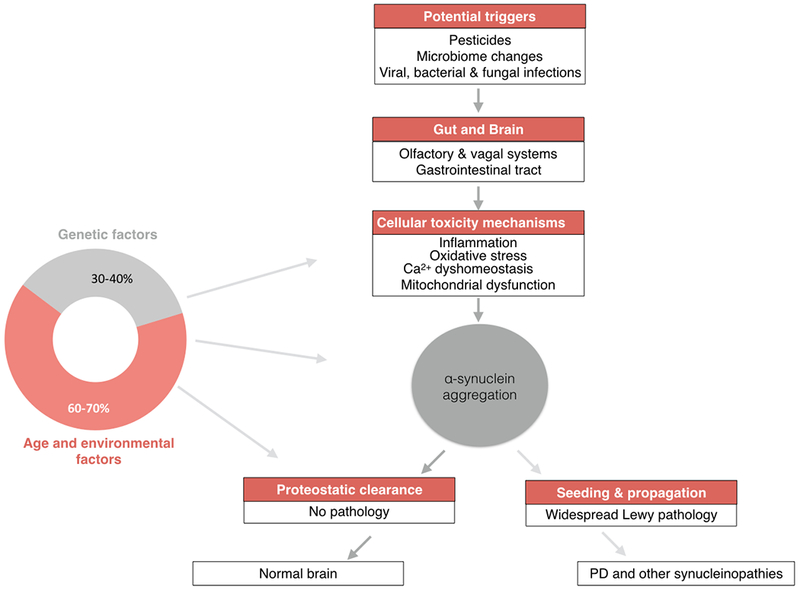
Parkinson's disease is characterized by the loss of nigrostriatal dopaminergic signaling and the presence of alpha-synuclein aggregates (also called Lewy bodies and neurites) throughout the brain. In 2003, Braak and colleagues created a staging system for Parkinson's disease describing the connection between the alpha-synuclein pathology and disease severity. Later, they suggested that the pathology might initially be triggered by exogenous insults targeting the gut and olfactory system. In 2008, we and other groups documented Lewy pathology in grafted neurons in people with Parkinson's disease who had been transplanted over a decade prior to autopsy. We proposed that the Lewy pathology in the grafted neurons was the result of permissive templating or prion-like spread of alpha-synuclein pathology from neurons in the host to those in the grafts. During the following ten years, several studies described the transmission of alpha-synuclein pathology between neurons, both in cell culture and in experimental animals. Recent research has also begun to identify underlying molecular mechanisms. Collectively, these experimental studies tentatively support the idea that the progression from one Braak stage to the next is the consequence of prion-like propagation of Lewy pathology. However, definitive proof that intercellular propagation of alpha-synuclein pathology occurs in Parkinson's disease cases has proven difficult to secure. In this review, we highlight several open questions that currently prevent us from concluding with certainty that prion-like transfer of alpha-synuclein contributes to the progression of Parkinson's disease.
Keywords: Parkinson’s disease; Transmission; α-synuclein, aggregation.
Conflict of interest statement
Conflicts of Interest
P.B. has received commercial support as a consultant from Renovo Neural, Inc., Roche, Cellular Dynamics International Inc, Teva Inc, Lundbeck A/S, AbbVie, ClearView Healthcare, FCB Health, IOS Press Partners, and Capital Technologies, Inc. Additionally, he has received commercial support for grants/research from Renovo and Teva/Lundbeck. Furthermore, P.B. has ownership interest in Acousort AB. J.A.S. and E.Q. report no conflicts of interest.
Figures
References
-
- Ansorge O, Daniel SE, Pearce RK (1997) Neuronal loss and plasticity in the supraoptic nucleus in Parkinson’s disease. Neurology 49:610–613 - PubMed
-
- Bellucci A, Mercuri NB, Venneri A, Faustini G, Longhena F, Pizzi M, Missale C, Spano P (2016) Review: Parkinson’s disease: from synaptic loss to connectome dysfunction. Neuropathol Appl Neurobiol 42:77–94 - PubMed
Publication types
MeSH terms
Substances
Grants and funding
LinkOut - more resources
Full Text Sources
Other Literature Sources
