


Management of term infants at increased risk for early-onset bacterial sepsis
- PMID: 29480905
- PMCID: PMC5804707
- DOI: 10.1093/pch/pxx023
Management of term infants at increased risk for early-onset bacterial sepsis
Abstract
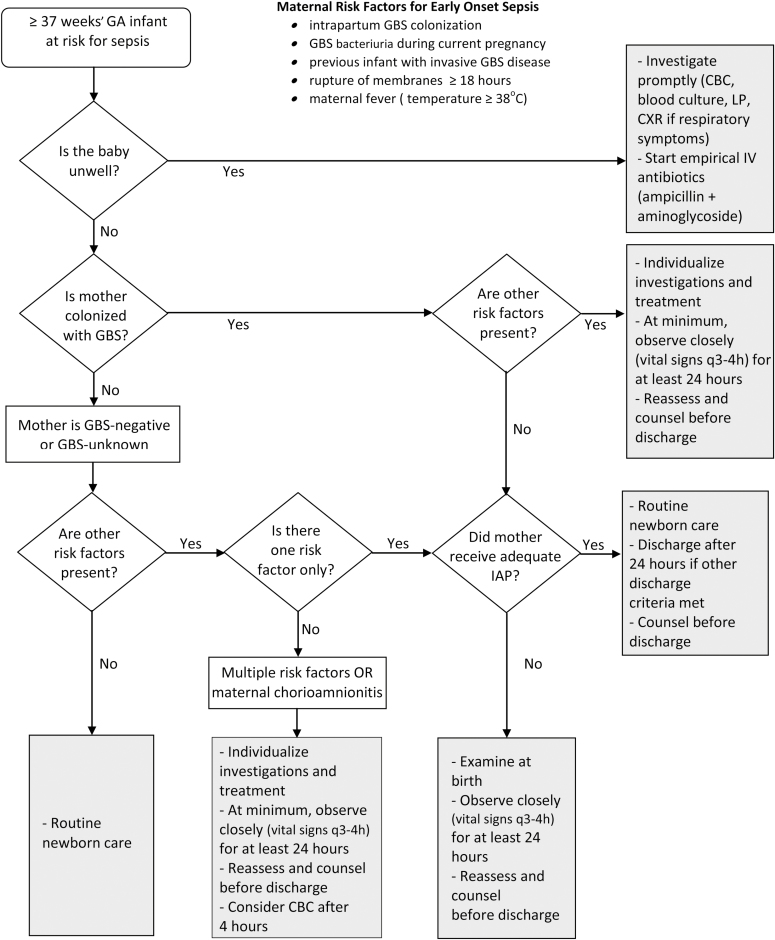
Early-onset neonatal bacterial sepsis (EOS) is sepsis occurring within the first 7 days of life. This statement provides updated recommendations for the care of term (≥37 weeks' gestational age) newborns at risk of EOS, during the first 24 hours of life. Maternal Group B streptococcus (GBS) colonization in the current pregnancy, GBS bacteriuria, a previous infant with invasive GBS disease, prolonged rupture of membranes (≥18 hours) and maternal fever (temperature ≥38°C) are the factors most commonly associated with EOS. These risk factors are additive; the presence of more than one factor increases the likelihood of EOS. At present, there is no laboratory test, including white blood cell indices, that has sufficient sensitivity to allow clinicians to safely rule out EOS. All unwell infants with clinical signs suggesting sepsis must be treated empirically with antibiotics, once cultures have been taken. The management of well-appearing, at-risk term infants depends on the number of risk factors (including maternal GBS colonization) and whether maternal intrapartum antibiotic prophylaxis for GBS was used. In some cases, management should be individualized. Careful assessment and observation of these at-risk infants are a fundamental component of appropriate care.
Figures
References
-
- Verani JR, McGee L, Schrag SJ; Division of Bacterial Diseases, National Center for Immunization and Respiratory Diseases, Centers for Disease Control and Prevention (CDC) Prevention of perinatal group B streptococcal disease-revised guidelines from CDC, 2010. MMWR Recomm Rep 2010;59(RR-10):1–36. - PubMed
-
- Escobar GJ, Li DK, Armstrong MA et al. Neonatal sepsis workups in infants >/= 2000 grams at birth: A population-based study. Pediatrics 2000;106(2 Pt 1):256–63. - PubMed
-
- Bromberger P, Lawrence JM, Braun D, Saunders B, Contreras R, Petitti DB. The influence of intrapartum antibiotics on the clinical spectrum of early-onset group B streptococcal infection in term infants. Pediatrics 2000;106(2 Pt 1):244–50. - PubMed
-
- Ottolini MC, Lundgren K, Mirkinson LJ, Cason S, Ottolini MG. Utility of complete blood count and blood culture screening to diagnose neonatal sepsis in the asymptomatic at risk newborn. Pediatr Infect Dis J 2003;22(5):430–4. - PubMed
-
- Canadian Neonatal Network Annual Report 2013. <www.canadianneonatalnetwork.org/Portal/LinkClick.aspx?fileticket=lreR087...> (Accessed August 8, 2016).
LinkOut - more resources
Full Text Sources
Other Literature Sources