


Control angiography for perioperative myocardial Ischemia after coronary surgery: meta-analysis
- PMID: 29482583
- PMCID: PMC5828145
- DOI: 10.1186/s13019-018-0710-0
Control angiography for perioperative myocardial Ischemia after coronary surgery: meta-analysis
Abstract
Background: Perioperative myocardial ischemia (PMI) in patients undergoing coronary artery bypass grafting (CABG) is associated with poor outcome. The aim of this study was to pool the available data on the outcome after control angiography and repeat revascularization in patients with perioperative myocardial ischemia (PMI) after coronary artery bypass grafting (CABG).
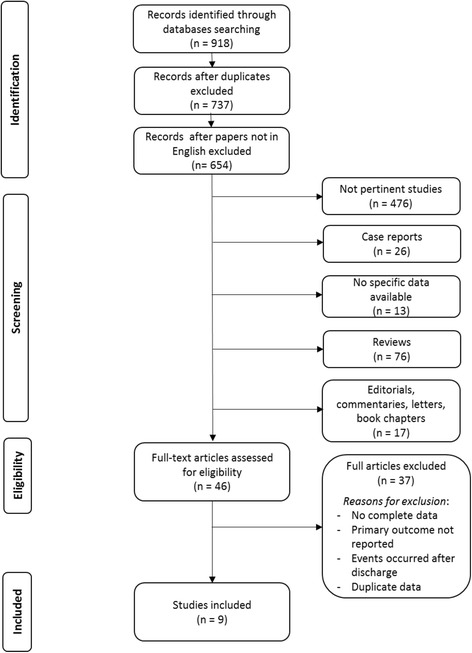
Methods: A literature review was performed through PubMed, Scopus, ScienceDirect and Google Scholar to identify studies published since 1990 evaluating the outcome of PMI after CABG.
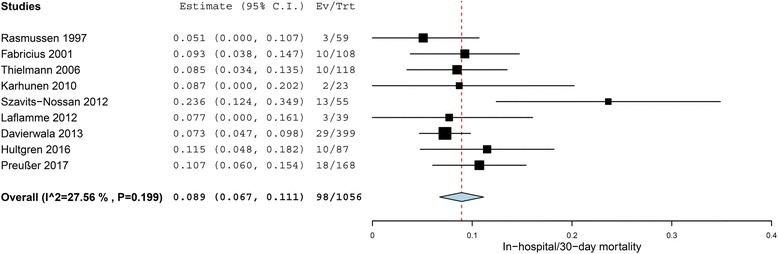
Results: Nine studies included 1104 patients with PMI after CABG and 1056 of them underwent control angiography early after CABG. Pooled early mortality after reoperation for PMI without control angiography was 43.6% (95%CI 29.7-57.6%) and 79.8% of them (95%CI 64.4-95.2%) had an acute graft failure detected at reoperation. Among patients who underwent control angiography for PMI, 31.7% had a negative finding at angiography (95%CI 25.6-37.8%) and 62.1% had an acute graft failure (95%CI 56.6-67.6%). Repeat revascularization was performed after early control angiography in 46.3% of patients (95%CI 39.9-52.6%; 54.2% underwent repeat surgical revascularization; 45.8% underwent percutaneous coronary intervention). Pooled early mortality after control angiography with or without repeat revascularization was 8.9% (95%CI 6.7-11.1%). Three studies reported on early mortality rates which did not differ between repeat surgical revascularization and PCI (11.7% vs. 9.2%, respectively; risk ratio 1.45, 95%CI 0.67-3.11). In these three series, early mortality after conservative treatment was 5.9% (95%CI 3.6-8.2%).
Conclusions: Control angiography seems to be a valid life-saving strategy to guide repeat revascularization in hemodynamically stable patients suffering PMI after CABG.
Keywords: Angiography; Coronary artery bypass; Percutaneous coronary intervention; Perioperative myocardial infarction.
Conflict of interest statement
Ethics approval and consent to participate
Not applicable.
Consent for publication
Not applicable.
Competing interests
The authors declare that they have no competing interests.
Publisher’s Note
Springer Nature remains neutral with regard to jurisdictional claims in published maps and institutional affiliations.
Figures
References
-
- Davierwala PM, Verevkin A, Leontyev S, Misfeld M, Borger MA, Mohr FW. Impact of expeditious management of perioperative myocardial ischemia in patients undergoing isolated coronary artery bypass surgery. Circulation. 2013;128(11 Suppl 1):S226–S234. doi: 10.1161/CIRCULATIONAHA.112.000347. - DOI - PubMed
-
- Preußer MJ, Landwehrt J, Mastrobuoni S, Biancari F, Dakkak AR, Alshakaki M, et al. Survival results of postoperative coronary angiogram for treatment of perioperative myocardial ischemia following coronary artery bypass grafting: a single centre experience. Interact Cardiovasc Thorac Surg. 2018;26:237–242. doi: 10.1093/icvts/ivx317. - DOI - PubMed
-
- Thielmann M, Massoudy P, Jaeger BR, Neuhauser M, Marggraf G, Sack S, et al. Emergency re-revascularization with percutaneous coronary intervention, reoperation, or conservative treatment in patients with acute perioperative graft failure following coronary artery bypass surgery. Eur J Cardiothorac Surg. 2006;30:117–125. doi: 10.1016/j.ejcts.2006.03.062. - DOI - PubMed
Publication types
MeSH terms
LinkOut - more resources
Full Text Sources
Other Literature Sources
Medical
Miscellaneous
