Review
. 2018 Feb 27;11(1):31.
doi: 10.1186/s13045-018-0578-4.

Lessons learned from the blockade of immune checkpoints in cancer immunotherapy

Affiliations
Review

Lessons learned from the blockade of immune checkpoints in cancer immunotherapy

Xiaolei Li et al. J Hematol Oncol. .

Abstract

The advent of immunotherapy, especially checkpoint inhibitor-based immunotherapy, has provided novel and powerful weapons against cancer. Because only a subset of cancer patients exhibit durable responses, further exploration of the mechanisms underlying the resistance to immunotherapy in the bulk of cancer patients is merited. Such efforts may help to identify which patients could benefit from immune checkpoint blockade. Given the existence of a great number of pathways by which cancer can escape immune surveillance, and the complexity of tumor-immune system interaction, development of various combination therapies, including those that combine with conventional therapies, would be necessary. In this review, we summarize the current understanding of the mechanisms by which resistance to checkpoint blockade immunotherapy occurs, and outline how actionable combination strategies may be derived to improve clinical outcomes for patients.

Keywords: Cancer immunotherapy; Combination immunotherapy; Immune checkpoint blockade; Resistance mechanism; Tumor microenvironment.


Conflict of interest statement

Ethics approval and consent to participate

This is not applicable for this review.

Consent for publication

This is not applicable for this review.

Competing interests

The authors declare that they have no competing interests.

Publisher’s Note

Springer Nature remains neutral with regard to jurisdictional claims in published maps and institutional affiliations.

Figures
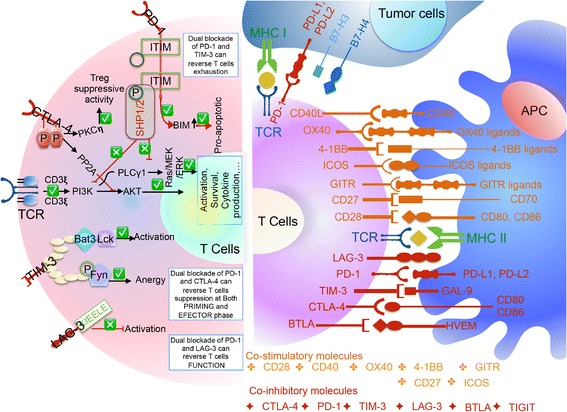
Fig. 1
Fig. 1
Mechanisms of action of multiple checkpoints in antitumor immunity. Co-stimulatory and co-inhibitory receptors in the immune synapse. The fine-tuning of the immune response is coordinated by a plethora of co-receptors that are responsible for amplifying or dampening the initial immune response. Most of these receptors require the TCR to specifically recognize antigens displayed by MHC molecules on APCs, to deliver their co-stimulatory or co-inhibitory signals. These interactions can take place either in secondary lymphoid sites where naïve T cells encounter antigen for the first time, or in the periphery where effector cells may be activated or suppressed. Many inhibitory receptors have ITIMs and/or ITSMs in their intracellular domains; however, some receptors have specific motifs, such as UVKM for CTLA-4 and KIEELE for LAG3. The molecular mechanisms of inhibitory receptor signaling are also illustrated and can be divided as ectodomain competition (inhibitory receptors sequester target receptors or ligands); modulation of intracellular mediators (local and transient intracellular attenuation of positive signals from activating receptors, i.e., TCR and co-stimulatory receptors); and induction of inhibitory genes. Multiple inhibitory receptors are responsible for these three mechanisms. Checkpoint therapies with antibodies to T cell inhibitory receptors (e.g., PD-1 and CTLA-4) produce durable responses in patients with many deadly malignancies. Several strategies are used to improve further the success rate of immunotherapies, including (1) combining PD-1 and CTLA-4 blockers with each other or with antagonists of other inhibitory receptors on T cells, such as TIM-3, LAG-3, TIGIT, and BTLA; (2) combining the ICB with agonists of co-stimulatory receptors of T cells, including CD27, 4-1BB, OX40, and GITR; and (3) blocking immune checkpoints in conjunction with stimulation of tumor antigen recognition using vaccines and DC activation by CD40 agonists. An alternative approach involves combining ICBs with other therapies (e.g., radiation, oncolytic viruses) that enhance tumor immunogenicity owing to ICD, and then prompt immune cells recruitment and tumor antigen presentation
Fig. 2
Fig. 2
Major factors operating in the establishment of immunoresistant milieu and actionable combinations with ICBs: Yin and Yang effects. Many potential tumor, host, and environmental-related factors might explain the degree of heterogeneity seen with ICB therapy, dividing into influences from the TME, endocrine and metabolic factors, environmental factors, and other influences, i.e., age and unfavorable host genetics (Yin). Each step the cancer-immunity cycle requires the coordination of numerous factors, both stimulatory, promoting immunity and inhibitory, helping keep the process in check and reducing immune activity and/or preventing autoimmunity in nature. The numerous factors that come into play in the cancer-immunity cycle provide a wide range of potential therapeutic targets, highlighting examples of some of the therapies currently under pre-clinical or clinical evaluation. Key highlights include that vaccines can primarily promote cancer antigen presentation, anti-CTLA-4 can primarily promote priming and activation, and anti-PD-L1 or anti-PD-1 antibodies can primarily promote killing of cancer cells. Although not developed as immunotherapies, chemotherapy, radiation therapy, and targeted therapies can primarily promote release of tumor cell antigens, and inhibitors of VEGF can potentially promote T cell infiltration into tumors (Yang)

References

    1. Gabrilovich DI, Nagaraj S. Myeloid-derived suppressor cells as regulators of the immune system. Nat Rev Immunol. 2009;9(3):162–174. doi: 10.1038/nri2506. - DOI - PMC - PubMed
    1. Yang Y. Cancer immunotherapy: harnessing the immune system to battle cancer. J Clin Invest. 2015;125(9):3335–3337. doi: 10.1172/JCI83871. - DOI - PMC - PubMed
    1. Majzner RG, Heitzeneder S, Mackall CL. Harnessing the immunotherapy revolution for the treatment of childhood cancers. Cancer Cell. 2017;31(4):476–485. doi: 10.1016/j.ccell.2017.03.002. - DOI - PubMed
    1. Pardoll DM. The blockade of immune checkpoints in cancer immunotherapy. Nat Rev Cancer. 2012;12(4):252–264. doi: 10.1038/nrc3239. - DOI - PMC - PubMed
    1. Sharma P, Allison JP. The future of immune checkpoint therapy. Science. 2015;348(6230):56–61. doi: 10.1126/science.aaa8172. - DOI - PubMed

Publication types
