. 2018 Feb 27;11(1):8.
doi: 10.1186/s13072-018-0178-0.

Alterations in sperm DNA methylation, non-coding RNA and histone retention associate with DDT-induced epigenetic transgenerational inheritance of disease

Affiliations

Alterations in sperm DNA methylation, non-coding RNA and histone retention associate with DDT-induced epigenetic transgenerational inheritance of disease

Michael K Skinner et al. Epigenetics Chromatin. .

Abstract

Background: Environmental toxicants such as DDT have been shown to induce the epigenetic transgenerational inheritance of disease (e.g., obesity) through the germline. The current study was designed to investigate the DDT-induced concurrent alterations of a number of different epigenetic processes including DNA methylation, non-coding RNA (ncRNA) and histone retention in sperm.

Methods: Gestating females were exposed transiently to DDT during fetal gonadal development, and then, the directly exposed F1 generation, the directly exposed germline F2 generation and the transgenerational F3 generation sperm were investigated.

Results: DNA methylation and ncRNA were altered in each generation sperm with the direct exposure F1 and F2 generations being predominantly distinct from the F3 generation epimutations. The piRNA and small tRNA were the most predominant classes of ncRNA altered. A highly conserved set of histone retention sites were found in the control lineage generations which was not significantly altered between generations, but a large number of new histone retention sites were found only in the transgenerational generation DDT lineage sperm.

Conclusions: Therefore, all three different epigenetic processes were concurrently altered as DDT induced the epigenetic transgenerational inheritance of sperm epimutations. The direct exposure generations sperm epigenetic alterations were distinct from the transgenerational sperm epimutations. The genomic features and gene associations with the epimutations were investigated to help elucidate the integration of these different epigenetic processes. Observations demonstrate all three epigenetic processes are involved in transgenerational inheritance. The different epigenetic processes appear to be integrated in mediating the epigenetic transgenerational inheritance phenomenon.

Keywords: DDT; DNA methylation; Disease etiology; Epigenetic; Histone; Inheritance; Sperm; Transgenerational; ncRNA.


Figures
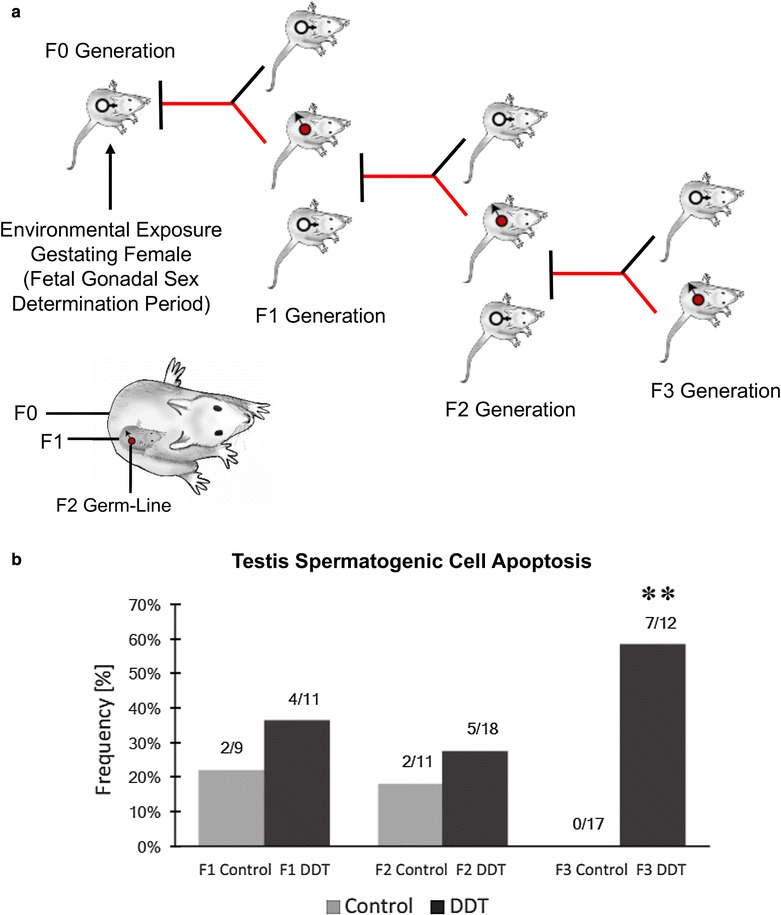
Fig. 1
Fig. 1
Animal breeding classification and disease. a Experimental design of F0 generation gestating female exposure and then F1, F2 and F3 generations being generated for sperm collection. The direct exposure of the F0 generation female, F1 generation fetus and F2 generation germline is also shown, b testis spermatogenic cell apoptosis as determined with TUNEL analysis with frequency (%) of apoptosis for each generation and lineage shown. Asterisk indicates statistical significance with control with a p < 0.01 with a Fisher’s exact t test
Fig. 2
Fig. 2
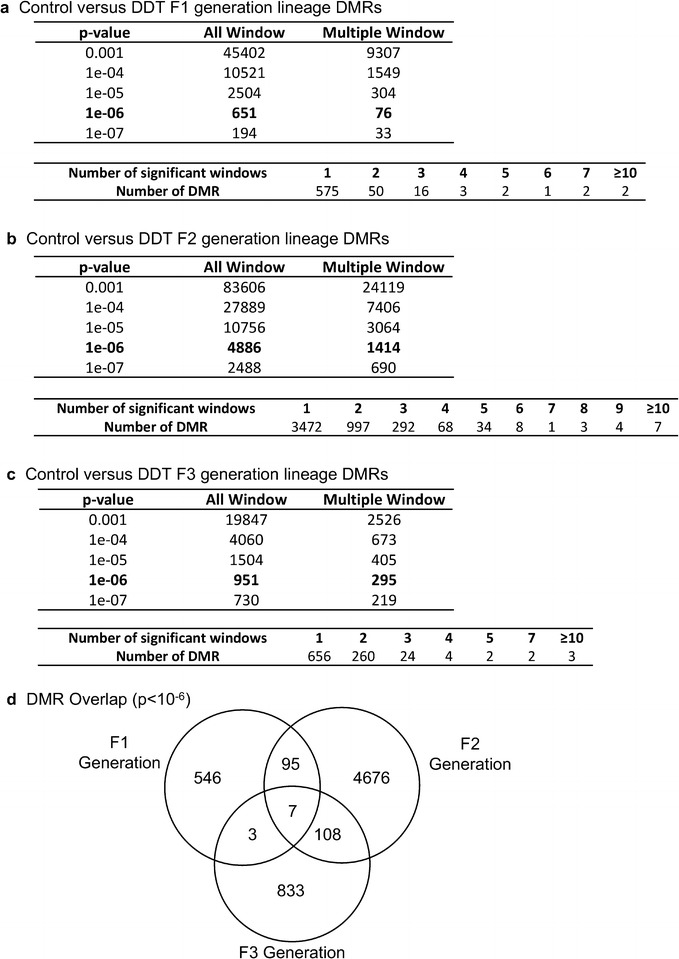
Differential DNA methylation regions (DMRs) analysis. a F1 generation control versus DDT lineage DMRs, b F2 generation control versus DDT lineage DMRs, c F3 generation control versus DDT lineage DMRs. The number of DMRs found using different p value cutoff thresholds is presented. The All Window column shows all DMRs. The Multiple Window column shows the number of DMRs containing at least two significant windows, d the DMR overlap (p ≤ 10−6) for the F1, F2 and F3 generation sperm
Fig. 3
Fig. 3
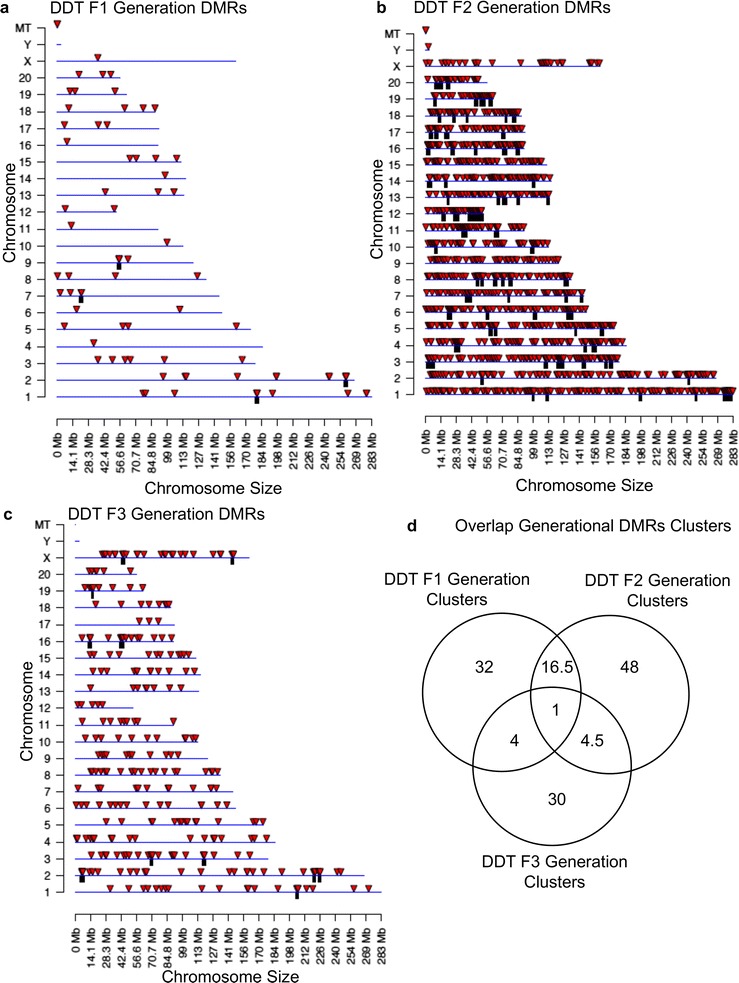
Chromosomal locations and overlaps of DMRs. a DDT F1 generation DMRs, b DDT F2 generation DMRs, c DDT F3 generation DMRs. The DMR locations on the individual chromosomes are shown with red arrowheads and clusters of DMRs with black boxes. Multiple Window DMRs at a p value threshold of 10−6 are shown, d overlap of the different generations DMR clusters
Fig. 4
Fig. 4
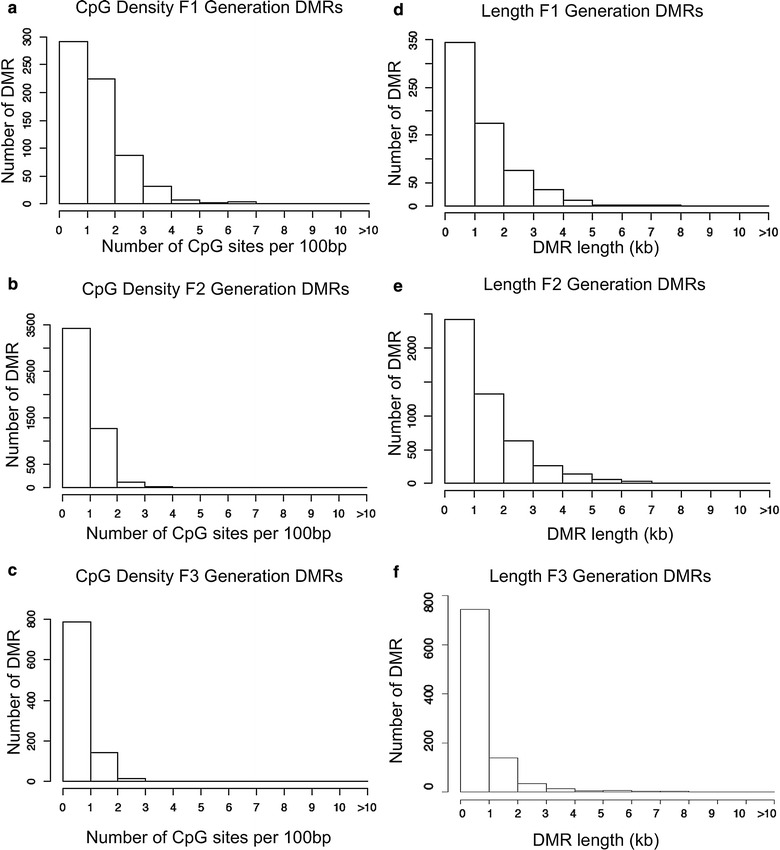
DMR CpG density for a F1 generation, b F2 generation and c F3 generation. Histograms of the number of DMRs at different CpG densities (CpG/100 bp). All DMRs at a p value threshold of 1e−06 are shown. DMR length (kb) for d F1 generation, e F2 generation and f F3 generation. Histograms of the number of DMR at different length (kb) are shown
Fig. 5
Fig. 5
Non-coding RNA (ncRNA) differentially regulated in control versus DDT lineage F1, F2 and F3 generation sperm. a Long ncRNA and b small ncRNA numbers at different p value thresholds. c Long ncRNA (p < 10−4) for the F1, F2 and F3 generation correlated to the number of differential lncRNA. d Small ncRNA (p < 10−4) for the F1, F2 and F3 generation correlated to the number of miRNA, piRNA, stRNA and other sncRNA
Fig. 6
Fig. 6
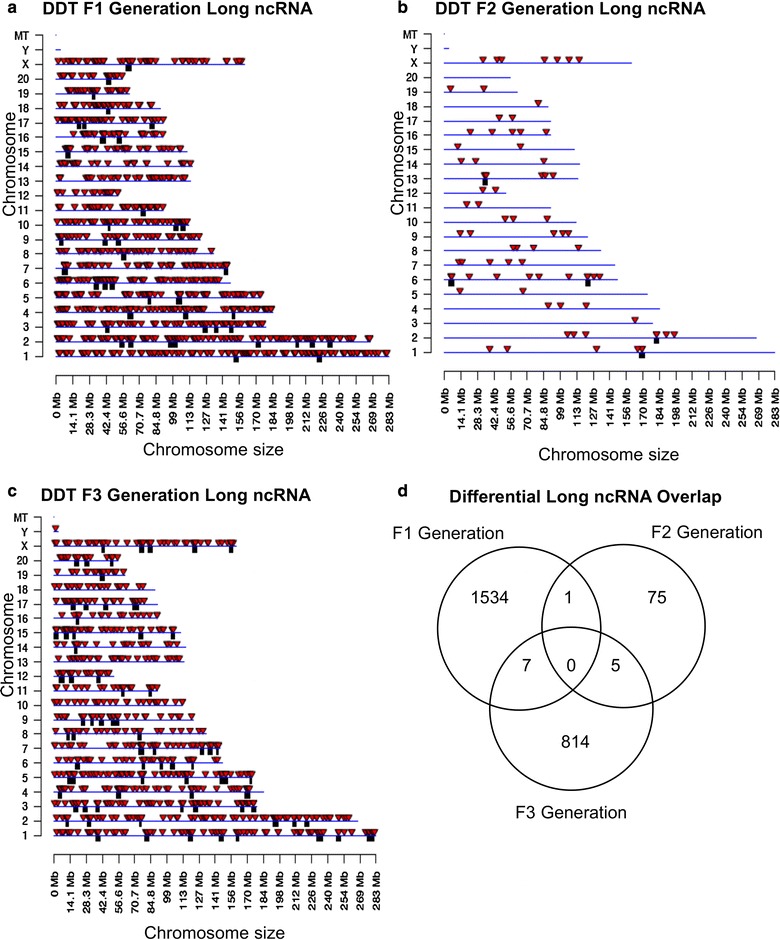
Chromosomal locations of long ncRNA for the a F1 generation, b F2 generation and c F3 generation sperm. The lncRNA locations on the individual chromosomes are indicated with red arrowheads and clusters with black boxes. The long ncRNA at a p value threshold of 10−4 is shown. d The overlap between the long ncRNA (p < 10−4) in the three DDT generations. Overlaps were determined based on common ncRNA names
Fig. 7
Fig. 7
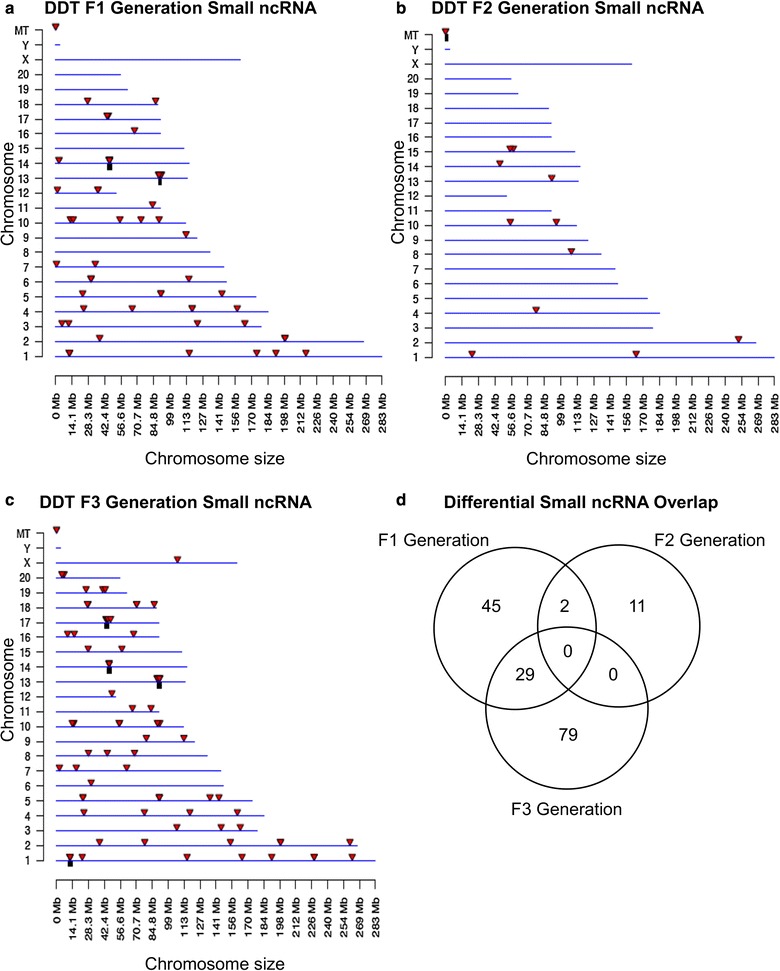
Chromosomal locations of small ncRNA for the a F1 generation, b F2 generation and c F3 generation. The sncRNA locations on the individual chromosomes are indicated with red arrowheads and clusters with black boxes. The sncRNA at an FDR-adjusted p value threshold of p < 10−4 is shown. There are four sncRNAs in the F1 generation and 6 sncRNAs in the F3 generation with unknown chromosome locations. d The overlap between the sncRNAs (p < 10−4) in the three DDT generations. Overlaps were determined based on common RNA names
Fig. 8
Fig. 8
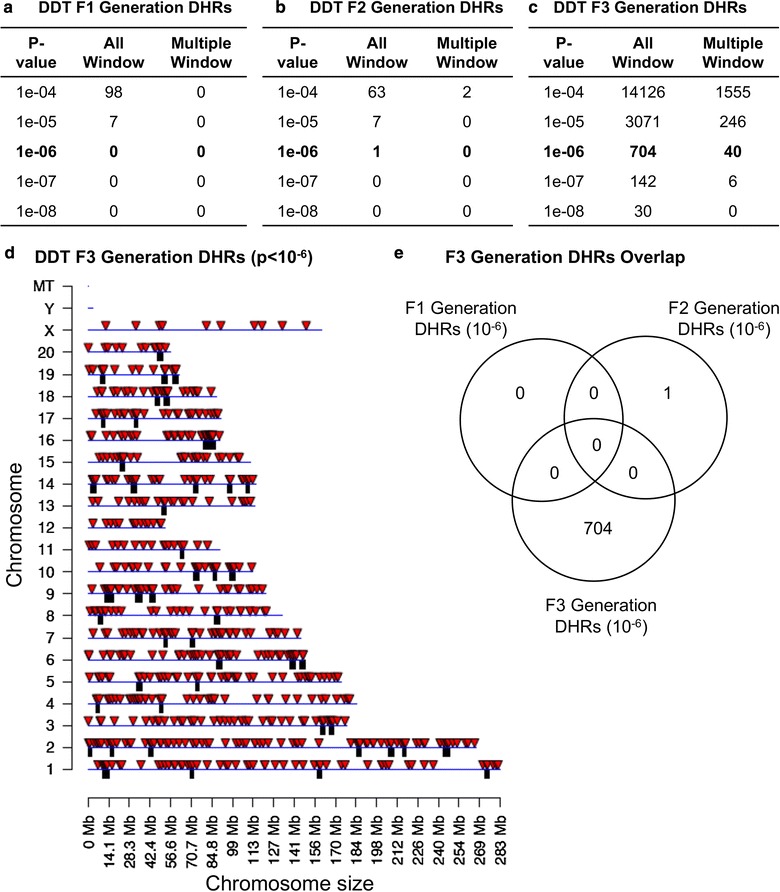
DDT differential histone retention sites (DHRs) in the a F1 generation, b F2 generation and c F3 generation. The number of DHRs found using different p value cutoff thresholds. The All Window column shows all DHRs. The Multiple Window column shows the number of DHRs containing at least two significant windows. d Chromosomal locations of F3 generation DHRs on individual chromosomes indicated by red arrowheads and DHR clusters with black boxes. All DHRs at a p value threshold of 1e-06 are shown. e The DMR overlap (p < 10−6) for the F1, F2 and F3 generation sperm
Fig. 9
Fig. 9
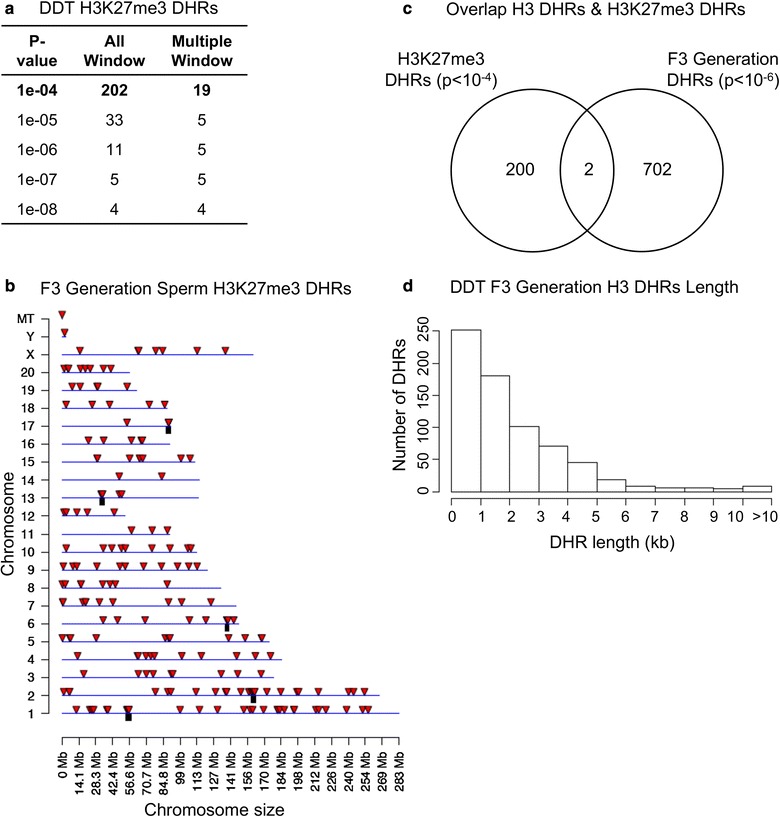
DDT F3 generation H3K27me3 DHRs. a The number of DHRs found using different p value cutoff thresholds. The All Window column shows all DHRs. The Multiple Window column shows the number of DHRs containing at least two significant windows. b The F3 generation sperm H3K27me3 DHR chromosomal locations on the individual chromosomes are indicated with red arrowheads and clusters with black boxes. All DHRs at a p value threshold of 1 × 10−4 are shown. c The overlap of F3 generation H3 DHRs (p < 10−6) and H3K27me3 DHRs (p < 10−4), d F3 generation H3 DHR lengths. All H3 DHRs at a p value threshold of < 10−6 are shown. F3 generation H3 DHR lengths (kb) versus the number of DHRs associated indicated
Fig. 10
Fig. 10
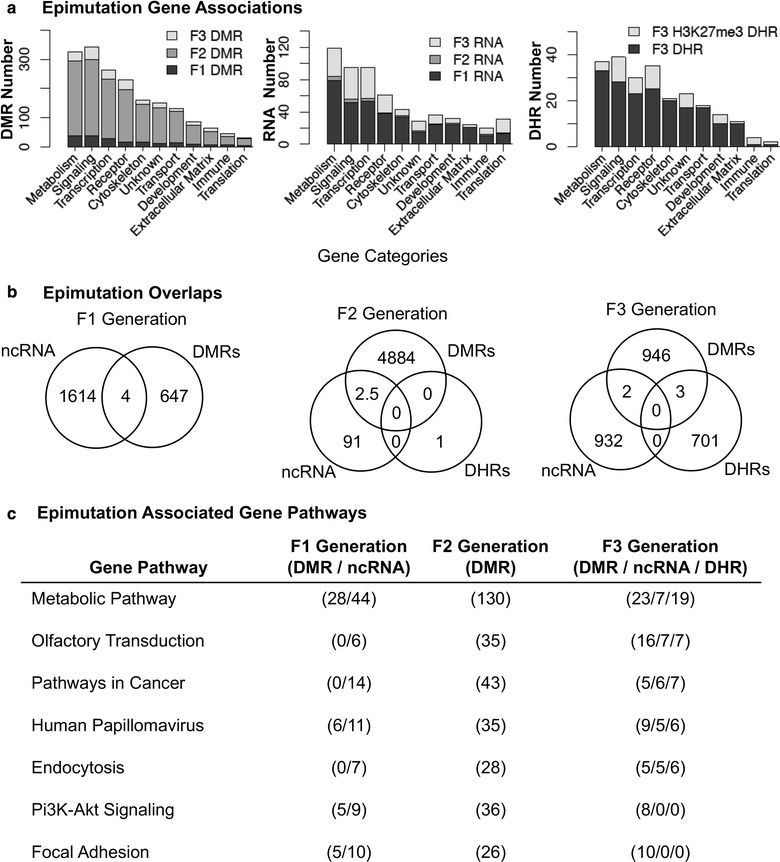
Epimutation overlaps and gene associations. a The number of DMR, DHR and ncRNA epimutation-associated genes is correlated to gene categories for the F1, F2 and F3 generations. b Overlaps of the F1, F2 and F3 generation epimutations between the DMRs, DHRs and ncRNAs. Gene pathways with epimutation-associated genes for the DMRs, DHRs and ncRNAs in the F1, F2 and F3 generations. The pathways with greater than five associated genes for each epimutation type are listed that were common between generations

References

    1. Skinner MK. Endocrine disruptor induction of epigenetic transgenerational inheritance of disease. Mol Cell Endocrinol. 2014;398:4–12. doi: 10.1016/j.mce.2014.07.019. - DOI - PMC - PubMed
    1. Anway MD, Cupp AS, Uzumcu M, Skinner MK. Epigenetic transgenerational actions of endocrine disruptors and male fertility. Science. 2005;308:1466–1469. doi: 10.1126/science.1108190. - DOI - PMC - PubMed
    1. Skinner MK. Environmental stress and epigenetic transgenerational inheritance. BMC Med. 2014;12:153. doi: 10.1186/s12916-014-0153-y. - DOI - PMC - PubMed
    1. Crews D, Gillette R, Scarpino SV, Manikkam M, Savenkova MI, Skinner MK. Epigenetic transgenerational inheritance of altered stress responses. Proc Natl Acad Sci USA. 2012;109:9143–9148. doi: 10.1073/pnas.1118514109. - DOI - PMC - PubMed
    1. McCreary JK, Truica LS, Friesen B, Yao Y, Olson DM, Kovalchuk I, Cross AR, Metz GA. Altered brain morphology and functional connectivity reflect a vulnerable affective state after cumulative multigenerational stress in rats. Neuroscience. 2016;330:79–89. doi: 10.1016/j.neuroscience.2016.05.046. - DOI - PubMed

Publication types