Review
. 2018 Apr;39(4):424-436.
doi: 10.1016/j.tips.2018.02.001. Epub 2018 Feb 23.

The Pharmacology of CD38/NADase: An Emerging Target in Cancer and Diseases of Aging

Affiliations
Review

The Pharmacology of CD38/NADase: An Emerging Target in Cancer and Diseases of Aging

Eduardo N Chini et al. Trends Pharmacol Sci. 2018 Apr.

Abstract

Recent reports indicate that intracellular NAD levels decline in tissues during chronological aging, and that therapies aimed at increasing cellular NAD levels could have beneficial effects in many age-related diseases. The protein CD38 (cluster of differentiation 38) is a multifunctional enzyme that degrades NAD and modulates cellular NAD homeostasis. At the physiological level, CD38 has been implicated in the regulation of metabolism and in the pathogenesis of multiple conditions including aging, obesity, diabetes, heart disease, asthma, and inflammation. Interestingly, many of these functions are mediated by CD38 enzymatic activity. In addition, CD38 has also been identified as a cell-surface marker in hematologic cancers such as multiple myeloma, and a cytotoxic anti-CD38 antibody has been approved by the FDA for use in this disease. Although this is a remarkable development, killing CD38-positive tumor cells with cytotoxic anti-CD38 antibodies is only one of the potential pharmacological uses of targeting CD38. The present review discusses the biology of the CD38 enzyme and the current state of development of pharmacological tools aimed at CD38, and explores how these agents may represent a novel approach for treating human conditions including cancer, metabolic disease, and diseases of aging.

Keywords: CD38; NAD(+); NADase; aging; antibodies; cancer and metabolism; sirtuins; small molecules.


Figures

Figure 1
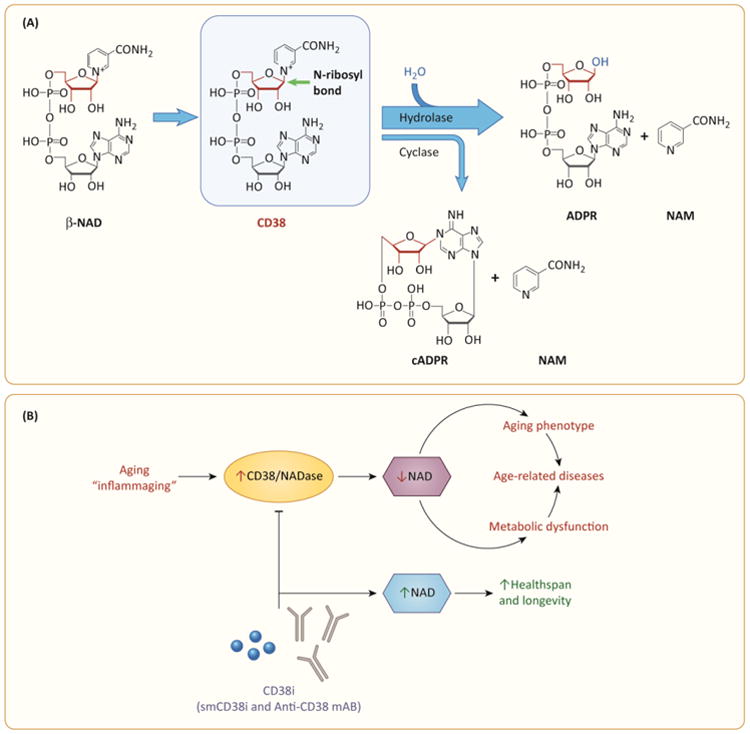
Figure 1. (key figure). “NAD boosting therapy” via CD38 inhibition in age-related diseases
A. CD38 breaks NAD into ADPR/cADPR and NAM. The main site of reaction in the NAD molecule is the terminal ribose, specifically the covalent bond between N1 in nicotinamide and anomeric carbon of the ribose. CD38 breaks the N-glycosyl bond and the main product of the reaction are ADPR and nicotinamide with a very small portion of NAD been converted to cADPR. The figure abbreviations are: ADPR – adenosine ribose cADPR cyclic adenosine ribose NAM – Nicotinamide NAD – nicotinamide adenosine dinucleotide. B. A pro-inflammatory phenotype is observed during the aging process (inflammaging hypothesis). Inflammatory cytokines and endotoxins are potent inducers of CD38 expression, leading to an increase in the tissue NADase activity and a subsequent decline in cellular NAD levels that may play a role in the development of the aging phenotype, decrease resilience, metabolic dysfunction, and the appearance of some age-related diseases. Inhibition of CD38 via small molecule CD38 inhibitors (smCD38i) or non-cytotoxic monoclonal antibodies that inhibit CD38 activity (CD38i mAB) may prevent cellular NAD decline and promote healthspan and successful aging.
Figure 2
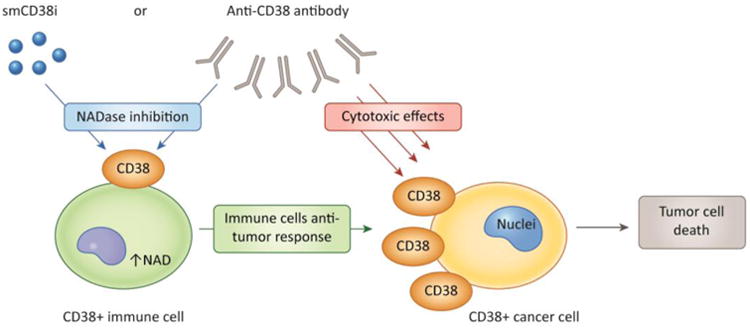
Figure 2. CD38 targeted therapy in cancer
CD38 has at least two potential roles in cancer therapy. First, cytotoxic anti-CD38 antibodies can promote the killing of CD38 positive cancer cells via direct and indirect effects. On the other hand, CD38 expression in immune cells, cancer cells and other cells in the tumor micro environment may cause a decrease in tissue NAD levels that has a negative effect in the immune-response against the tumor. Thus, small molecule CD38 inhibitors (smCD38i), or monoclonal antibodies that inhibit CD38 activity (CD38imAB) can promote an increase in tissue NAD levels and a positive anti-tumor immune response.
Figure 3
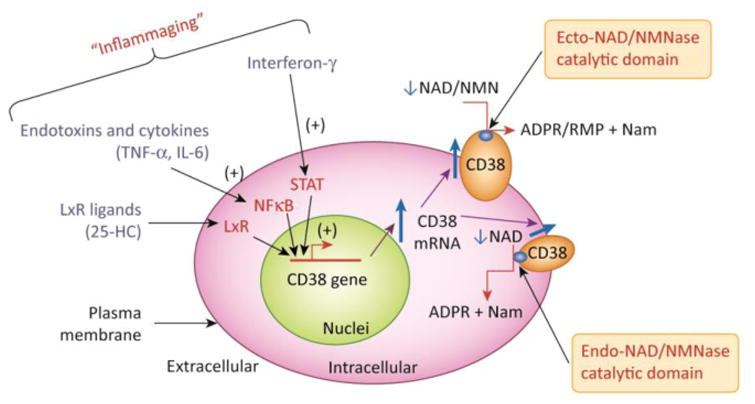
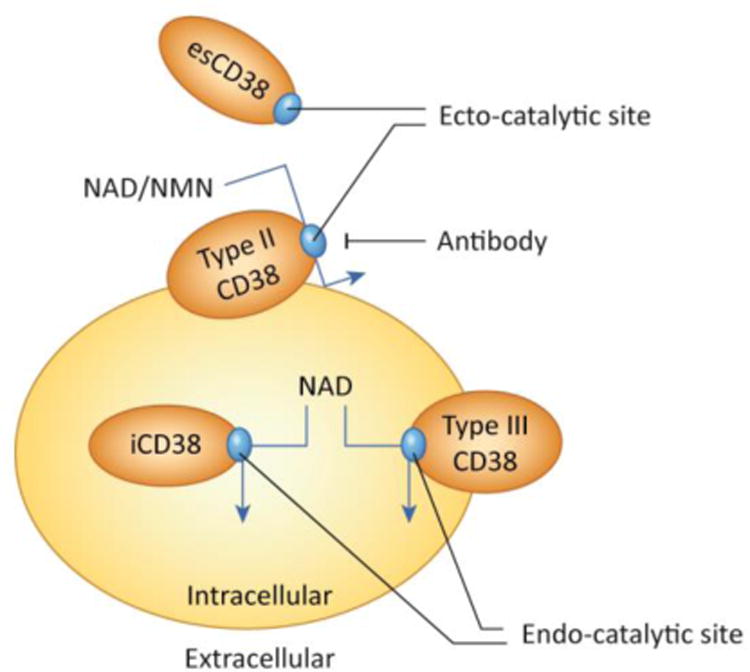
Figure 3. The biology of CD38 and topological paradox
Figure 3A demonstrates the regulation of the CD38 gene expression by inflammatory agents and the link between “inflammaging”, increased CD38 expression, and cellular NAD decline. CD38 expression is activated by LPS, cytokines, interferon, and L×R ligands such as 25-hydroxycholesterolcholesterol (25-HC). In particular, cytokines, interferon and endotoxins have been proposed to play a role on the sterile inflammatory process observed during aging. In B the CD38 topologic paradox dictates that although most NAD is intracellular only a minority of CD38 has its catalytic site facing the inside of the cells. Thus, the most prevalent form of CD38 (type II), that has its catalytic site facing the outside degrades extracellular NAD and NAD precursors, such as NMN, limiting its availability to NAD synthesis in intracellular pools. A secretory soluble form of CD38 with extracellular NADase activity has also been described (esCD38). On the other hand, the type III transmembrane form of CD38 has its catalytic site facing the inside, hence having accessibility to the larger intracellular NAD pools. Minor expression of CD38 has also been described in intracellular membranes such as the nuclear membrane and mitochondrial membrane. The expression of intracellular CD38 may be limited to prevent cellular NAD degradation and cellular metabolic collapse.
Figure 3
Figure 3. The biology of CD38 and topological paradox
Figure 3A demonstrates the regulation of the CD38 gene expression by inflammatory agents and the link between “inflammaging”, increased CD38 expression, and cellular NAD decline. CD38 expression is activated by LPS, cytokines, interferon, and L×R ligands such as 25-hydroxycholesterolcholesterol (25-HC). In particular, cytokines, interferon and endotoxins have been proposed to play a role on the sterile inflammatory process observed during aging. In B the CD38 topologic paradox dictates that although most NAD is intracellular only a minority of CD38 has its catalytic site facing the inside of the cells. Thus, the most prevalent form of CD38 (type II), that has its catalytic site facing the outside degrades extracellular NAD and NAD precursors, such as NMN, limiting its availability to NAD synthesis in intracellular pools. A secretory soluble form of CD38 with extracellular NADase activity has also been described (esCD38). On the other hand, the type III transmembrane form of CD38 has its catalytic site facing the inside, hence having accessibility to the larger intracellular NAD pools. Minor expression of CD38 has also been described in intracellular membranes such as the nuclear membrane and mitochondrial membrane. The expression of intracellular CD38 may be limited to prevent cellular NAD degradation and cellular metabolic collapse.
Figure 4
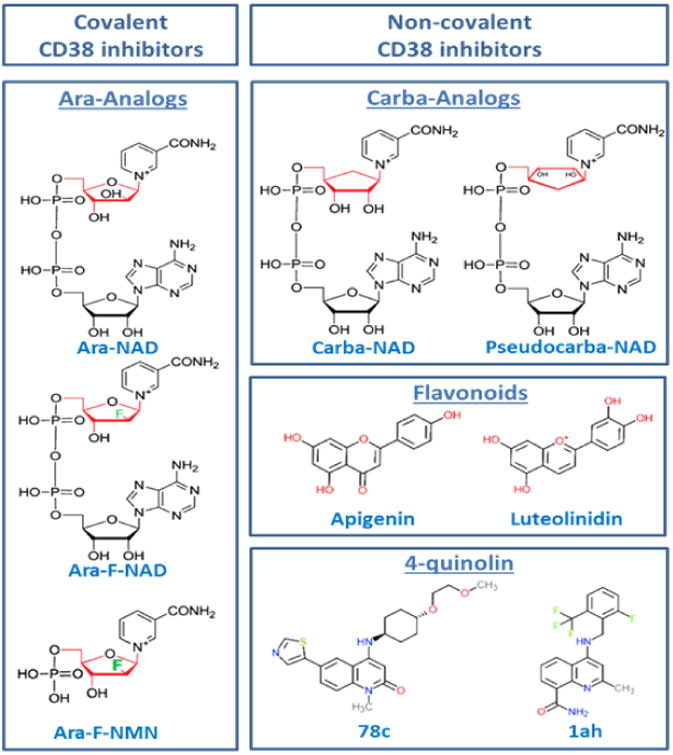
Figure 4. The chemical structure of the different classes of smCD38i
The overall mechanism of action is the inhibition of NAD breakdown. To date no inhibitors can selectively block the glycohydrolase vs the cyclase activity of CD38. NAD analogs can be considered covalent and non-covalent inhibitors. Ara-NAD analogs are covalent competitive inhibitors. Carba-analogs are non-covalent competitive inhibitors. Most flavonoids and small molecule inhibitors of CD38 are non-covalent competitive inhibitors. RHein is the only uncompetitive inhibitor in the flavonoid class.

References

    1. Chini CCS, et al. NAD and the aging process: Role in life, death and everything in between. Mol Cell Endocrinol. 2017;455:62–74. - PMC - PubMed
    1. Verdin E. NAD+ in aging, metabolism, and neurodegeneration. Science. 2015;350:1208–1213. - PubMed
    1. Imai S, Guarente L. NAD+ and sirtuins in aging and disease. Trends Cell Biol. 2014;24:464–471. - PMC - PubMed
    1. Schultz MD, Sinclair DA. Why NAD+ Declines during Aging: It's Destroyed. Cell Metab. 2016;23(6):965–966. - PMC - PubMed
    1. Gomes AP, et al. Declining NAD[+] induces a pseudohypoxic state disrupting nuclear-mitochondrial communication during aging. Cell= 2013;155:1624–1638. - PMC - PubMed

Publication types

MeSH terms