Clinical Trial
. 2018 Feb 26;9(1):832.
doi: 10.1038/s41467-018-03210-2.

A randomized and open-label phase II trial reports the efficacy of neoadjuvant lobaplatin in breast cancer

Affiliations
Clinical Trial

A randomized and open-label phase II trial reports the efficacy of neoadjuvant lobaplatin in breast cancer

Xiujuan Wu et al. Nat Commun. .

Abstract

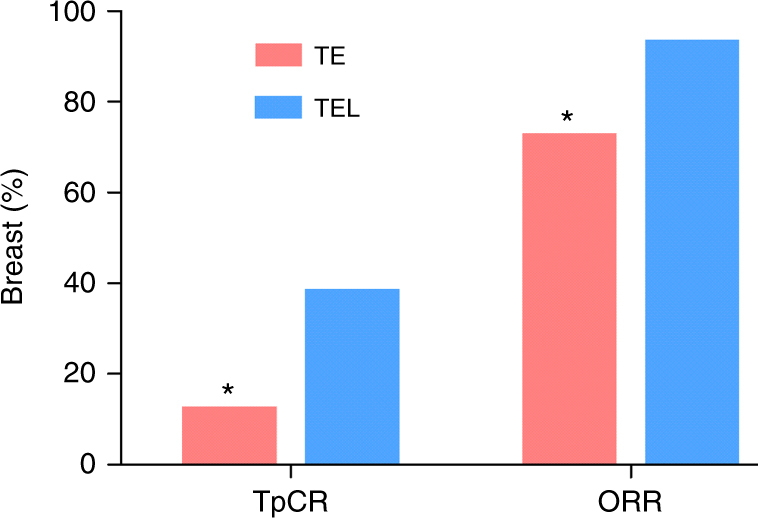
Currently, one sixth of triple-negative breast cancer (TNBC) patients who receive docetaxel (T) and epirubicin (E) as neoadjuvant chemotherapy achieve a pathologic complete response (pCR). This study evaluates the impact of adding lobaplatin (L) to the TE regimen. Here, we show data from 125 patients (63 TE and 62 TEL patients). Four patients did not complete all the cycles. Two-sided P values show that the addition of L (38.7% vs. 12.7%, P = 0.001) significantly increases the rate of pCR in the breast and the axilla (TpCR) and the overall response rate (ORR; 93.5% vs. 73.0%, P = 0.003). The occurrence of grade 3-4 anemia and thrombocytopenia is higher in the TEL group (52.5% vs. 10.0% and 34.4% vs. 1.7% respectively). These results demonstrate that the addition of L to the TE regimen as neoadjuvant chemotherapy improves the TpCR and the ORR rates of TNBC but with increased side effects.


Conflict of interest statement

The authors declare no competing financial interests.

Figures
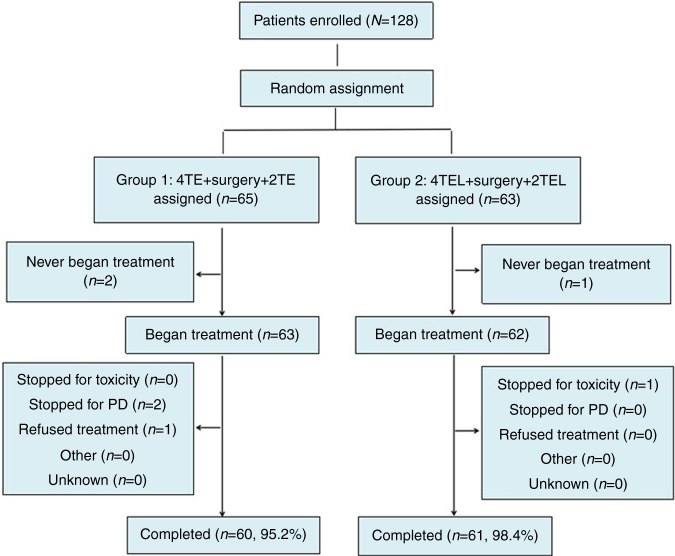
Fig. 1
Fig. 1
CONSORT diagram. TE docetaxel and epirubicin, TEL docetaxel, epirubicin, and lobaplatin
Fig. 2
Fig. 2
Pathologic complete response in the breast and the axilla (TpCR) and overall response rate (ORR) of TNBC patients after 4 cycles of neoadjuvant chemotherapy. TE docetaxel and epirubicin, TEL docetaxel, epirubicin, and lobaplatin. *indicates statistically significant differences between the two groups (P < 0.05)
Fig. 3
Fig. 3
Cumulative incidence of breast tumor recurrence and metastasis. HR hazard ratio
Fig. 4
Fig. 4
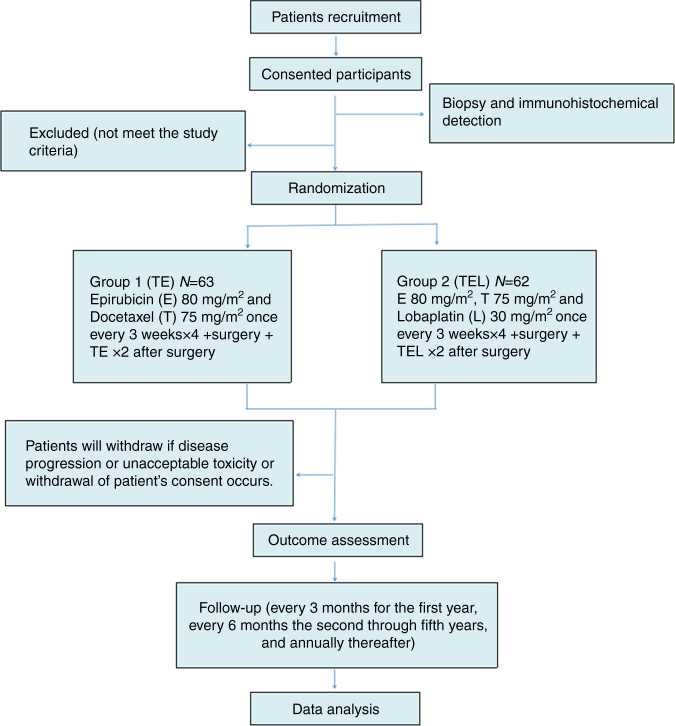
The trial flow chart. TE, docetaxel and epirubicin; TEL, docetaxel, epirubicin, and lobaplatin

References

    1. Stover DG, Winer EP. Tailoring adjuvant chemotherapy regimens for patients with triple negative breast cancer. Breast. 2016;Suppl 2:S132–S135. - PubMed
    1. Berry DA, et al. Estrogen-receptor status and outcomes of modern chemotherapy for patients with node-positive breast cancer. JAMA. 2006;295:1658–1667. doi: 10.1001/jama.295.14.1658. - DOI - PMC - PubMed
    1. Liedtke C, et al. Response to neoadjuvanttherapy and long-term survival in patients with triple-negative breast cancer. J. Clin. Oncol. 2008;26:1275–1281. doi: 10.1200/JCO.2007.14.4147. - DOI - PubMed
    1. Early Breast Cancer Trialists’ Collaborative G, et al. Adjuvant chemotherapy in oestrogen-receptor-poor breast cancer: patient-level meta-analysis of randomised trials. Lancet. 2008;371:29–40. doi: 10.1016/S0140-6736(08)60069-0. - DOI - PubMed
    1. Steger GG, et al. Pathologic complete response with six compared with three cycles of neoadjuvant epirubicin plus docetaxel and granulocyte colony-stimulating factor in operable breast cancer: results of ABCSG-14. J. Clin. Oncol. 2007;25:2012–2018. doi: 10.1200/JCO.2006.09.1777. - DOI - PubMed

Publication types

MeSH terms

LinkOut - more resources