Review
. 2018 Feb 12:11:49-60.
doi: 10.2147/JIR.S137606. eCollection 2018.

NOD2 and inflammation: current insights

Affiliations
Review

NOD2 and inflammation: current insights

Anna Negroni et al. J Inflamm Res. .

Abstract

The nucleotide-binding oligomerization domain (NOD) protein, NOD2, belonging to the intracellular NOD-like receptor family, detects conserved motifs in bacterial peptidoglycan and promotes their clearance through activation of a proinflammatory transcriptional program and other innate immune pathways, including autophagy and endoplasmic reticulum stress. An inactive form due to mutations or a constitutive high expression of NOD2 is associated with several inflammatory diseases, suggesting that balanced NOD2 signaling is critical for the maintenance of immune homeostasis. In this review, we discuss recent developments about the pathway and mechanisms of regulation of NOD2 and illustrate the principal functions of the gene, with particular emphasis on its central role in maintaining the equilibrium between intestinal microbiota and host immune responses to control inflammation. Furthermore, we survey recent studies illustrating the role of NOD2 in several inflammatory diseases, in particular, inflammatory bowel disease, of which it is the main susceptibility gene.

Keywords: ER stress; autophagy; extraintestinal disease; inflammatory bowel disease; innate immunity; intestinal homeostasis.


Conflict of interest statement

Disclosure The authors report no conflicts of interest in this work.

Figures
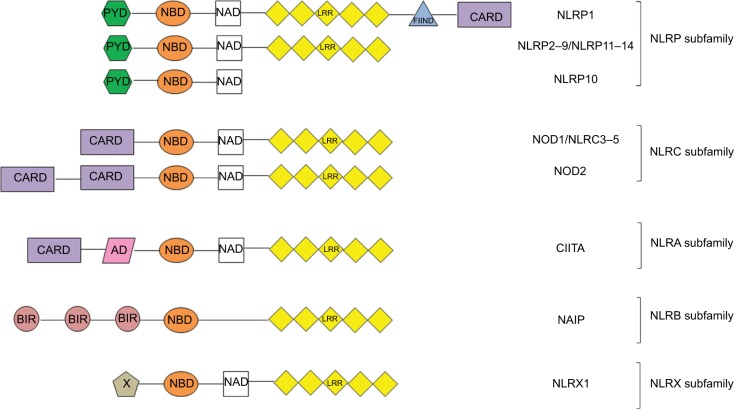
Figure 1
Figure 1
Structure of the NLR subfamilies. Abbreviations: AD, atopic dermatitis; BIR, baculovirus inhibitor repeat; CARD, caspase recruitment domain; CIITA, class II major histocompatibility complex transactivator; FIIND, function to find domain; LRR, leucine-rich repeat; NAD, NBD-associated domain; NBD, nucleotide-binding domain; NLR, NOD-like receptor; NLRA, acidic transactivation domain; NLRB, baculovirus inhibitor repeat; NLRC, caspase recruitment domain; NLRP, NLR family pyrin domain; NOD, nucleotide-binding oligomerization domain; PYD, pyrin domain; X, unknown effector domain.
Figure 2
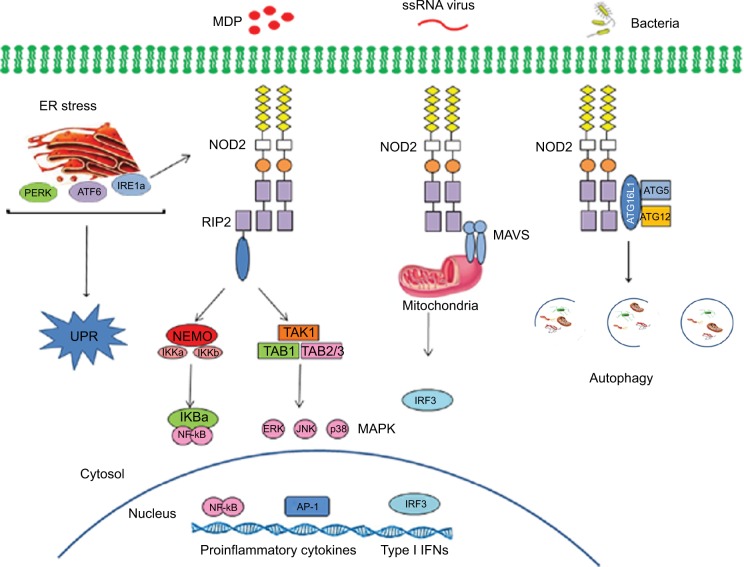
Figure 2
Signaling pathways triggered by NOD2. Abbreviations: AP-1, activator protein-1; ATF6, activating transcription factor 6; ATG, autophagy-related genes; ATG16L1, autophagy related 16 like 1; ER, endoplasmic reticulum; ERK, extracellular signal-regulated kinase; IFNs, interferons; IKB, NF-κB inhibitor; IKK, IκB kinase; IRF3, interferon response factor 3; JNK, c-Jun N-terminal kinase; MAVS, mitochondrial antiviral signaling; MDP, muramyl dipeptide; NEMO, NF-κB essential modulator; NOD, nucleotide-binding oligomerization domain; PERK, protein kinase RNA-like endoplasmic reticulum kinase; RIP2, receptor-interacting protein kinase 2; TAB, TGF-β activated kinase; TAK1, targets transforming growth factor-β-activated kinase 1; UPR, unfolded protein response.

References

    1. Takeuchi O, Akira S. Pattern recognition receptors and inflammation. Cell. 2010;140(6):805–20. - PubMed
    1. Proell M, Riedl SJ, Fritz JH, Rojas AM, Schwarzenbacher R. The Nod-like receptor (NLR) family: a tale of similarities and differences. PLoS One. 2008;3(4):e2119. - PMC - PubMed
    1. Kawai T, Akira S. The roles of TLRs, RLRs and NLRs in pathogen recognition. Int Immunol. 2009;21(4):317–337. - PMC - PubMed
    1. Feerick CL, McKernan DP. Understanding the regulation of pattern recognition receptors in inflammatory diseases – a ‘Nod’ in the right direction. Immunology. 2017;150(3):237–247. - PMC - PubMed
    1. Philpott DJ, Sorbara MT, Robertson SJ, Croitoru K, Girardin SE. NOD proteins: regulators of inflammation in health and disease. Nat Rev Immunol. 2014;14(1):9–23. - PubMed