


Using Meta-analytic Structural Equation Modeling to Study Developmental Change in Relations Between Language and Literacy
- PMID: 29484642
- PMCID: PMC6110989
- DOI: 10.1111/cdev.13049
Using Meta-analytic Structural Equation Modeling to Study Developmental Change in Relations Between Language and Literacy
Abstract
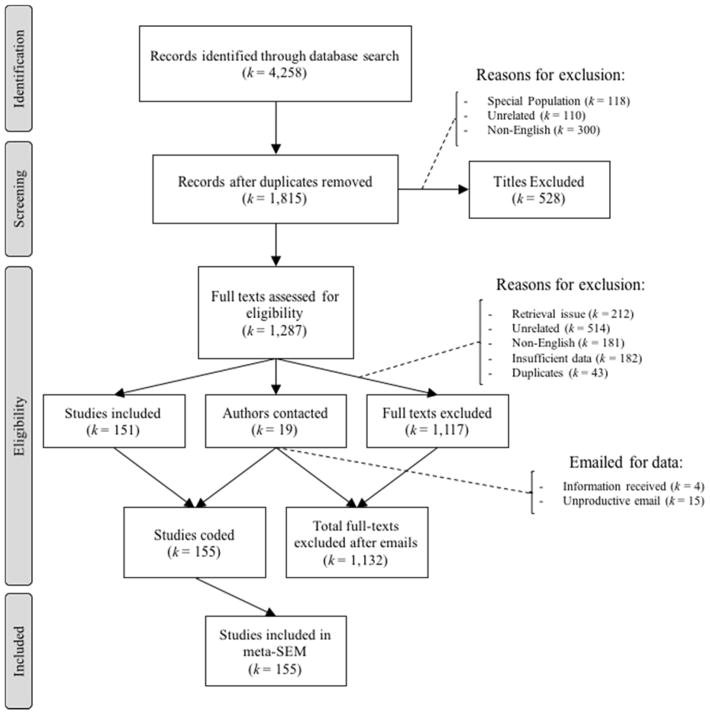
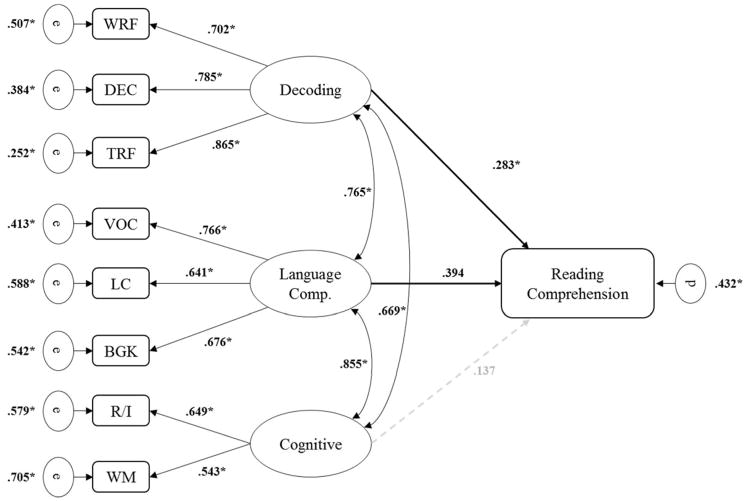
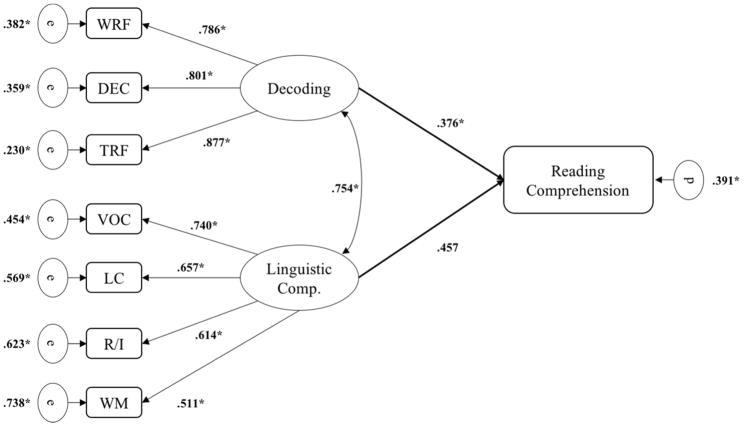
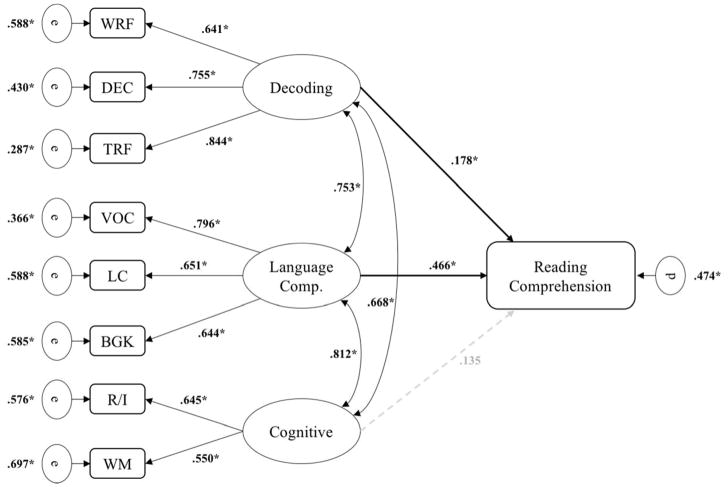
The purpose of this review was to introduce readers of Child Development to the meta-analytic structural equation modeling (MASEM) technique. Provided are a background to the MASEM approach, a discussion of its utility in the study of child development, and an application of this technique in the study of reading comprehension (RC) development. MASEM uses a two-stage approach: first, it provides a composite correlation matrix across included variables, and second, it fits hypothesized a priori models. The provided MASEM application used a large sample (N = 1,205,581) of students (ages 3.5-46.225) from 155 studies to investigate the factor structure and relations among components of RC. The practical implications of using this technique to study development are discussed.
© 2018 The Authors. Child Development © 2018 Society for Research in Child Development, Inc.
Figures
References
-
- Adams M. Beginning to read: Thinking and learning about print. Cambridge, MA: M.I.T. Press; 1990.
-
- Ahmed Y, Francis DJ, York M, Fletcher JM, Barnes M, Kulesz P. Validation of the direct and inferential mediation (DIME) model of reading comprehension in grades 7 through 12. Contemporary Educational Psychology. 2016;44:68–82. doi: 10.1016/j.cedpsych.2016.02.002. - DOI
-
- Anderson RC, Freebody P. Vocabulary knowledge. In: Guthrie JT, editor. Comprehension and teaching: Research reviews. Newark, DE: International Reading Association; 1981. pp. 77–117.
-
- Araújo S, Reis A, Petersson KM, Faísca L. Rapid automatized naming and reading performance: A meta-analysis. Journal of Educational Psychology. 2015;107:868–883. doi: 10.1037/edu0000006. - DOI
Publication types
MeSH terms
Grants and funding
LinkOut - more resources
Full Text Sources
Other Literature Sources
Medical
