Prevalence of sexually transmitted infections among young people in South Africa: A nested survey in a health and demographic surveillance site
- PMID: 29485985
- PMCID: PMC5828358
- DOI: 10.1371/journal.pmed.1002512
Prevalence of sexually transmitted infections among young people in South Africa: A nested survey in a health and demographic surveillance site
Abstract
Background: Sexually transmitted infections (STIs) and bacterial vaginosis (BV) are associated with increased transmission of HIV, and poor reproductive and sexual health. The burden of STIs/BV among young people is unknown in many high HIV prevalence settings. We conducted an acceptability, feasibility, and prevalence study of home-based sampling for STIs/BV among young men and women aged 15-24 years old in a health and demographic surveillance site (HDSS) in rural KwaZulu-Natal, South Africa.
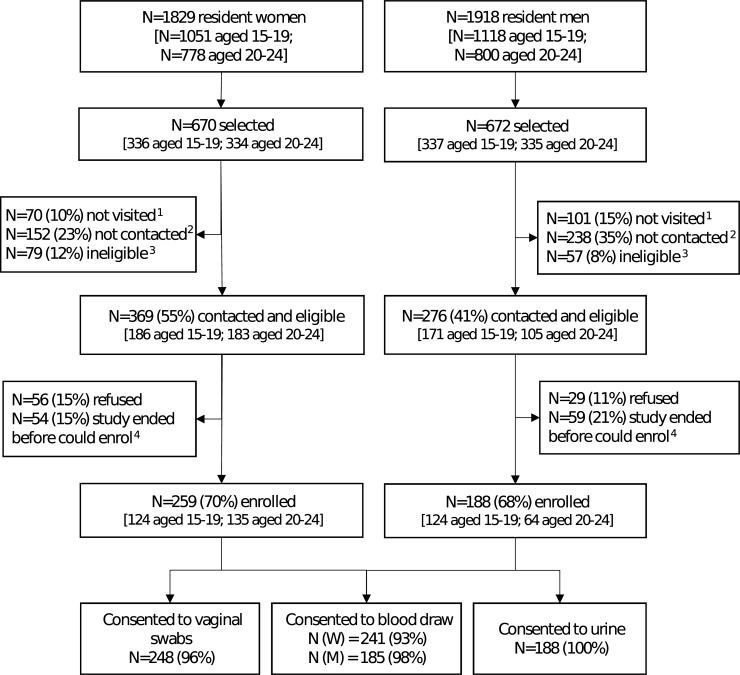
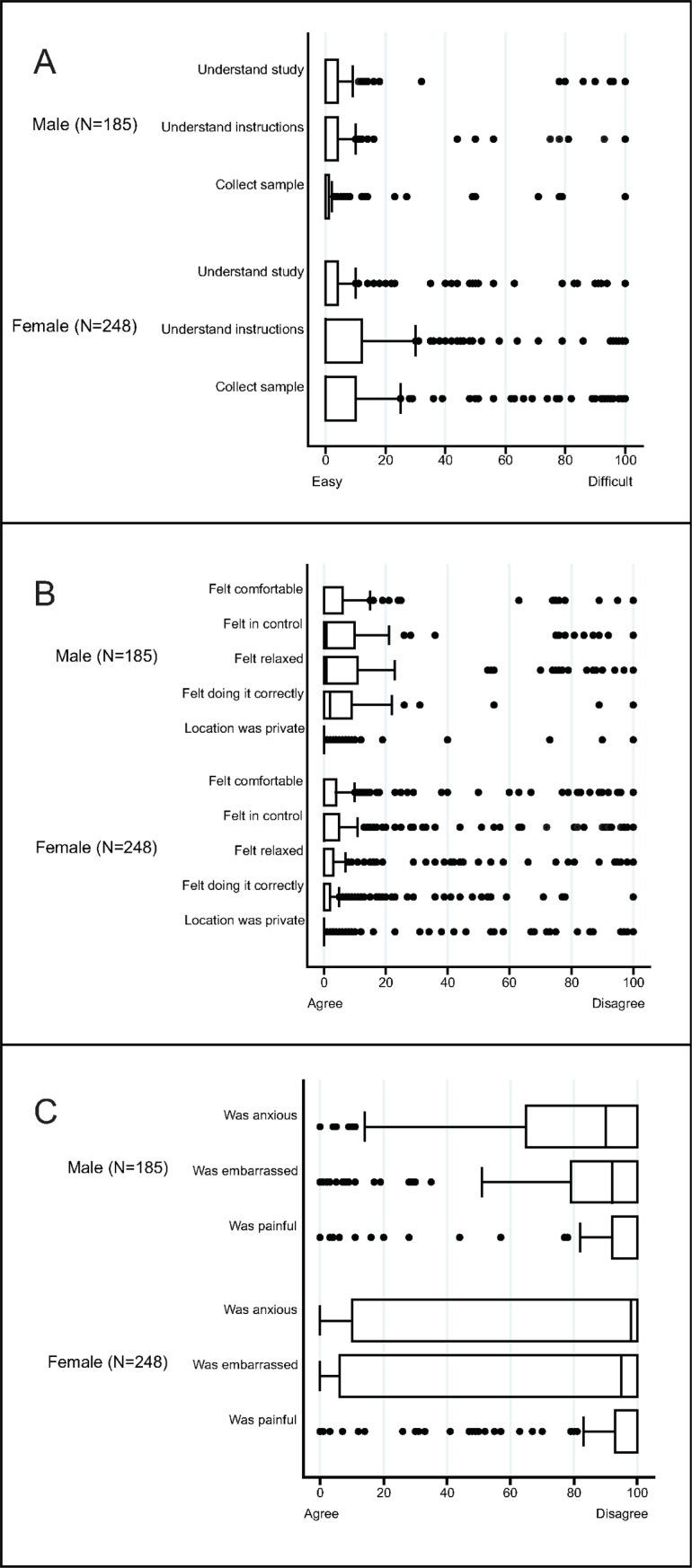
Methods and findings: A total of 1,342 young people, stratified by age (15-19 and 20-24 years) and sex were selected from the HDSS sampling frame; 1,171/1,342 (87%) individuals had ≥1 attempted home visit between 4 October 2016 and 31 January 2017, of whom 790 (67%) were successfully contacted. Among the 645 who were contacted and eligible, 447 (69%) enrolled. Consenting/assenting participants were interviewed, and blood, self-collected urine (men), and vaginal swabs (women) were tested for herpes simplex virus type 2 (HSV-2), chlamydia, gonorrhoea, syphilis, trichomoniasis, and BV. Both men and women reported that sample collection was easy. Participants disagreed that sampling was painful; more than half of the participants disagreed that they felt anxious or embarrassed. The weighted prevalence of STIs/BV among men and women, respectively, was 5.3% and 11.2% for chlamydia, 1.5% and 1.8% for gonorrhoea, 0% and 0.4% for active syphilis, 0.6% and 4.6% for trichomoniasis, 16.8% and 28.7% for HSV-2, and 42.1% for BV (women only). Of the women with ≥1 curable STI, 75% reported no symptoms. Factors associated with STIs/BV included having older age, being female, and not being in school or working. Among those who participated in the 2016 HIV serosurvey, the prevalence of HIV was 5.6% among men and 19% among women. Feasibility was impacted by the short study duration and the difficulty finding men at home.
Conclusions: A high prevalence of STIs/BV was found in this rural setting with high HIV prevalence in South Africa. Most STIs and HIV infections were asymptomatic and would not have been identified or treated under national syndromic management guidelines. A nested STI/BV survey within a HDSS proved acceptable and feasible. This is a proof of concept for population-based STI surveillance in low- and middle-income countries that could be utilised in the evaluation of STI/HIV prevention and control programmes.
Conflict of interest statement
The authors have declared that no competing interests exist.
Figures
References
-
- Department of Economic and Social Affairs. World population monitoring: adolescents and youth. New York: United Nations; 2012. [cited 2018 Jan 31]. Available from: http://www.un.org/en/development/desa/population/publications/pdf/fertil....
-
- World Health Organization. Guidelines for the management of sexually transmitted infections. Geneva: World Health Organization; 2004. [cited 2018 Jan 31]. Available from: http://apps.who.int/medicinedocs/en/d/Jh2942e/2.html.
-
- Low N, Chersich MF, Schmidlin K, Egger M, Francis SC, van de Wijgert JHHM, et al. Intravaginal practices, bacterial vaginosis, and HIV infection in women: individual participant data meta-analysis. PLoS Med. 2011;8(2):e1000416 doi: 10.1371/journal.pmed.1000416 - DOI - PMC - PubMed
-
- Atashili J, Poole C, Ndumbe PM, Adimora AA, Smith JS. Bacterial vaginosis and HIV acquisition: a meta-analysis of published studies. AIDS. 2008;22:1493–501. doi: 10.1097/QAD.0b013e3283021a37 - DOI - PMC - PubMed
-
- Klatt NR, Cheu R, Birse K, Zevin AS, Perner M, Noël-Romas L, et al. Vaginal bacteria modify HIV tenofovir microbicide efficacy in Africanwomen. Science. 2017;356:938–45. doi: 10.1126/science.aai9383 - DOI - PubMed
Publication types
MeSH terms
Grants and funding
LinkOut - more resources
Full Text Sources
Other Literature Sources
Medical