. 2018 Feb 27;8(1):3698.
doi: 10.1038/s41598-018-21845-5.

Symmetry between repulsive and attractive interactions in driven-dissipative Bose-Hubbard systems

Affiliations

Symmetry between repulsive and attractive interactions in driven-dissipative Bose-Hubbard systems

Adil A Gangat et al. Sci Rep. .

Abstract

The driven-dissipative Bose-Hubbard model can be experimentally realized with either negative or positive onsite detunings, inter-site hopping energies, and onsite interaction energies. Here we use one-dimensional matrix product density operators to perform a fully quantum investigation of the dependence of the non-equilibrium steady states of this model on the signs of these parameters. Due to a symmetry in the Lindblad master equation, we find that simultaneously changing the sign of the interaction energies, hopping energies, and chemical potentials leaves the local boson number distribution and inter-site number correlations invariant, and the steady-state complex conjugated. This shows that all driven-dissipative phenomena of interacting bosons described by the Lindblad master equation, such as "fermionization" and "superbunching", can equivalently occur with attractive or repulsive interactions.


Conflict of interest statement

The authors declare no competing interests.

Figures
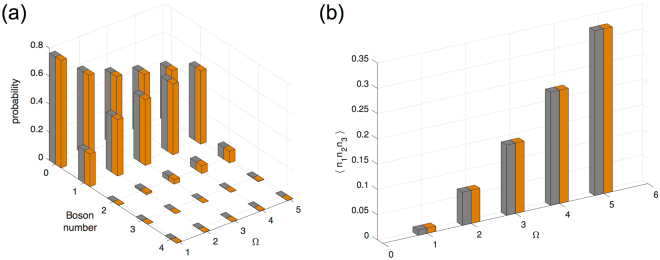
Figure 1
Figure 1
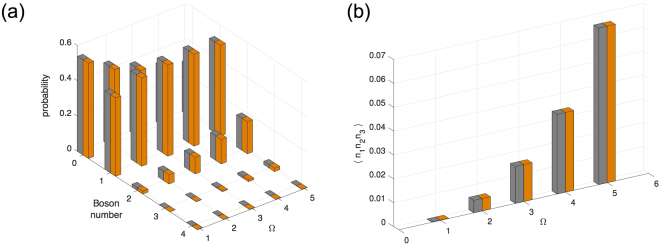
Boson number statistics for site 1 and three-site correlators under a number-conserving transformation in a uniform trimer. Gray bars correspond to the lower sign choice in the parameters listed in Table 1(a), Case 1; and orange bars correspond to the upper sign choice. (a) Boson number statistics as a function of drive strength Ω. (b) Three-site correlator as a function of drive strength. Although the NESS changes between the two different sign choices at each drive strength, the number statistics and the correlator remain the same.
Figure 2
Figure 2
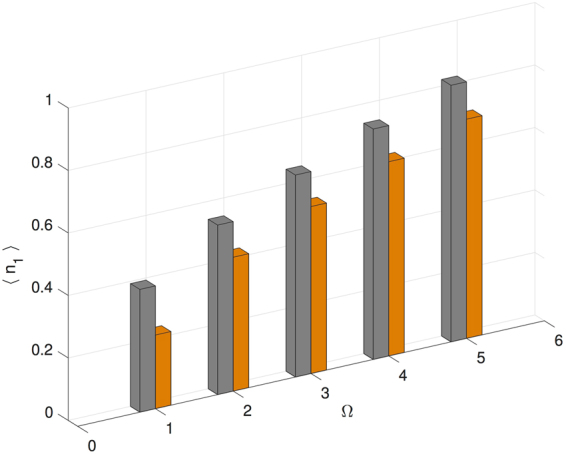
Boson number expectation value on site 1 as function of varying drive strength (Ω) for a uniform trimer. Gray bars correspond to the lower sign choice in the parameters listed in Table 1(a), Case 2; and orange bars correspond to the upper sign choice. The transformation from the lower sign choice to the upper sign choice is not number-conserving and the boson number expectation value is not invariant.
Figure 3
Figure 3
Boson number statistics for site 1 and three-site correlators under a number-conserving transformation in a disordered trimer. Gray bars correspond to the lower sign choice in the parameters listed in Table 1(b), Case 1; and orange bars correspond to the upper sign choice. (a) Boson number statistics as a function of drive strength Ω. (b) Three-site correlator as a function of drive strength. Although the NESS changes between the two different sign choices at each drive strength, the number statistics and the correlator remain the same even in the presence of strong disorder.
Figure 4
Figure 4
Boson number expectation value on site 1 as function of varying drive strength (Ω) for a disordered trimer. Gray bars correspond to the lower sign choice in the parameters listed in Table 1(b), Case 2; and orange bars correspond to the upper sign choice. The transformation from the lower sign choice to the upper sign choice is not number-conserving and the boson number expectation value is not invariant.

References

    1. Carusotto I, et al. Fermionized photons in an array of driven dissipative nonlinear cavities. Physical Review Letters. 2009;103:033601. doi: 10.1103/PhysRevLett.103.033601. - DOI - PubMed
    1. Hartmann MJ. Polariton crystallization in driven arrays of lossy nonlinear resonators. Physical Review Letters. 2010;104:113601. doi: 10.1103/PhysRevLett.104.113601. - DOI - PubMed
    1. Grujic T, Clark SR, Jaksch D, Angelakis DG. Repulsively induced photon superbunching in driven resonator arrays. Physical Review A. 2013;87:053846. doi: 10.1103/PhysRevA.87.053846. - DOI
    1. Le Boité A, Orso G, Ciuti C. Bose-hubbard model: Relation between driven-dissipative steady states and equilibrium quantum phases. Physical Review A. 2014;90:063821. doi: 10.1103/PhysRevA.90.063821. - DOI - PubMed
    1. Biella A, Mazza L, Carusotto I, Rossini D, Fazio R. Photon transport in a dissipative chain of nonlinear cavities. Physical Review A. 2015;91:053815. doi: 10.1103/PhysRevA.91.053815. - DOI

LinkOut - more resources