. 2019 Jul;24(7):1040-1052.
doi: 10.1038/s41380-018-0028-2. Epub 2018 Feb 27.

Ketamine has distinct electrophysiological and behavioral effects in depressed and healthy subjects

Affiliations

Ketamine has distinct electrophysiological and behavioral effects in depressed and healthy subjects

Allison C Nugent et al. Mol Psychiatry. 2019 Jul.

Abstract

Ketamine's mechanism of action was assessed using gamma power from magnetoencephalography (MEG) as a proxy measure for homeostatic balance in 35 unmedicated subjects with major depressive disorder (MDD) and 25 healthy controls enrolled in a double-blind, placebo-controlled, randomized cross-over trial of 0.5 mg/kg ketamine. MDD subjects showed significant improvements in depressive symptoms, and healthy control subjects exhibited modest but significant increases in depressive symptoms for up to 1 day after ketamine administration. Both groups showed increased resting gamma power following ketamine. In MDD subjects, gamma power was not associated with the magnitude of the antidepressant effect. However, baseline gamma power was found to moderate the relationship between post-ketamine gamma power and antidepressant response; specifically, higher post-ketamine gamma power was associated with better response in MDD subjects with lower baseline gamma, with an inverted relationship in MDD subjects with higher baseline gamma. This relationship was observed in multiple regions involved in networks hypothesized to be involved in the pathophysiology of MDD. This finding suggests biological subtypes based on the direction of homeostatic dysregulation and has important implications for inferring ketamine's mechanism of action from studies of healthy controls alone.


Conflict of interest statement

Conflict of Interest

Funding for this work was supported by the Intramural Research Program at the National Institute of Mental Health, National Institutes of Health (IRP-NIMH-NIH; NCT00088699/04-M-0222/ZIA MH002857), by a NARSAD Independent Investigator Award to Dr. Zarate, and by a Brain and Behavior Mood Disorders Research Award to Dr. Zarate. Dr. Zarate is listed as a coinventor on a patent for the use of ketamine in major depression and suicidal ideation. Dr. Zarate is listed as a co-inventor on a patent for the use of (2R,6R)-hydroxynorketamine, (S)-dehydronorketamine, and other stereoisomeric dehydro and hydroxylated metabolites of (R,S)-ketamine metabolites in the treatment of depression and neuropathic pain. Dr. Zarate is listed as co-inventor on a patent application for the use of (2R,6R)-hydroxynorketamine and (2S,6S)-hydroxynorketamine in the treatment of depression, anxiety, anhedonia, suicidal ideation, and post-traumatic stress disorders; he has assigned his patent rights to the U.S. government but will share a percentage of any royalties that may be received by the government. All other authors have no conflict of interest to disclose, financial or otherwise.

Figures

Figure 1
Figure 1
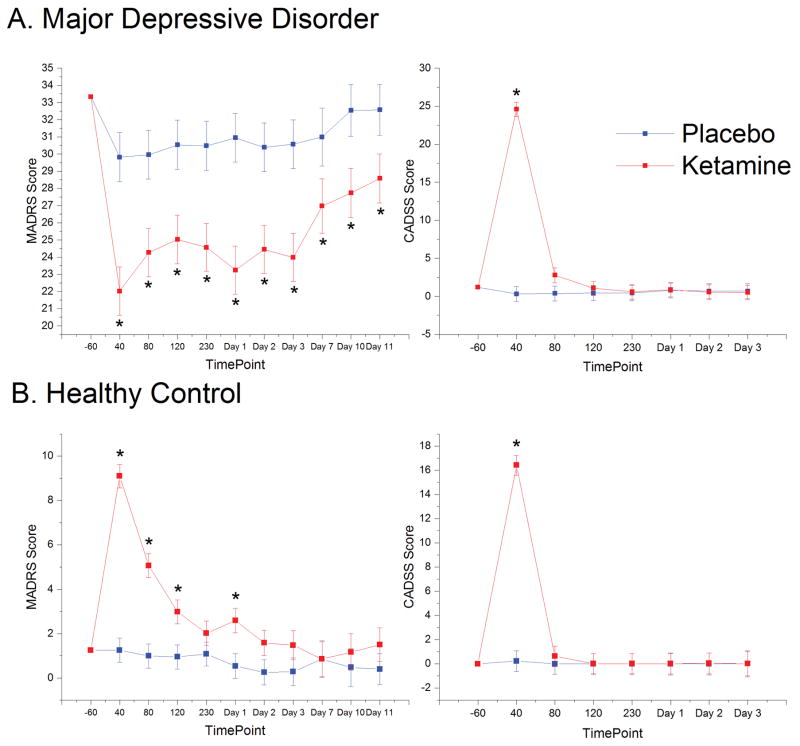
Effects of Ketamine on Mood. Graphs of the marginal means derived from the linear mixed models for the Montgomery-Åsberg Depression Rating Scale (MADRS) and Clinician Administered Dissociative States Scale (CADSS) time points significant at p<0.05 after Bonferroni correction are indicated with an asterisk. A) In major depressive disorder (MDD) subjects, MADRS scores demonstrated a significant main effect of drug (F1,559=140.70, p<.001; Supplementary Table S2). CADSS scores indicated significant main effects of drug (F1,414=57.66, p<.001), time (F6,380=43.61, p<0.001), and a drug by time interaction (F6,380=45.59, <0.001). CADSS scores peaked at 40 minutes post-ketamine (F1,389=326.7, p<.001); the effect of the drug was not significant at any other time point. B) In healthy controls, MADRS scores indicated significant main effects of drug (F1,328=61.87, p<0.001) and time (F9,314=14.31, p<0.001) and a significant drug by time interaction (F9,313=9.87, p<0.001). The increase in depressive symptoms was significant at 40, 80, and 120 minutes post-infusion and at Day 1. Seventeen of 24 healthy controls receiving ketamine (71%) showed an increase of at least five points on the MADRS at any time point, compared to only one of 23 healthy controls receiving placebo (4%). By Day 2, only one healthy control subject still scored above 5 on the MADRS. CADSS scores in healthy controls demonstrated significant main effects of drug (F1,274=26.21, p<0.001), time (F6,261=27.50, p<0.001), and a drug by time interaction (F6,259=26.01, p<0.001), with significant differences between ketamine and placebo observed only at the 40-minute time point.
Figure 2
Figure 2
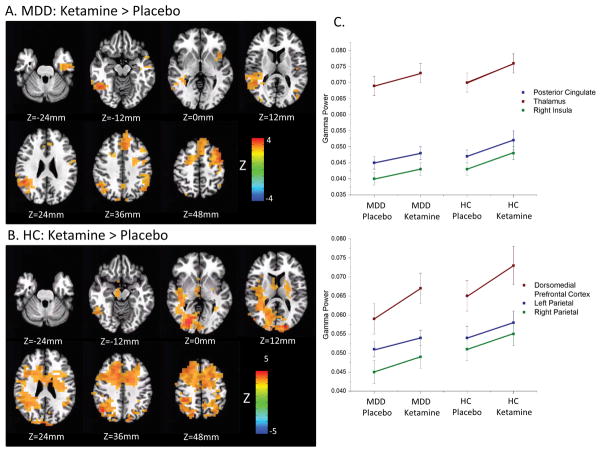
Images of Ketamine-Day0 vs. Placebo-Day0 contrasts derived from the mixed model are shown for A) patients with major depressive disorder (MDD). Images are thresholded at a voxel-level threshold of p<0.01, which corresponds to pFDR=0.049. The same images are shown for B) healthy controls, where in order to differentiate regions of peak change, images are thresholded at a more restrictive voxel-level threshold of p<0.001, which corresponds to pFDR=0.0014. Gamma power was robustly increased in regions of the central executive network (CEN; Figure 2a,b Z=36mm), including bilateral parietal cortex, dorsomedial prefrontal cortex, and dorsolateral prefrontal cortex (DLPFC) in both groups. The MDD group exhibited increases in the insula, which is involved in the salience network (SN; Figure 2a, Z=0mm). Healthy control subjects exhibited increases in gamma power in the posterior cingulate and thalamus (Figure 2b, Z=0mm to 12mm), regions related to the default mode network (DMN). MDD subjects exhibited increases under ketamine in the inferior temporal cortex extending into the parahippocampal cortex (Figure 2a, Z=−24mm to −12mm). C) The plots of estimated marginal means from mixed models performed on regions of interest (ROIs) defined on the Ketamine-Day0 vs. Placebo-Day0 contrast collapsed across groups. Coordinates are given in Supplementary Table S7. Because these are functionally defined ROIs, effect sizes cannot be interpreted, although the general trend of MDD subjects exhibiting increases in gamma power following ketamine infusion to a level commensurate with that of the healthy controls following placebo infusion can be observed. HC: healthy control.
Figure 3
Figure 3
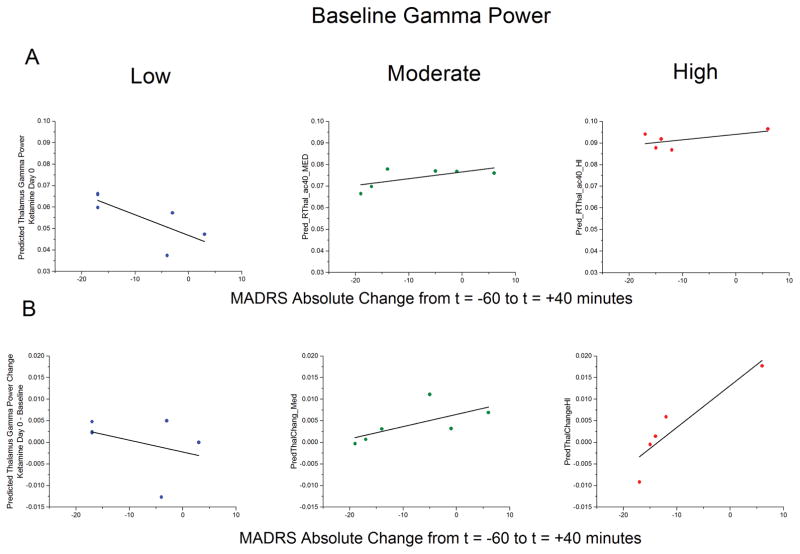
A) Exploratory results in major depressive disorder (MDD) patients from a mixed model examining post-infusion gamma power in the right thalamus with baseline gamma power and change in Montgomery Åsberg Depression Rating Scale (MADRS) score as a covariate. Significant main effects were noted for both baseline gamma power (F1,12=224.8, p<0.001) and MADRS response (F1,12=32.6, p<0.001), as was a significant interaction between baseline gamma power and MADRS response (F1,12=47.46, p<0.001). The predicted values are plotted versus change in MADRS score from t=−60 to t=+40 following ketamine infusion for three groups of patients stratified by baseline gamma power to visualize the interaction. Note that subgroup stratification was performed here for visualization purposes only; baseline gamma power was a continuous variable in the statistical model. B) The same data from A (above), except with change in gamma power from baseline to ketamine sessions plotted along the y-axis; note that the statistical effects are the same.

References

    1. Trivedi MH, Rush AJ, Wisniewski SR, Nierenberg AA, Warden D, Ritz L, et al. Evaluation of outcomes with citalopram for depression using measurement-based care in STAR*D: implications for clinical practice. Am J Psychiatry. 2006 Jan;163:28–40. - PubMed
    1. Zarate CA, Jr, Singh JB, Carlson PJ, Brutsche NE, Ameli R, Luckenbaugh DA, et al. A randomized trial of an N-methyl-D-aspartate antagonist in treatment-resistant major depression. Arch Gen Psychiatry. 2006 Aug;63:856–864. - PubMed
    1. Valentine GW, Mason GF, Gomez R, Fasula M, Watzl J, Pittman B, et al. The antidepressant effect of ketamine is not associated with changes in occipital amino acid neurotransmitter content as measured by [(1)H]-MRS. Psychiatry Res. 2011 Feb 28;191:122–127. - PMC - PubMed
    1. Murrough JW, Iosifescu DV, Chang LC, Al Jurdi RK, Green CE, Perez AM, et al. Antidepressant efficacy of ketamine in treatment-resistant major depression: a two-site randomized controlled trial. Am J Psychiatry. 2013 Oct;170:1134–1142. - PMC - PubMed
    1. Singh JB, Fedgchin M, Daly EJ, De Boer P, Cooper K, Lim P, et al. A Double-Blind, Randomized, Placebo-Controlled, Dose-Frequency Study of Intravenous Ketamine in Patients With Treatment-Resistant Depression. Am J Psychiatry. 2016 Aug 01;173:816–826. - PubMed

Publication types