


Economic Evaluation of a Catheter-Associated Urinary Tract Infection Prevention Program in Nursing Homes
- PMID: 29489017
- PMCID: PMC6374025
- DOI: 10.1111/jgs.15316
Economic Evaluation of a Catheter-Associated Urinary Tract Infection Prevention Program in Nursing Homes
Abstract
Objective: To assess the economic effect and cost effectiveness of a targeted catheter-associated urinary tract infection (CAUTI) prevention intervention in the nursing home (NH) setting.
Design: Randomized clinical trial.
Setting: Community-based NHs (N=12).
Participants: NH residents with indwelling urinary catheters (N=418).
Intervention: Standard care versus infection prevention program involving barrier precautions, active surveillance, and NH staff education.
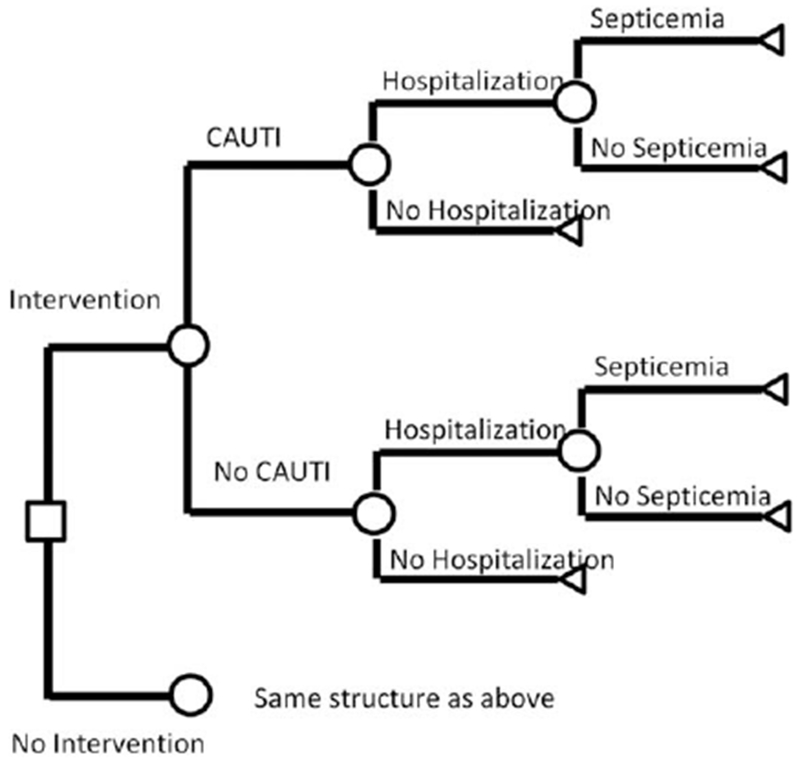
Measurements: Costs of the intervention, costs of disease, and health outcomes were used to calculate an incremental cost-effectiveness ratio for the intervention. Data came from intervention results and the literature and outcomes were analyzed over one year.
Results: A 120-bed NH would have program costs of $20,279/year. The cost of disease treatment would be reduced by $54,316 per year, resulting in a $34,037 net cost savings. Most of this savings would come from fewer CAUTI hospitalizations ($39,180), with $15,136 in savings from CAUTI care within the NH. The intervention also yielded a gain of 0.197 quality-adjusted life-years (QALYs). Taking into account uncertainty in all parameters suggests there is an 85% chance that the intervention is cost-saving.
Conclusions: The CAUTI prevention program is expected to benefit payers by reducing costs and improving health outcomes. Because the savings accrue to payers and not to NHs, payers such as Medicare and private insurers may want to provide incentives for NHs to implement such programs.
Trial registration: clinicaltrials.gov Identifier: NCT01062841.
Keywords: catheter-related infections; cost-effectiveness; drug resistance, multiple; nursing homes.
© 2018, Copyright the Authors Journal compilation © 2018, The American Geriatrics Society.
Conflict of interest statement
Figures
Comment in
-
Re: Economic Evaluation of a Catheter-Associated Urinary Tract Infection Prevention Program in Nursing Homes.J Urol. 2018 Dec;200(6):1143. doi: 10.1016/j.juro.2018.09.006. J Urol. 2018. PMID: 30838911 No abstract available.
References
-
- Harris-Kojetin L, Sengupta M, Park-Lee E et al. Long-term care services in the United States: 2013 overview. National Center for Health Statistics. Vital Health Stat 2013;3:1–107. - PubMed
-
- Rogers MA, Mody L, Kaufman S et al. Use of urinary collection devices in skilled nursing facilities in five states. J Am Geriatr Soc 2008;56:854–861. - PubMed
Publication types
MeSH terms
Associated data
Grants and funding
LinkOut - more resources
Full Text Sources
Other Literature Sources
Medical
