. 2018 Jun;12(6):799-813.
doi: 10.1002/1878-0261.12187. Epub 2018 May 9.

Long non-coding RNA CASC15 regulates gastric cancer cell proliferation, migration and epithelial mesenchymal transition by targeting CDKN1A and ZEB1

Affiliations

Long non-coding RNA CASC15 regulates gastric cancer cell proliferation, migration and epithelial mesenchymal transition by targeting CDKN1A and ZEB1

Qiong Wu et al. Mol Oncol. 2018 Jun.

Abstract

Long non-coding RNA (lncRNA) is responsible for a diverse range of cellular functions, such as transcriptional and translational regulation and variance in gene expression. The lncRNA CASC15 (cancer susceptibility candidate 15) is a long intergenic non-coding RNA (lincRNA) locus in chromosome 6p22.3. Previous research shows that lncRNA CASC15 is implicated in the biological behaviors of several cancers such as neuroblastoma and melanoma. Here, we aimed to explore in detail how CASC15 contributes to the growth of gastric cancer (GC). As predicted, the expression of CASC15 was enriched in GC tissues and cell lines as compared with healthy tissues and cells using qRT-PCR. The Kaplan-Meier method was used to demonstrate that high expression of CASC15 is linked to a poor prognosis for patients suffering from GC. Additionally, functional experiments proved that the down- or up-regulation of CASC15 inhibited or facilitated cell proliferation via the induction of cell cycle arrest and apoptosis, and also suppressed or accelerated cell migration and invasion by affecting the progression of the epithelial-to-mesenchymal transition (EMT). In vivo experiments showed that the knockdown of CASC15 lessened the tumor volume and weight and influenced the EMT process. This was confirmed by western blot assays and immunohistochemistry, indicating impaired metastatic ability in nude mice. CASC15 involvement in the tumorigenesis of GC occurs when CASC15 interacts with EZH2 and WDR5 to modulate CDKN1A in nucleus. Additionally, the knockdown of CASC15 triggered the silencing of ZEB1 in cytoplasm, which was shown to be associated with the competitive binding of CASC15 to miR-33a-5p.

Keywords: CDKN1A; ZEB1; cancer susceptibility candidate 15; epithelial-to-mesenchymal transition; gastric cancer.


Figures

Figure 1
Figure 1
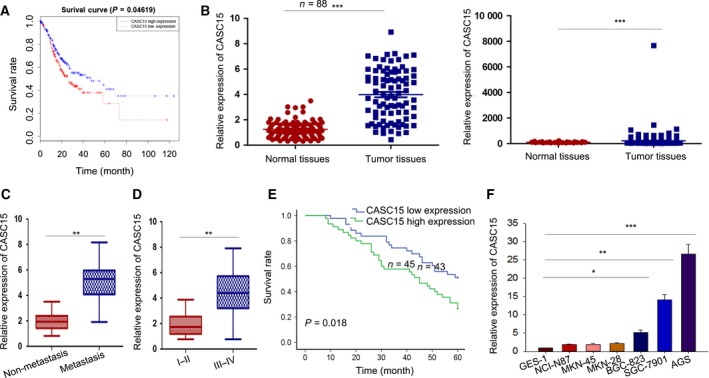
Highly expressed CASC15 is associated with poor survival in GC patients. (A) On the basis of TCGA data, a high level of CASC15 was positively correlated with poorer overall survival outcome. (B–D). qRTPCR and TCGA analysis demonstrated that CASC15 was obviously up‐regulated in GC tissues compared with normal tissues (B). Tissues with distant metastasis presented a higher expression level of CASC15 than those without distant metastasis (C). CASC15 was significantly correlated with the TNM stage of GC (D). (E) Kaplan–Meier analysis (log‐rank test) showed that higher CASC15 was associated with poorer overall survival. (F) qRTPCR was used to demonstrate that the expression of CASC15 was significantly increased in the GC cell lines. Error bars represent the mean ± SD of at least three independent experiments. *< 0.05, **< 0.01 and ***< 0.001 vs. control group.
Figure 2
Figure 2
CASC15 regulates GC cell proliferation, migration and EMT. (A) AGS and SGC7901 cells transfected with si‐CASC15 exhibited a relatively high expression of CASC15 (left). GES‐1 cell transfected with pcDNACASC15 showed a relatively low level of CASC15 (right). (B,C) MTT and colony formation assays revealed that the silencing of CASC15 inhibited cell viability and clonogenic survival, whereas overexpression of CASC15 enhanced cell viability and clonogenic survival, compared with the control group. (D) Transwell assays demonstrated that the knockdown of CASC15 caused clearly inhibited cell migration, whereas overexpression of CASC15 caused the opposite. (E) Western blot assays revealed that the silencing of CASC15 decreased the levels of the mesenchymal markers but increased the level of the epithelial marker; overexpression of CASC15 caused the opposite effect. (F) Immunofluorescence staining revealed that the dysregulated CASC15 changed the distribution of E‐cadherin and N‐cadherin in the AGS cell. Error bars represent the mean ± SD of at least three independent experiments. **< 0.01 vs. control group.
Figure 3
Figure 3
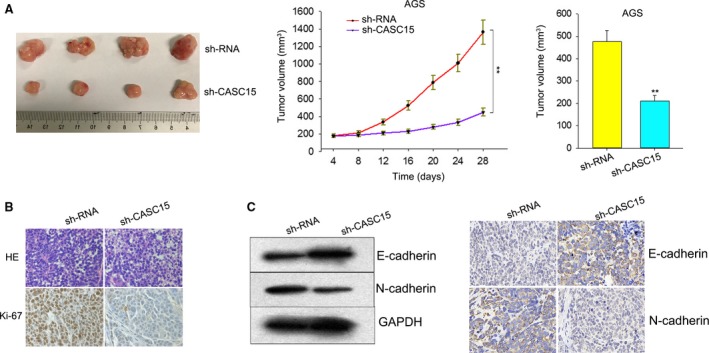
CASC15 regulates GC tumorigenesis in vivo. (A) The sh‐CASC15 transfection decreased the tumor volume and weight in vivo. (B) The sh‐CASC15‐transfected AGS cell exhibited a weakened positivity for Ki‐67 compared with control cells. (C) Western blot revealed that silenced CASC15 was able to reduce significantly the level of N‐cadherin but increase the level of E‐cadherin. Error bars represent the mean ± SD of at least three independent experiments. **< 0.01 vs. control group.
Figure 4
Figure 4
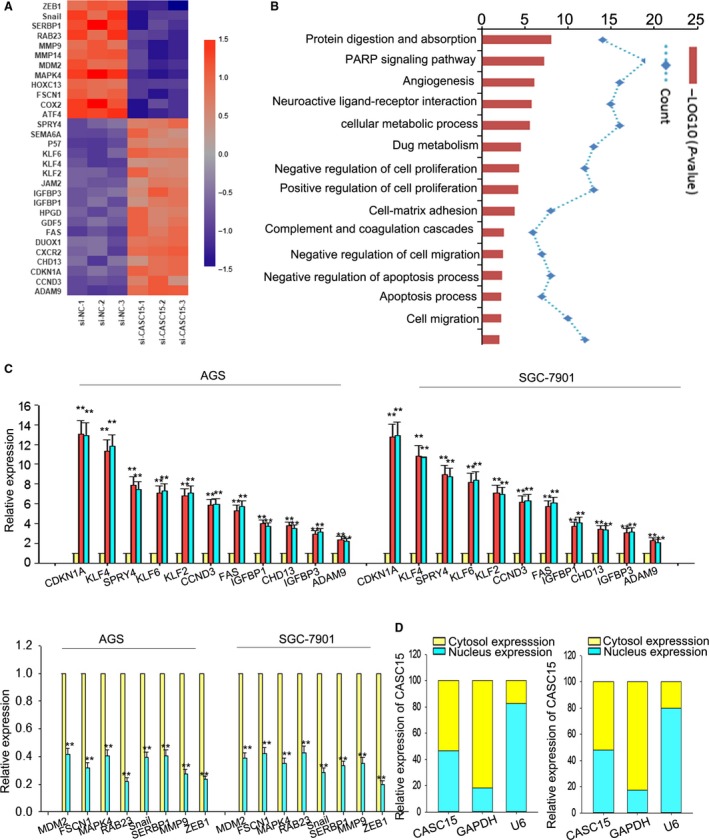
ZEB1 and CDKN1A genes are closely associated with CASC15. (A) Gene expression profiles of AGS cell in response to the knockdown of CASC15 by applying RNA transcriptome sequencing. (B) Gene ontology analysis revealed that these genes were involved in many signal pathways, including cell proliferation and cell migration. (C) qRTPCR showed that all these genes could be significantly affected by CASC15; with ZEB1 and CDKN1A exhibiting the greatest change. (D) Subcellular fractionation location assays indicated that CASC15 was located in both the nucleus and cytoplasm in AGS and SGC7901 cells. Error bars represent the mean ± SD of at least three independent experiments. **< 0.01 vs. control group.
Figure 5
Figure 5
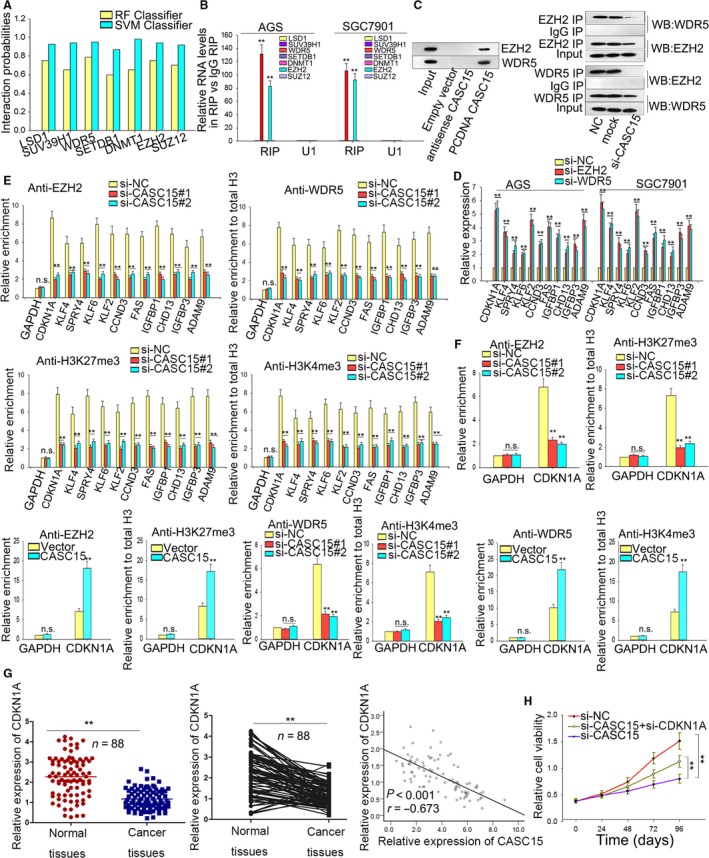
CASC15 modulates CDKN1A through interaction with EZH2 and WDR5 in nucleus. (A) The online bioinformatics analysis was employed to predict the potential chromatin modifiers. (B) RIP was applied to confirm the interaction of chromatin modifiers with the antibodies of these predicted chromatin modifiers. (C) RNA pull‐down assays showed that the labeled CASC15 could pull down EZH2 and WDR5 from the nuclear extract fraction of AGS cell. IP ssay illustrated that CASC15 was required to bridge the interaction between EZH2 and WDR5. (D) qRTPCR demonstrated that the silencing of EZH2 or WDR5 increased the expression levels of suppressed genes. (E) ChIP assays revealed that knockdown of CASC15 weakened the binding of EZH2/WDR5 and H3K27me3/H3K4me3 levels across the promoters of these CASC15‐mediated suppression genes. (F) ChIP indicated that CDKN1A was a bona fide target of CASC15‐regulated genes. (G) qRTPCR and Spearman's correlation analysis revealed that CDKN1A was decreased in GC tissues and was negatively correlated with CASC15. (H) Rescue assays revealed that down‐regulated CASC15‐mediated growth inhibition could be reversed by silenced CDKN1A. Error bars represent the mean ± SD of at least three independent experiments. **< 0.01 vs. control group.
Figure 6
Figure 6
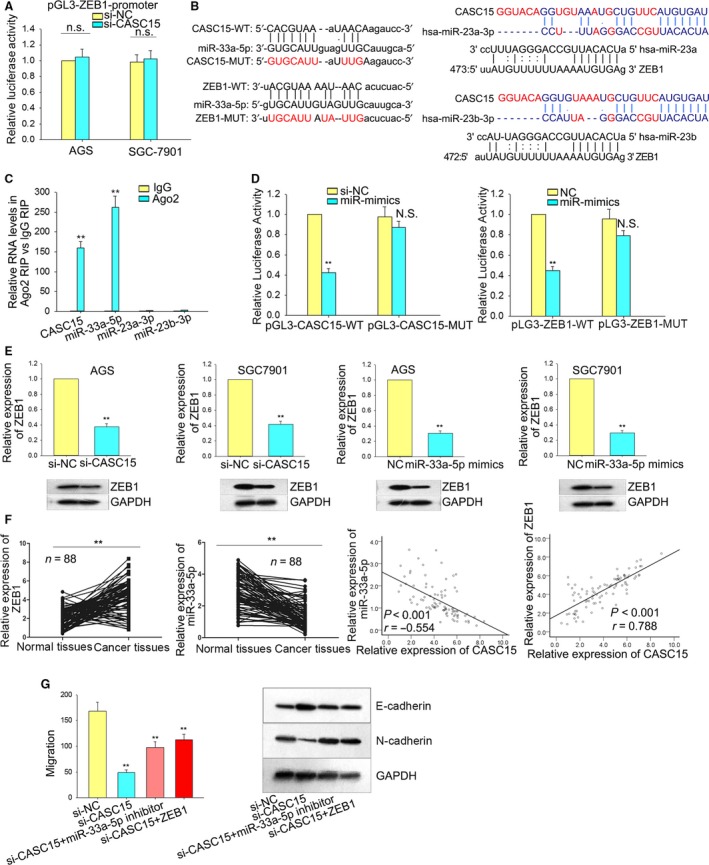
CASC15 modulates the expression of ZEB1 through sponging miRNA‐33a‐5p in cytoplasm. (A) Luciferase reporter assays demonstrated that CASC15 could not impact the transactivation of ZEB1 promoter, suggesting that CASC15 might regulate ZEB1 mRNA at a post‐transcriptional level. (B) Binding sites between CASC15 and miR‐33a‐5p, and between ZEB1 and miR‐33a‐5p. (C) RIP assays revealed that miR‐33a‐5p was involved in the CASC15‐mediated ZEB1 modulation. (D) Luciferase reporter assays demonstrated that both CASC15 and miR‐33a‐5p were able to influence the luciferase activity of ZEB1. (E) qRTPCR and western blot analysis showed that silenced CASC15 or forced expression of miR‐33a‐5p decreased ZEB1 expression levels in AGS and SGC7901 cells. (F) qRTPCR and Spearman's correlation analysis showed that miR‐33a‐5p/ZEB1 were respectively significantly down‐regulated/up‐regulated in the GC tissues and negatively/positively correlated with CASC15. (G) Rescue experiments revealed that silenced CASC15‐mediated migration inhibition and EMT process blockage could be reversed by inhibiting miR‐33a‐5p or forcibly expressing ZEB1. Error bars represent the mean ± SD of at least three independent experiments. **< 0.01 vs. control group.

References

    1. Abdel‐Latif MM, Windle HJ, Davies A, Volkov Y and Kelleher D (2009) A new mechanism of gastric epithelial injury induced by acid exposure: the role of Egr‐1 and ERK signaling pathways. J Cell Biochem 108, 249–260. - PubMed
    1. Cao R, Wang L, Wang H, Xia L, Erdjument‐Bromage H, Tempst P, Jones RS and Zhang Y (2002) Role of histone H3 lysine 27 methylation in Polycomb‐group silencing. Science 298, 1039–1043. - PubMed
    1. Cesana M, Cacchiarelli D, Legnini I, Santini T, Sthandier O, Chinappi M, Tramontano A and Bozzoni I (2011) A long noncoding RNA controls muscle differentiation by functioning as a competing endogenous RNA. Cell 147, 358–369. - PMC - PubMed
    1. Chaffer CL and Weinberg RA (2011) A perspective on cancer cell metastasis. Science 331, 1559–1564. - PubMed
    1. Chen X, Xie W, Gu P, Cai Q, Wang B, Xie Y, Dong W, He W, Zhong G, Lin T et al (2015) Upregulated WDR5 promotes proliferation, self‐renewal and chemoresistance in bladder cancer via mediating H3K4 trimethylation. Sci Rep 5, 8293. - PMC - PubMed

Publication types

MeSH terms

Substances