


Genome-wide association study of maternal genetic effects and parent-of-origin effects on food allergy
- PMID: 29489655
- PMCID: PMC5851764
- DOI: 10.1097/MD.0000000000010043
Genome-wide association study of maternal genetic effects and parent-of-origin effects on food allergy
Abstract
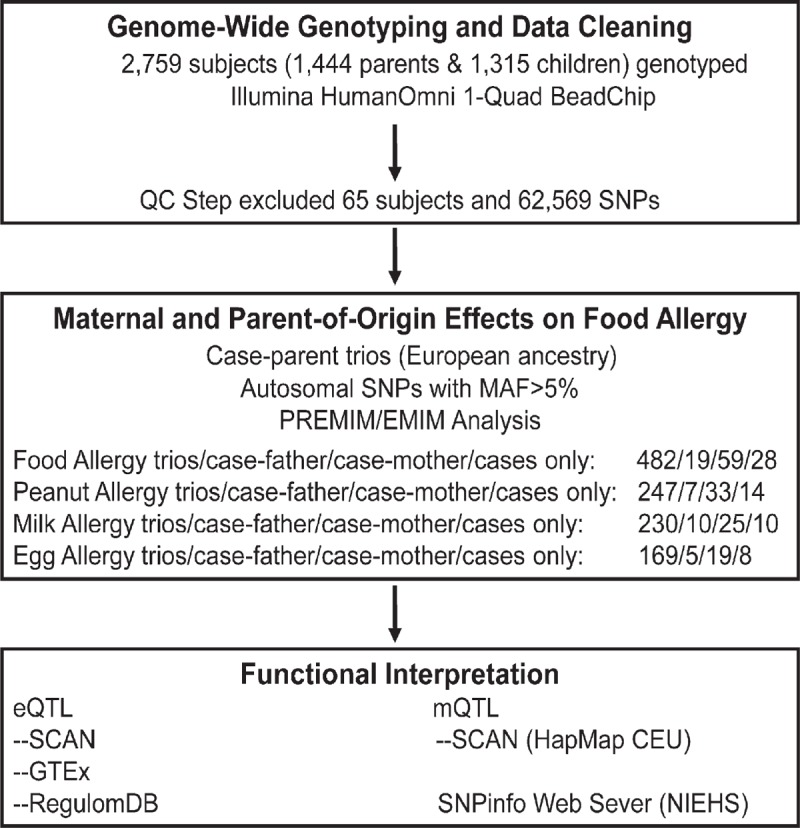
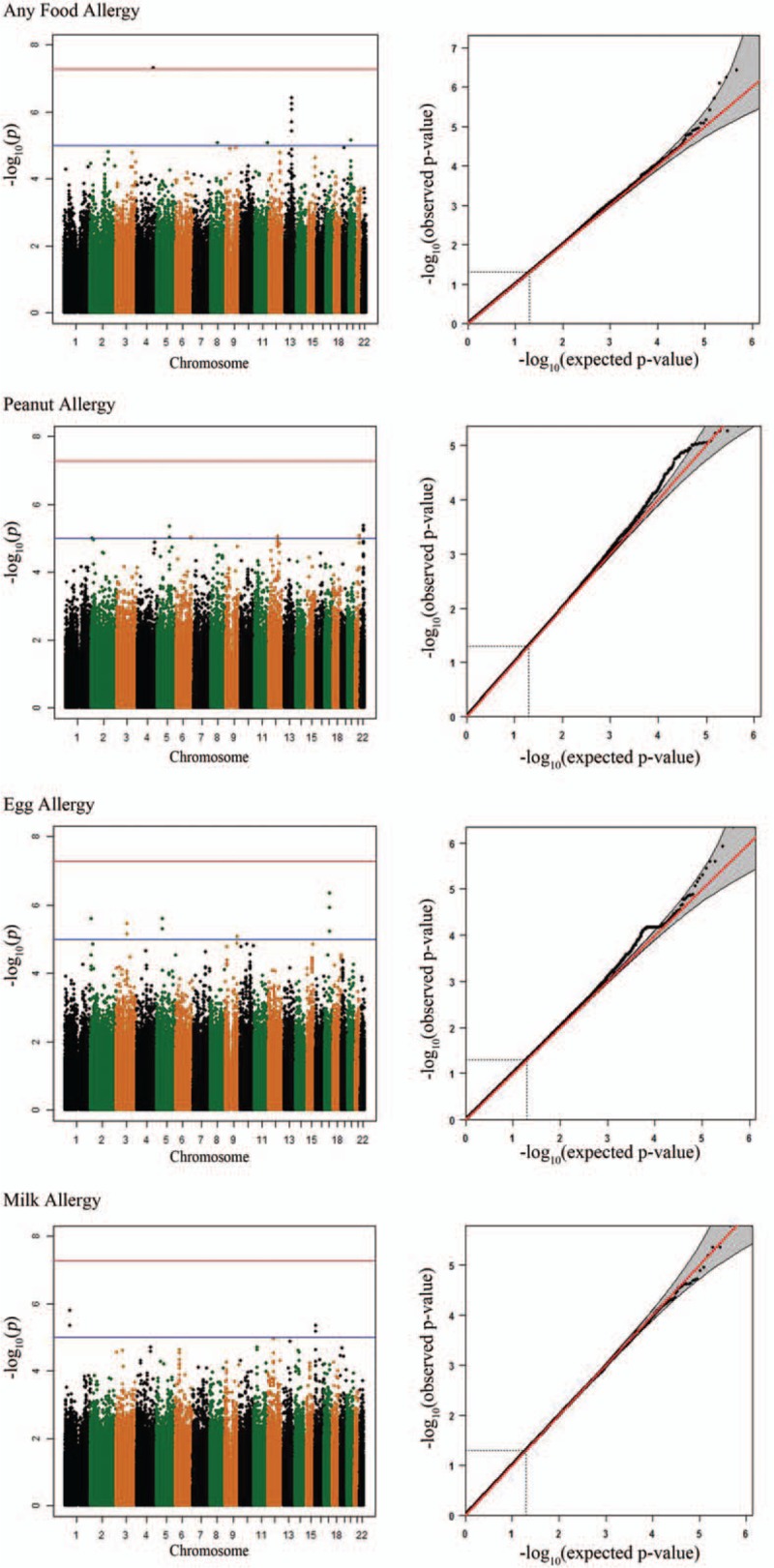
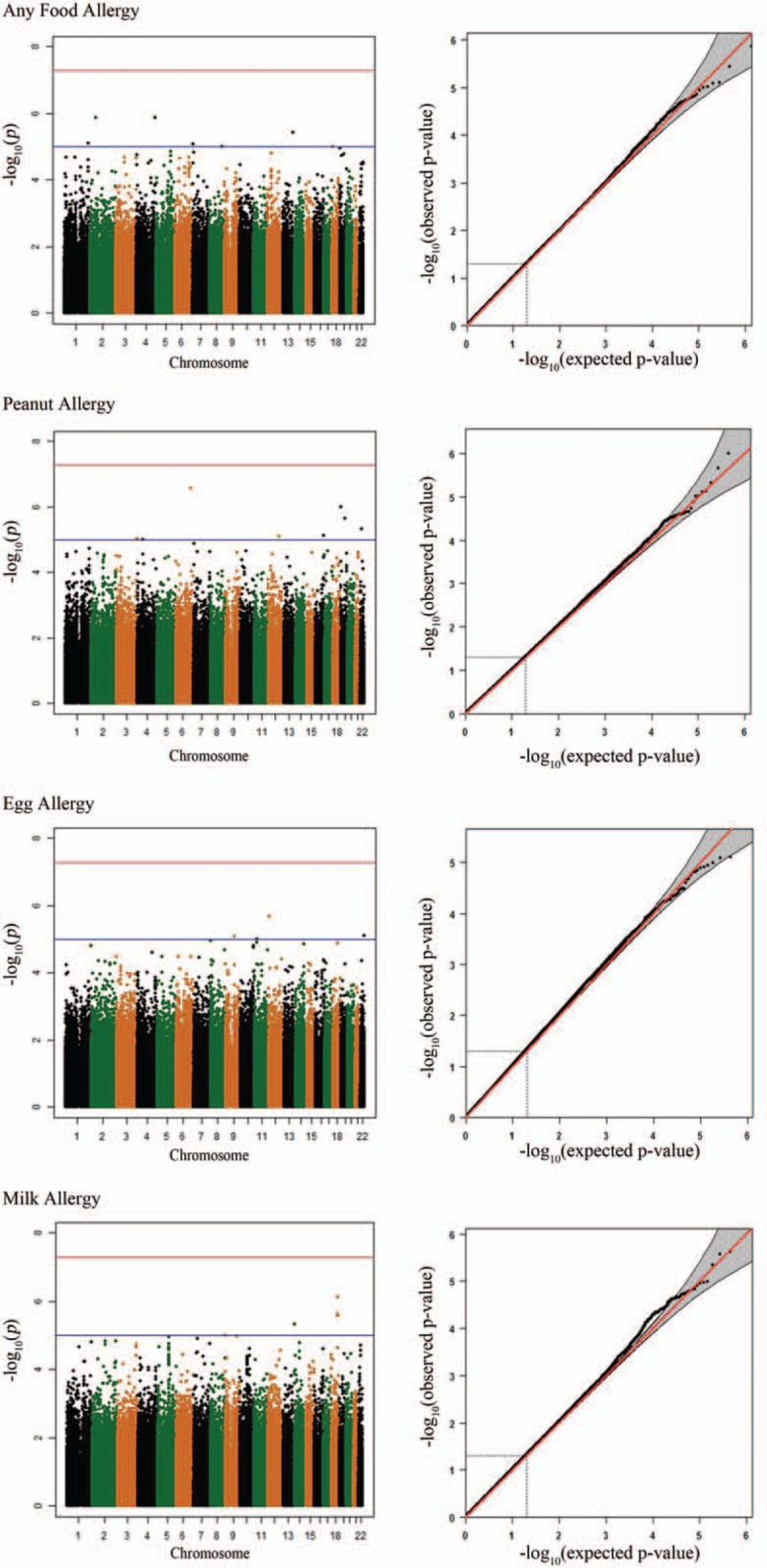
Previous genetic studies of food allergy (FA) have mainly focused on inherited genotypic effects. The role of parental genotypic effects remains largely unexplored. Leveraging existing genome-wide association study (GWAS) data generated from the Chicago Food Allergy Study, we examined maternal genotypic and parent-of-origin (PO) effects using multinomial likelihood ratio tests in 588 complete and incomplete Caucasian FA trios. We identified 1 single nucleotide polymorphism with significant (P < 5×10) maternal effect on any FA (rs4235235), which is located in a noncoding RNA (LOC101927947) with unknown function. We also identified 3 suggestive (P < 5×10) loci with maternal genetic effects: 1 for any FA (rs976078, in a gene desert region on 13q31.1) and 2 for egg allergy (rs1343795 and rs4572450, in the ZNF652 gene, where genetic variants have been associated with atopic dermatitis). Three suggestive loci with PO effect were observed: 1 for peanut allergy (rs4896888 in the ADGB gene) and 2 for any FA in boys only (rs1036504 and rs2917750 in the IQCE gene). Findings from this family-based GWAS of FA provided some preliminary evidence on maternal genotypic or PO effects on FA. Additional family-based studies are needed to confirm our findings and gain new insight into maternal and paternal genetic contribution to FA.
Conflict of interest statement
The authors have no conflicts of interest to disclose.
Figures
References
-
- Gupta RS, Springston EE, Warrier MR, et al. The prevalence, severity, and distribution of childhood food allergy in the United States. Pediatrics 2011;128:e9–17. - PubMed
-
- Sicherer SH, Sampson HA. 9 Food allergy. J Allergy Clin Immunol 2006;117(2 suppl Mini-Primer):S470–5. - PubMed
-
- Sampson HA. Update on food allergy. J Allergy Clin Immunol 2004;113:805–19. quiz 820. - PubMed
Publication types
MeSH terms
Grants and funding
LinkOut - more resources
Full Text Sources
Other Literature Sources
Medical
