. 2018 Feb 1;148(2):185-193.
doi: 10.1093/jn/nxx032.

Arginine Metabolism Is Altered in Adults with A-β + Ketosis-Prone Diabetes

Affiliations

Arginine Metabolism Is Altered in Adults with A-β + Ketosis-Prone Diabetes

Surya N Mulukutla et al. J Nutr. .

Abstract

Background: A-β + ketosis-prone diabetes (KPD) is a subset of type 2 diabetes in which patients have severe but reversible β cell dysfunction of unknown etiology. Plasma metabolomic analysis indicates that abnormal arginine metabolism may be involved.

Objective: The objective of this study was to determine the relation between gut microbiome and arginine metabolism and the relation between arginine availability and β cell function in KPD patients compared with control participants.

Methods: Kinetics of arginine and related metabolites were measured with stable isotope tracers, and insulin secretory responses to arginine and glucose were determined under euglycemic and hyperglycemic conditions in 6 KPD patients and 6 age-, gender-, and body mass index-matched control participants. Glucose potentiation of arginine-induced insulin secretion was performed in a different set of 6 KPD and 3 control participants.

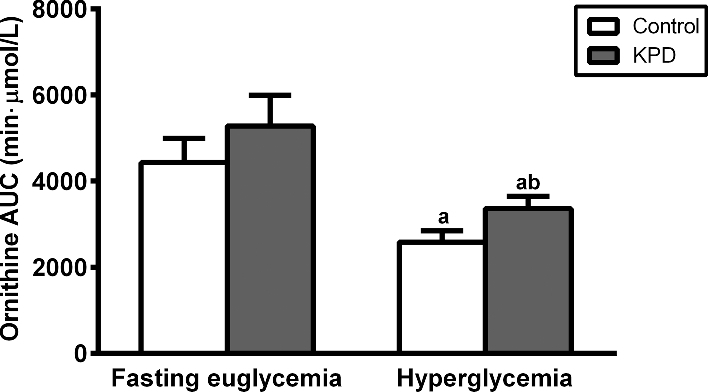
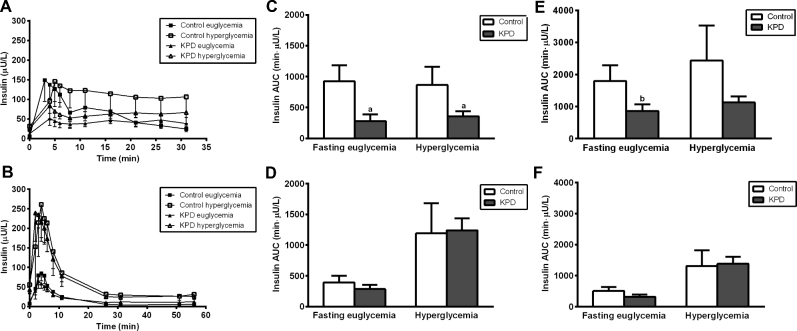
Results: Arginine availability was higher in KPD patients during euglycemia [53.5 ± 4.3 (mean ± SEM) compared with 40.3 ± 2.4 μmol · kg lean body mass (LBM)-1 · h-1, P = 0.03] but declined more in response to hyperglycemia (Δ 10.15 ± 2.6 compared with Δ 3.20 ± 1.3 μmol · kg LBM-1 · h-1, P = 0.041). During hyperglycemia, ornithine flux was not different between groups but after an arginine bolus, plasma ornithine AUC trended higher in KPD patients (3360 ± 294 compared with 2584 ± 259 min · μmol · L-1, P = 0.08). In both euglycemia and hyperglycemia, the first-phase insulin responses to glucose stimulation were lower in KPD patients (euglycemic insulin AUC 282 ± 108 compared with 926 ± 257 min · μU · mL-1, P = 0.02; hyperglycemic insulin AUC 358 ± 79 compared with 866 ± 292 min · μU · mL-1, P = 0.05), but exogenous arginine restored first-phase insulin secretion in KPD patients to the level of control participants.

Conclusion: Compared with control participants, KPD patients have increased arginine availability in the euglycemic state, indicating a higher requirement. This is compromised during hyperglycemia, with an inadequate supply of arginine to sustain metabolic functions such as insulin secretion. Exogenous arginine administration restores a normal insulin secretory response.


Figures
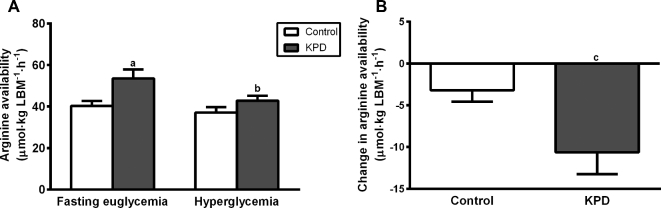
FIGURE 1
FIGURE 1
Available arginine under euglycemic and hyperglycemic conditions (A) and the change in available arginine between the euglycemic and hyperglycemic conditions (B) in 6 recent-onset KPD patients and 6 age-, gender-, and BMI-matched control participants. Values are means ± SEMs. (A) Means were compared by repeated-measures 2-factor ANOVA. Significant interaction between group and glycemic state (P < 0.05), significant main effect of glycemic state and group (P < 0.05). Post hoc comparisons: asignificantly different from control group in corresponding clinical condition, P < 0.05 (post hoc Sidak multiple comparison test); bsignificantly different from corresponding group in euglycemic condition, P < 0.05 (post hoc Sidak multiple comparison test); csignificantly different from control group, P < 0.05 (t test). KPD, ketosis-prone diabetes; LBM, lean body mass.
FIGURE 2
FIGURE 2
Plasma ornithine AUC from 0 to 56 min following intravenous arginine bolus in 6 recent-onset KPD patients and 6 age-, gender-, and BMI-matched control participants under euglycemic and hyperglycemic conditions. Values are means ± SEM, n = 6. aSignificantly different from corresponding group in euglycemic condition, P < 0.05 (paired t test); bsignificantly different from control group in corresponding clinical condition, P < 0.10 (nonpaired t test). KPD, ketosis-prone diabetes.
FIGURE 3
FIGURE 3
Plasma insulin concentrations (secretory response) (A, B), first-phase plasma insulin AUC (C, D), and total plasma insulin AUC (E, F) after glucose bolus (A, C, E) and after arginine bolus (B, D, F) in recent-onset KPD patients and age-, gender-, and BMI-matched control participants, following euglycemic and hyperglycemic conditions. Values are means ± SEMs, n = 4 for control participants and n = 5 for KPD. aSignificantly different from control group in corresponding clinical condition: aP < 0.05; bP < 0.10 (t test). KPD, ketosis-prone diabetes.
FIGURE 4
FIGURE 4
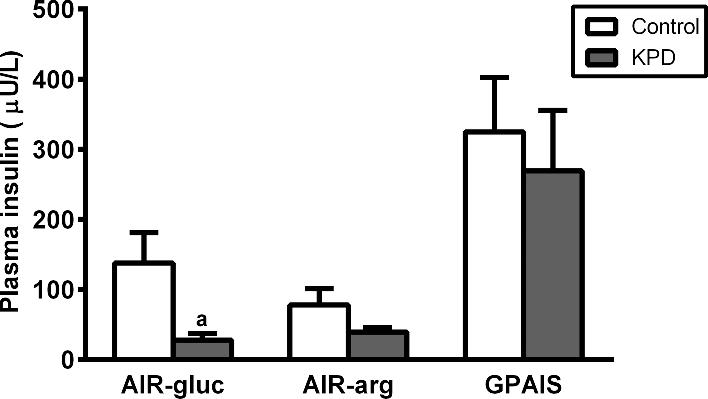
Mean of 3 peak insulin values during first-phase insulin secretion in response to glucose bolus (AIR-gluc), arginine bolus (AIR-arg), and glucose + arginine (GPAIS), in 6 recent-onset KPD patients and 3 control participants. Values are means ± SEMs. aSignificantly different from control group, P < 0.05 (t test). AIR, acute insulin response; GPAIS, glucose potentiation of arginine-induced insulin secretion; KPD, ketosis-prone diabetes.
FIGURE 5
FIGURE 5
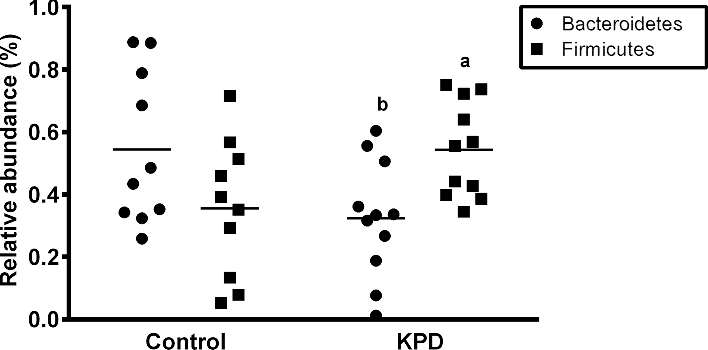
Relative abundance of Bacteroidetes and Firmicutes within the intestinal microbiome of 6 recent-onset KPD patients and 6 age-, gender-, and BMI-matched control participants. Values are individuals with mean (–). a,bSignificantly different from the control group: aP < 0.05; bP < 0.10 (paired t test). KPD, ketosis-prone diabetes.
FIGURE 6
FIGURE 6
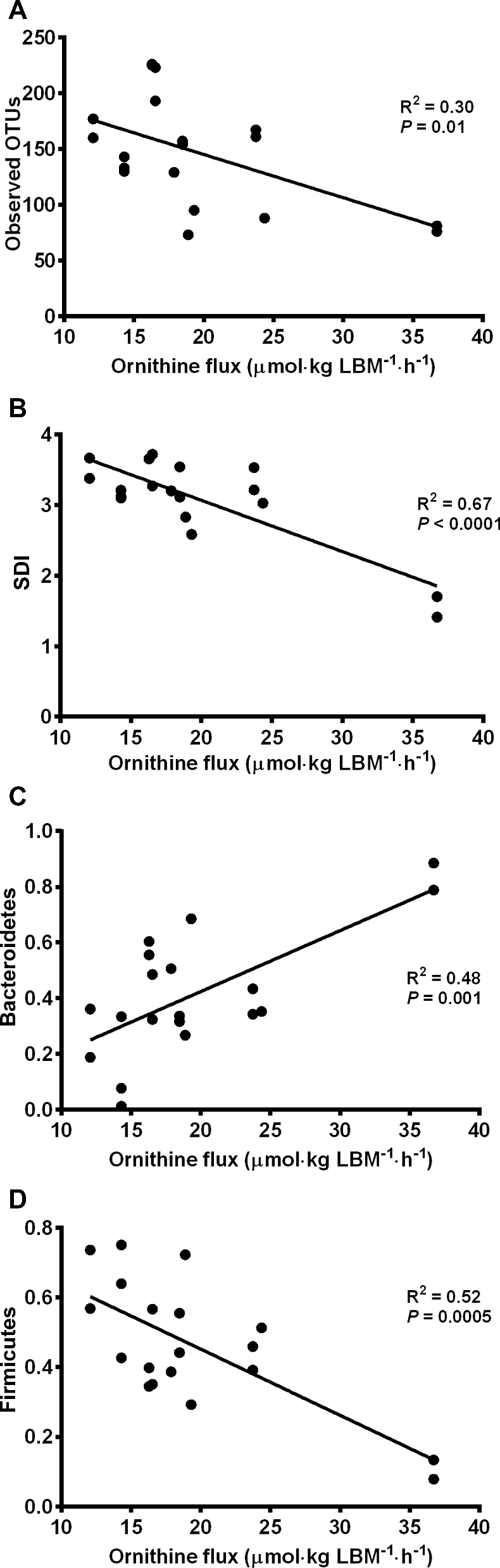
Correlation of bacterial richness using OTUs (A), bacterial evenness using SDI (B), Bacteroidetes relative abundance (C), and Firmicutes relative abundance (D) with ornithine flux in all 12 study participants [6 recent-onset KPD patients and 6 age-, gender-, and BMI-matched control participants]. KPD, ketosis-prone diabetes; LBM, lean body mass; OTU, organizational taxonomic unit; SDI, Shannon diversity index.

Comment in

References

    1. Patel SG, Hsu JW, Jahoor F, Coraza I, Bain JR, Stevens RD, Iyer D, Nalini R, Ozer K, Hampe CS, et al. Pathogenesis of A(-)beta(+) ketosis-prone diabetes. Diabetes 2013;62:912–22. - PMC - PubMed
    1. Kashyap SR, Lara A, Zhang R, Park YM, DeFronzo RA. Insulin reduces plasma arginase activity in type 2 diabetic patients. Diabetes Care 2008;31:134–9. - PMC - PubMed
    1. Schmidt HH, Warner TD, Ishii K, Sheng H, Murad F. Insulin secretion from pancreatic B cells caused by L-arginine-derived nitrogen oxides. Science 1992;255:721–3. - PubMed
    1. Floyd JC, Jr., Fajans SS, Conn JW, Knopf RF, Rull J. Stimulation of insulin secretion by amino acids. J Clin Invest 1966;45:1487–502. - PMC - PubMed
    1. Morris SM., Jr Arginine: beyond protein. Am J Clin Nutr 2006;83:S508–12. - PubMed

Publication types

MeSH terms