


The Pathways from a Behavior Change Communication Intervention to Infant and Young Child Feeding in Bangladesh Are Mediated and Potentiated by Maternal Self-Efficacy
- PMID: 29490102
- PMCID: PMC6299133
- DOI: 10.1093/jn/nxx048
The Pathways from a Behavior Change Communication Intervention to Infant and Young Child Feeding in Bangladesh Are Mediated and Potentiated by Maternal Self-Efficacy
Abstract
Background: Although self-efficacy is a potential determinant of feeding and care behaviors, there is limited empirical analysis of the role of maternal self-efficacy in low- and middle-income countries. In the context of behavior change interventions (BCIs) addressing complementary feeding (CF), it is possible that maternal self-efficacy can mediate or enhance intervention impacts.
Objective: In the context of a BCI in Bangladesh, we studied the role of maternal self-efficacy for CF (MSE-CF) for 2 CF behaviors with the use of a theoretically grounded empirical model of determinants to illustrate the potential roles of MSE-CF.
Methods: We developed and tested a locally relevant scale for MSE-CF and included it in a survey (n = 457 mothers of children aged 6-24 mo) conducted as part of a cluster-randomized evaluation. Qualitative research was used to inform the selection of 2 intervention-targeted behaviors: feeding green leafy vegetables in the last 24 h (GLV) and on-time introduction of egg (EGG) between 6 and 8 mo of age. We then examined direct, mediated, and potentiated paths of MSE-CF in relation to the impacts of the BCI on these behaviors with the use of regression and structural equation modeling.
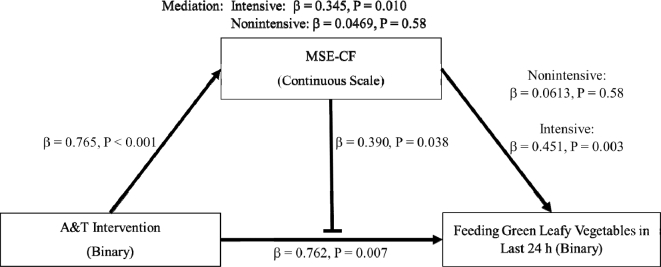
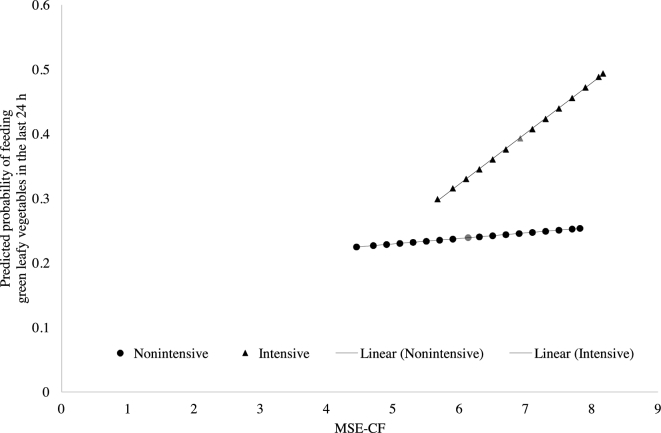
Results: GLV and EGG were higher in the intensive group than in the nonintensive control group (16.0 percentage points for GLV; P < 0.001; 11.2 percentage points for EGG; P = 0.037). For GLV, MSE-CF mediated (β = 0.345, P = 0.010) and potentiated (β = 0.390, P = 0.038) the effect of the intensive group. In contrast, MSE-CF did not mediate or potentiate the effect of the intervention on EGG.
Conclusions: MSE-CF was a significant mediator and potentiator for GLV but not for EGG. The divergent findings highlight the complex determinants of individual specific infant and young child feeding behaviors. The study shows the value of measuring behavioral determinants, such as MSE-CF, that affect a caregiver's capability to adopt intervention-targeted behaviors.
Figures
References
-
- WHO ; Pan American Health Organization Guiding principles for complementary feeding of the breastfed child. Washington (DC): Pan American Health Organization; 2003.
-
- Allen LH. Adequacy of family foods for complementary feeding. Am J Clin Nutr 2012;95:785–6. - PubMed
-
- Kimmons JE, Dewey KG, Haque E, Chakraborty J, Osendarp SJM, Brown KH. Low nutrient intakes among infants in rural Bangladesh are attributable to low intake and micronutrient density of complementary foods. J Nutr 2005;135:444–51. - PubMed
Publication types
MeSH terms
Grants and funding
LinkOut - more resources
Full Text Sources
Other Literature Sources
Medical
