


Study on expression of plasma sCD138 in patients with hemorrhagic fever with renal syndrome
- PMID: 29490629
- PMCID: PMC5831831
- DOI: 10.1186/s12879-018-3005-0
Study on expression of plasma sCD138 in patients with hemorrhagic fever with renal syndrome
Abstract
Background: Until now, there is non-specific treatment, and exploring early and novel biomarkers to determine the disease severity and prognosis of hemorrhagic fever with renal syndrome (HFRS) would be of importance for clinician to take systematic and timely intervention. This study observed the expression of plasma sCD138, a soluble component shedding from the glycocalyx (GCX) to the circulating blood, and evaluated its predictive value on disease severity and prognosis of HFRS.
Methods: One hundred and seventy-six patients with HFRS who were treated at our center between January 2011 and December 2013 were randomly enrolled in this study. The patients were divided into a mild-type group, a moderate-type group, a severe-type group and a critical-type group according to the HFRS criteria for clinical classification. Thirty-five blood samples from healthy subjects were obtained as the controls. The concentrations of sCD138 were detected using enzyme linked immunosorbent assay (ELISA). The levels of prothrombin time (PT), activated partial thromboplastin time (APTT), fibrinogen (Fib), albumin (ALB), alanine aminotransferase (ALT), aspartate aminotransferase (AST), white blood cells (WBC), platelets (PLT), glucose (GLU), blood urea nitrogen (BUN) and serum creatinine (Scr) in the samples were routinely tested. The levels of sCD138 among the different types were compared; the correlation among sCD138 and the laboratory parameters mentioned above were analyzed. The predictive effectiveness for prognosis of sCD138 was evaluated using the receiver operating characteristic (ROC) curve analysis.
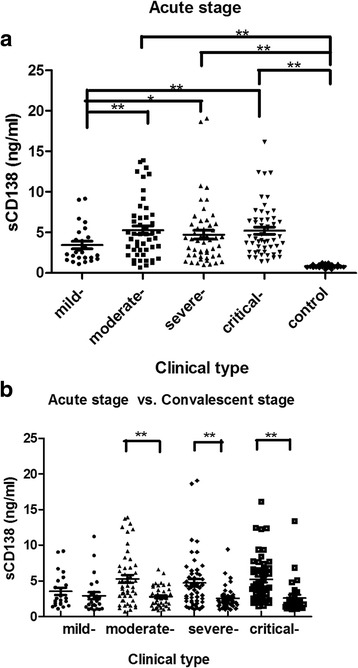
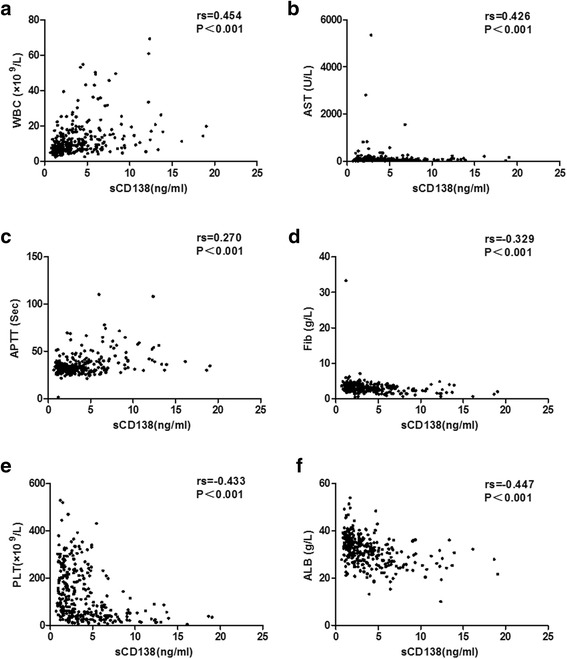
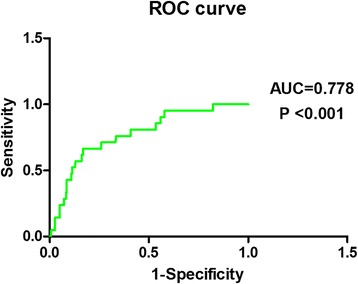
Results: Except for the mild-type, the levels of sCD138 in the moderate-, severe- and critical-type patients during the acute stage were significantly higher than that of the convalescent stage and the control (P<0.05). With the aggravation of the disease, the levels of sCD138 during the acute stage had an increasing tendency, while demonstrated no significant difference among the moderate-, severe- and critical-type patients (P>0.05). sCD138 was negatively correlated with Fib, PLT and ALB, and was positively correlated with WBC and AST (P<0.05). sCD138 demonstrated predictive effectiveness for prognosis with the area under the curve (AUC) of 0.778 (P<0.001).
Conclusion: Dynamic detection of plasma sCD138 might be benefit to evaluating the disease severity and prognosis of the patients with HFRS.
Keywords: Hantavirus; Hemorrhagic fever with renal syndrome; Prognosis; Soluble CD138.
Conflict of interest statement
Availability of data and materials
Data contains personal information. The data will not be made available in order to protect the participants’ identity.
Ethics approval and consent to participate
The study was approved by the Institutional Review Board of Tangdu Hospital. Before inclusion, the patients were informed about the objectives of this study, and they or their direct relatives agreed and signed the informed consent form before inclusion.
Consent for publication
Not applicable.
Competing interests
The authors declare that they have no competing interests.
Publisher’s Note
Springer Nature remains neutral with regard to jurisdictional claims in published maps and institutional affiliations.
Figures
References
-
- Du H, Li J, Yu HT, Jiang W, Zhang Y, Wang JN, Wang PZ, Bai XF. Early indicators of severity and construction of a risk model for prognosis based upon laboratory parameters in patients with hemorrhagic fever with renal syndrome. Clin Chem Lab Med. 2014;52(11):1667–1675. - PubMed
Publication types
MeSH terms
Substances
Grants and funding
- 2016JCYJ001/Basic and Clinical Research Projects of Technology Innovation Development Foundation in Tangdu Hospital/International
- 2015LCYJ017/Basic and Clinical Research Projects of Technology Innovation Development Foundation in Tangdu Hospital/International
- 2016XD252/the Technology Development Foundation of the Fourth Military Medical University/International
- 81373118/the National Natural Science Foundation of China/International
- 2012CB518905/the National Basic Research Program of China (973 Program)/International
LinkOut - more resources
Full Text Sources
Other Literature Sources
Miscellaneous
