. 2018 Mar 1;6(1):44.
doi: 10.1186/s40168-018-0421-8.

"Candidatus Paraporphyromonas polyenzymogenes" encodes multi-modular cellulases linked to the type IX secretion system

Affiliations

"Candidatus Paraporphyromonas polyenzymogenes" encodes multi-modular cellulases linked to the type IX secretion system

A E Naas et al. Microbiome. .

Abstract

Background: In nature, obligate herbivorous ruminants have a close symbiotic relationship with their gastrointestinal microbiome, which proficiently deconstructs plant biomass. Despite decades of research, lignocellulose degradation in the rumen has thus far been attributed to a limited number of culturable microorganisms. Here, we combine meta-omics and enzymology to identify and describe a novel Bacteroidetes family ("Candidatus MH11") composed entirely of uncultivated strains that are predominant in ruminants and only distantly related to previously characterized taxa.

Results: The first metabolic reconstruction of Ca. MH11-affiliated genome bins, with a particular focus on the provisionally named "Candidatus Paraporphyromonas polyenzymogenes", illustrated their capacity to degrade various lignocellulosic substrates via comprehensive inventories of singular and multi-modular carbohydrate active enzymes (CAZymes). Closer examination revealed an absence of archetypical polysaccharide utilization loci found in human gut microbiota. Instead, we identified many multi-modular CAZymes putatively secreted via the Bacteroidetes-specific type IX secretion system (T9SS). This included cellulases with two or more catalytic domains, which are modular arrangements that are unique to Bacteroidetes species studied to date. Core metabolic proteins from Ca. P. polyenzymogenes were detected in metaproteomic data and were enriched in rumen-incubated plant biomass, indicating that active saccharification and fermentation of complex carbohydrates could be assigned to members of this novel family. Biochemical analysis of selected Ca. P. polyenzymogenes CAZymes further iterated the cellulolytic activity of this hitherto uncultured bacterium towards linear polymers, such as amorphous and crystalline cellulose as well as mixed linkage β-glucans.

Conclusion: We propose that Ca. P. polyenzymogene genotypes and other Ca. MH11 members actively degrade plant biomass in the rumen of cows, sheep and most likely other ruminants, utilizing singular and multi-domain catalytic CAZymes secreted through the T9SS. The discovery of a prominent role of multi-modular cellulases in the Gram-negative Bacteroidetes, together with similar findings for Gram-positive cellulosomal bacteria (Ruminococcus flavefaciens) and anaerobic fungi (Orpinomyces sp.), suggests that complex enzymes are essential and have evolved within all major cellulolytic dominions inherent to the rumen.

Keywords: Bacteroidetes; Carbohydrate-active enzymes; Cellulases; Type IX secretion system.


Conflict of interest statement

Ethics approval and consent to participate

All animal procedures were carried out under an animal care and use protocol (IUCAC #06081) approved by the Committee for Animal Care and Use of Animals at the University of Illinois.

Consent for publication

Not applicable.

Competing interests

The authors declare that they have no competing interests.

Publisher’s Note

Springer Nature remains neutral with regard to jurisdictional claims in published maps and institutional affiliations.

Figures
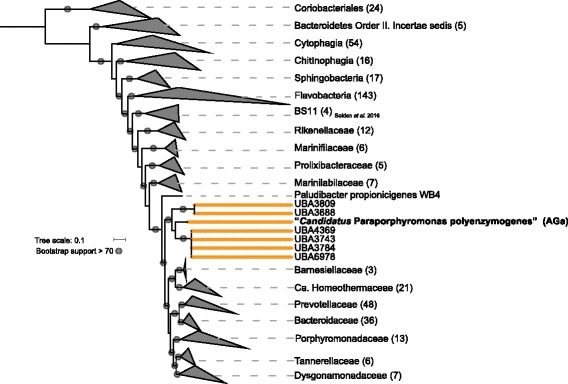
Fig. 1
Fig. 1
Concatenated ribosomal protein tree of the AGa genome and genomic representatives from the phylum Bacteroidetes. The Coriobacteriales within the Actinobacteria are also included as an outgroup. Clades are collapsed by family with the number of genomes denoted in parentheses next to the name. Family names follow the description by Ormerod et al. [62]. The newly proposed Ca. MH11 is highlighted in orange. Grey circles on the node represent bootstrap support > 70, using 100 bootstraps
Fig. 2
Fig. 2
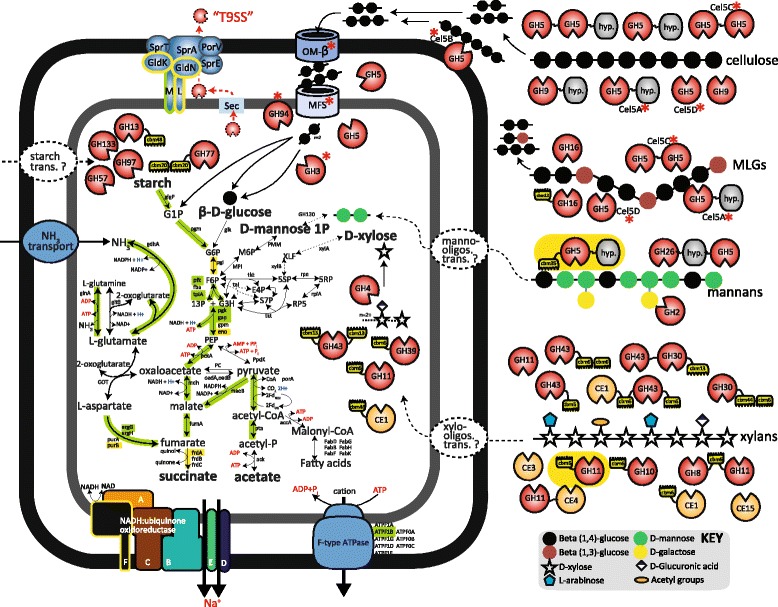
Selected metabolic features of “Candidatus Paraporphyromonas polyenzymogenes” (AGa) as inferred from genome and proteome comparisons. Graphical representation of pathways, enzymes, CAZymes, and cellular features are based on functional annotations listed in Additional file 2: Table S1. Ca. P. polyenzymogenes encoded glucose, mannose, and xylose fermentation capabilities, as well as CAZymes inferred in degradation of cellulose, mannans, and xylans. CAZymes located outside the cell are predicted to be secreted via the T9SS. Metaproteomic analysis (detected genes, enzyme complexes, and transport systems highlighted in green) indicated that Ca. P. polyenzymogenes was metabolically active in rumen samples, with proteins for glycolysis, succinate production, and ammonium metabolism detected, as well as components of the T9SS and T9SS-secreted multimodular CAZymes (details found in Additional file 2: Table S1, Additional file 7: Table S4). Features highlighted by yellow boxes indicate detected genes that were identified in only one sample (Additional file 7: Table S4). Hypothetical domains in multi-modular CAZymes are denoted by “hyp.”, and the red asterisks indicate CAZymes that were encoded in the gene cluster characterized in this study (Fig. 3). Broken lines indicate annotations for which representative genes were not identified in the respective reconstructed genomes. Further details on enzyme abbreviations, gene abbreviations, and identification numbers (Integrated Microbial Genomics gene ID) can be found in Additional file 2: Table S1. The abbreviations for central metabolites are PEP phosphoenolpyruvate, G1P glucose-1-phosphate, G6P glucose-6-phosphate, F6P fructose-6-phosphate, M6P mannose-6-phosphate, G3H d-glyceraldehyde 3-phosphate, E4P d-erythrose 4-phosphate, 5SP d-xylulose 5-phosphate, S7P sedoheptulose 7-phosphate, 5RP d-ribulose 5-phosphate, and RP5 d-ribose 5-phosphate
Fig. 3
Fig. 3
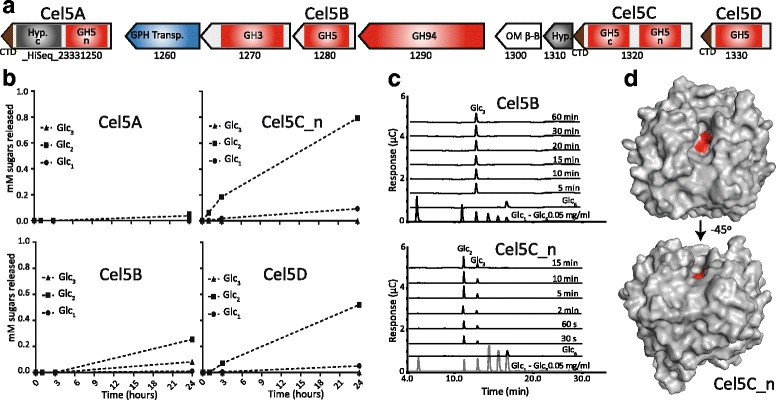
Ca. P. polyenzymogenes encodes a cellulolytic gene cluster. a Gene organisation of a putative cellulolytic gene cluster encoding four GH5s with varying modular arrangements. For multi-modular ORFs, both C-terminal (c) and N-terminal (n) domains are indicated, whereas “CTD” denotes a carboxy-terminal domain that infers export via T9SS. Hyp indicates domains with no known function. b Products released from crystalline cellulose (Avicel) by Cel5A, Cel5B, Cel5C_N, and Cel5D enzymes. A total of 1% (w/v) Avicel was incubated with 1 μM enzyme in 20 mM citrate buffer, pH 5.5 at 40 °C with 1000 rpm horizontal shaking. Products were analyzed by HPAEC-PAD at given time points after stopping the reactions by addition of NaOH to 0.1 M. Error bars represent standard deviations between three replicates (hidden by the markers). c Degradation of Glc(6) by Cel5B and Cel5C_N enzymes, illustrating differences in substrate specificity. Glc(6) (0.1 mg/ml) was incubated with 0.25 μM enzyme in 20 mM citrate buffer pH 5.5. Samples were taken at indicated intervals, and the reaction was stopped by adding NaOH to 0.1 M. Products were analyzed using HPAEC-PAD with cellodextrins as standards. A more complete analysis for all four cellulases shown in Additional file 13: Figure S7. d Crystal structure of Cel5C_N. Surface view of the structure, seen from above the active-site cleft, and − 45° rotated. The surface of the catalytic residues is shown in red. Figures were created using The PyMOL Molecular Graphics System, Version 1.3 Schrödinger, LLC

References

    1. Hackmann TJ, Spain JN. Invited review: ruminant ecology and evolution: perspectives useful to ruminant livestock research and production. J Dairy Sci. 2010;93:1320–1334. doi: 10.3168/jds.2009-2071. - DOI - PubMed
    1. Ding SY, Rincon MT, Lamed R, Martin JC, McCrae SI, Aurilia V, Shoham Y, Bayer EA, Flint HJ. Cellulosomal scaffoldin-like proteins from Ruminococcus flavefaciens. J Bacteriol. 2001;183:1945–1953. doi: 10.1128/JB.183.6.1945-1953.2001. - DOI - PMC - PubMed
    1. Horn SJ, Vaaje-Kolstad G, Westereng B, Eijsink VG. Novel enzymes for the degradation of cellulose. Biotechnol Biofuels. 2012;5:45. doi: 10.1186/1754-6834-5-45. - DOI - PMC - PubMed
    1. Burnet MC, Dohnalkova AC, Neumann AP, Lipton MS, Smith RD, Suen G, Callister SJ. Evaluating models of cellulose degradation by Fibrobacter succinogenes S85. PLoS One. 2015;10:1–19. doi: 10.1371/journal.pone.0143809. - DOI - PMC - PubMed
    1. Arntzen MØ, Várnai A, Mackie RI, Eijsink VGH, Pope PB. Outer membrane vesicles from Fibrobacter succinogenes S85 contain an array of carbohydrate-active enzymes with versatile polysaccharide-degrading capacity. Environ Microbiol. 2017;19:2701–2714. doi: 10.1111/1462-2920.13770. - DOI - PubMed

Publication types