


Identifying trial recruitment uncertainties using a James Lind Alliance Priority Setting Partnership - the PRioRiTy (Prioritising Recruitment in Randomised Trials) study
- PMID: 29490702
- PMCID: PMC5831203
- DOI: 10.1186/s13063-018-2544-4
Identifying trial recruitment uncertainties using a James Lind Alliance Priority Setting Partnership - the PRioRiTy (Prioritising Recruitment in Randomised Trials) study
Abstract
Background: Despite the problem of inadequate recruitment to randomised trials, there is little evidence to guide researchers on decisions about how people are effectively recruited to take part in trials. The PRioRiTy study aimed to identify and prioritise important unanswered trial recruitment questions for research. The PRioRiTy study - Priority Setting Partnership (PSP) included members of the public approached to take part in a randomised trial or who have represented participants on randomised trial steering committees, health professionals and research staff with experience of recruiting to randomised trials, people who have designed, conducted, analysed or reported on randomised trials and people with experience of randomised trials methodology.
Methods: This partnership was aided by the James Lind Alliance and involved eight stages: (i) identifying a unique, relevant prioritisation area within trial methodology; (ii) establishing a steering group (iii) identifying and engaging with partners and stakeholders; (iv) formulating an initial list of uncertainties; (v) collating the uncertainties into research questions; (vi) confirming that the questions for research are a current recruitment challenge; (vii) shortlisting questions and (viii) final prioritisation through a face-to-face workshop.
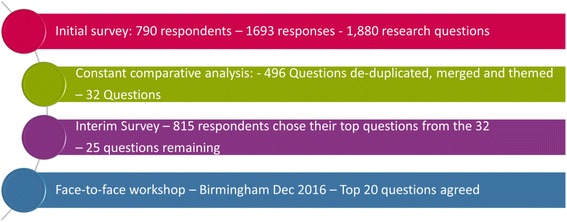
Results: A total of 790 survey respondents yielded 1693 open-text answers to 6 questions, from which 1880 potential questions for research were identified. After merging duplicates, the number of questions was reduced to 496. Questions were combined further, and those that were submitted by fewer than 15 people and/or fewer than 6 of the 7 stakeholder groups were excluded from the next round of prioritisation resulting in 31 unique questions for research. All 31 questions were confirmed as being unanswered after checking relevant, up-to-date research evidence. The 10 highest priority questions were ranked at a face-to-face workshop. The number 1 ranked question was "How can randomised trials become part of routine care and best utilise current clinical care pathways?" The top 10 research questions can be viewed at www.priorityresearch.ie .
Conclusion: The prioritised questions call for a collective focus on normalising trials as part of clinical care, enhancing communication, addressing barriers, enablers and motivators around participation and exploring greater public involvement in the research process.
Keywords: James Lind Alliance; Participation in randomised trials; Priority setting partnership; Recruitment challenges; Survey; Trial methodology.
Conflict of interest statement
Author information
Not applicable.
Ethics approval and consent to participate
Ethical approval was obtained for the PRioRiTy study from Galway University Hospitals Ethics Committee (C.A.1496 – PRioRiTy) Participants indicated written consent to participate at the beginning of the survey.
Consent for publication
Not applicable.
Competing interests
Prof Shaun Treweek is a senior Editor for Trials.
Publisher’s Note
Springer Nature remains neutral with regard to jurisdictional claims in published maps and institutional affiliations.
Figures
Comment in
-
Improving trial recruitment processes: how qualitative methodologies can be used to address the top 10 research priorities identified within the PRioRiTy study.Trials. 2018 Oct 25;19(1):584. doi: 10.1186/s13063-018-2964-1. Trials. 2018. PMID: 30359293 Free PMC article.
References
-
- McDonald AM, Knight RC, Campbell MK, Entwistle VA, Grant AM, Cook JA, Elbourne DR, Francis D, Garcia J, Roberts I, Snowdon C. What influences recruitment to randomised controlled trials? A review of trials funded by two UK funding agencies. Trials. 2006;7:9. doi: 10.1186/1745-6215-7-9. - DOI - PMC - PubMed
-
- Treweek S, Mitchell E, Pitkethly M, Cook J, Kjeldstrøm M, Johansen M, Taskila TK, Sullivan F, Wilson S, Jackson C, Jones R, Lockhart P. Strategies to improve recruitment to randomised controlled trials. Cochrane Database Syst Rev. 2010;(4):MR000013. 10.1002/14651858.MR000013.pub5. - PubMed
-
- Treweek S, Lockhart P, PitKethly M, Cook J, Kjeldstrøm M, Johansen M, Taskila T, Sullivan F, Wilson S, Jackson C, Jones R, Mitchell ED. Methods to improve recruitment to randomized controlled trials: Cochrane systematic review and meta-analysis. BMJ Open. 2013;3:e002360. doi: 10.1136/bmjopen-2012-002360. - DOI - PMC - PubMed
Publication types
MeSH terms
Grants and funding
LinkOut - more resources
Full Text Sources
Other Literature Sources
Miscellaneous
