


Sex Differences in the Association Between Measures of General and Central Adiposity and the Risk of Myocardial Infarction: Results From the UK Biobank
- PMID: 29490971
- PMCID: PMC5866342
- DOI: 10.1161/JAHA.117.008507
Sex Differences in the Association Between Measures of General and Central Adiposity and the Risk of Myocardial Infarction: Results From the UK Biobank
Abstract
Background: There are substantial differences in the distribution of adipose tissue between women and men. We assessed the sex-specific relationships and their differences between measures of general and central adiposity and the risk of incident myocardial infarction (MI).
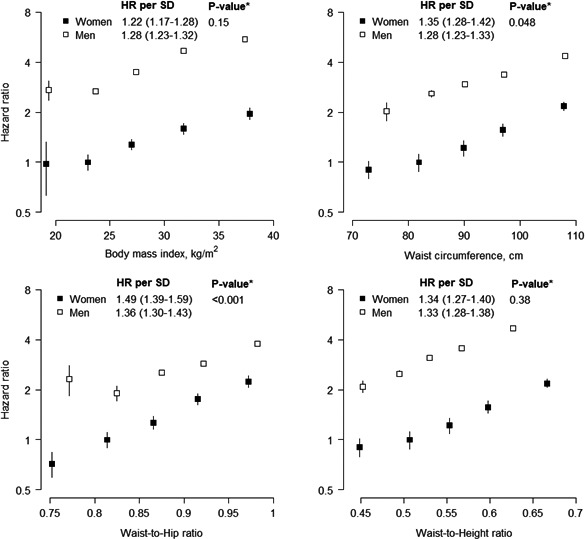
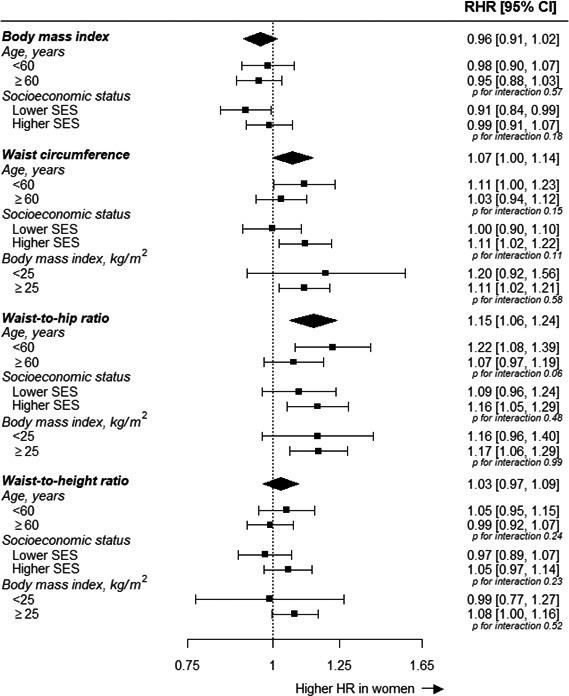
Methods and results: Between 2006 and 2010, the UK Biobank recruited over 500 000 participants aged 40 to 69 years across the United Kingdom. During 7 years of follow-up, 5710 cases of MI (28% women) were recorded among 265 988 women and 213 622 men without a history of cardiovascular disease at baseline. Cox regression models yielded adjusted hazard ratios for MI associated with body mass index, waist circumference, waist-to-hip ratio, and waist-to-height ratio. There was an approximate log-linear relationship between measures of general and central adiposity and the risk of MI in both sexes. A 1-SD higher in body mass index, waist circumference, waist-to-hip ratio, and waist-to-height ratio, respectively, were associated with hazard ratios (confidence intervals) for MI of 1.22 (1.17; 1.28), 1.35 (1.28; 1.42), 1.49 (1.39; 1.59), and 1.34 (1.27; 1.40) in women and of 1.28 (1.23; 1.32), 1.28 (1.23; 1.33), 1.36 (1.30; 1.43), and 1.33 (1.28; 1.38) in men. The corresponding women-to-men ratios of hazard ratios were 0.96 (0.91; 1.02), 1.07 (1.00; 1.14), 1.15 (1.06; 1.24), and 1.03 (0.97; 1.09).
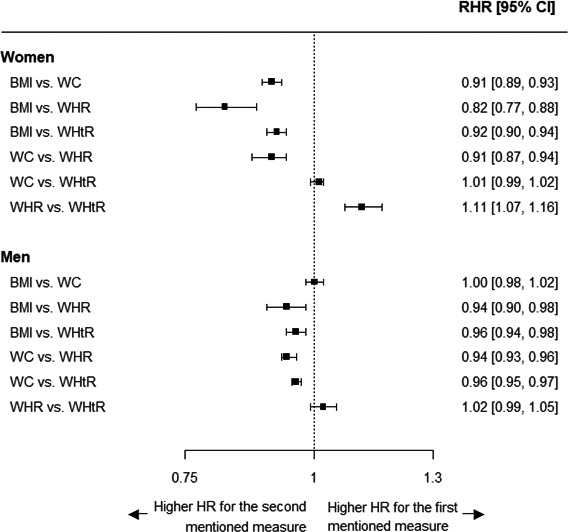
Conclusions: Although general and central adiposity measures each have profound deleterious effects on the risk of MI in both sexes, a higher waist circumference and waist-to-hip ratio conferred a greater excess risk of MI in women than in men. Waist-to-hip ratio was more strongly associated with the risk of MI than body mass index in both sexes, especially in women.
Keywords: adipose tissue; men; myocardial infarction; women.
© 2018 The Authors. Published on behalf of the American Heart Association, Inc., by Wiley.
Figures
References
-
- NCD Risk Factor Collaboration . 2017. Available at: http://www.ncdrisc.org/index.html. Accessed November 10, 2017.
-
- Institute for Health Metrics and Evaluation . GBD compare data visualization. 2016. Available at: http://vizhub.healthdata.org/gbd-compare. Accessed November 13, 2017.
-
- World Health Organization . Obesity and overweight. 2016. Available at: http://www.who.int/mediacentre/factsheets/fs311/en/. Accessed November 13, 2017.
-
- Ibrahim MM. Subcutaneous and visceral adipose tissue: structural and functional differences. Obes Rev. 2010;11:11–18. - PubMed
-
- Despres JP. Body fat distribution and risk of cardiovascular disease: an update. Circulation. 2012;126:1301–1313. - PubMed
Publication types
MeSH terms
Grants and funding
LinkOut - more resources
Full Text Sources
Other Literature Sources
Medical
