. 2018 Feb 28;8(1):3748.
doi: 10.1038/s41598-018-22166-3.

Pathways of cellular internalisation of liposomes delivered siRNA and effects on siRNA engagement with target mRNA and silencing in cancer cells

Affiliations

Pathways of cellular internalisation of liposomes delivered siRNA and effects on siRNA engagement with target mRNA and silencing in cancer cells

Abdullah Alshehri et al. Sci Rep. .

Erratum in

Abstract

Design of an efficient delivery system is a generally recognised bottleneck in translation of siRNA technology into clinic. Despite research efforts, cellular processes that determine efficiency of siRNA silencing achieved by different delivery formulations remain unclear. Here, we investigated the mechanism(s) of cellular internalisation of a model siRNA-loaded liposome system in a correlation to the engagement of delivered siRNA with its target and consequent silencing by adopting siRNA molecular beacon technology. Probing of cellular internalisation pathways by a panel of pharmacological inhibitors indicated that clathrin-mediated (dynamin-dependent) endocytosis, macropinocytosis (dynamine independent), and cell membrane cholesterol dependent process(es) (clathrin and caveolea-independent) all play a role in the siRNA-liposomes internalization. The inhibition of either of these entry routes was, in general, mirrored by a reduction in the level of siRNA engagement with its target mRNA, as well as in a reduction of the target gene silencing. A dramatic increase in siRNA engagement with its target RNA was observed on disruption of endosomal membrane (by chloroquine), accompanied with an increased silencing. The work thus illustrates that employing molecular beacon siRNA technology one can start to assess the target RNA engagement - a stage between initial cellular internalization and final gene silencing of siRNA delivery systems.


Conflict of interest statement

The authors declare no competing interests.

Figures
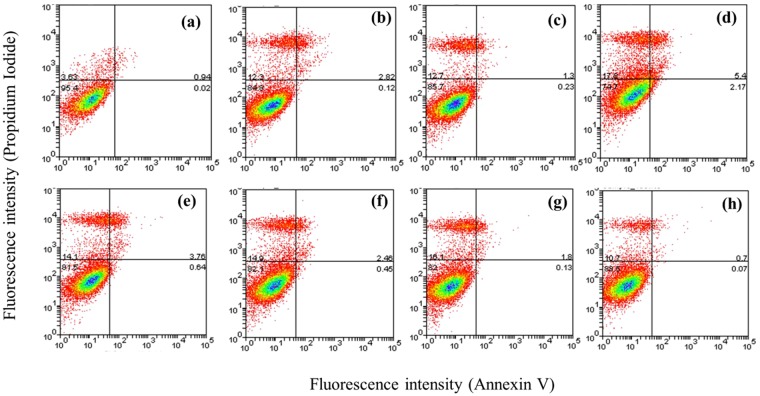
Figure 1
Figure 1
Flow cytometry dot plots of Cy3-Annexin/PI cytotoxicity test for siRNA-liposomes treatmet of A549 cells. Flow cytometry dot plots for necrosis (PI) and cell apoptosis (Cy3-Annexin) probes in A549 cells after 4 hours incubation with siRNA-liposomes at total lipid concentration of 1.0 mM, fixed N/P ratio of 3.125:1, and different DC-Chol:DOPE ratios: (b) 0.33:1, (c) 0.5:1, (d) 0.66:1, (e) 1:1, (f) 1.5:1, (g) 2:1 and (h) 3:1. A549 cells not treated with siRNA-liposomes used as negative control (a). The minimum 10,000 cells/sample analysed.
Figure 2
Figure 2
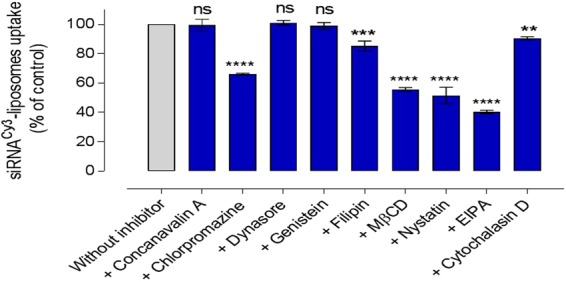
The effect of a panel of pharmacological inhibitors on the internalisation of cy3siRNA-liposomes in A549 cells. Cellular uptake of cy3siRNA-liposomes in absence (‘without inhibitor’ control) and presence of inhibitors, assessed by flow cytometry (MFI). Data represent the mean ± SD (N = 2, n = 4). **, *** and **** indicate a significant difference between the results (p < 0.01, p < 0.001 and p < 0.0001, respectively, and ns indicates the difference is non-statistically significant (p > 0.05) compared to the control without inhibitor treatment.
Figure 3
Figure 3
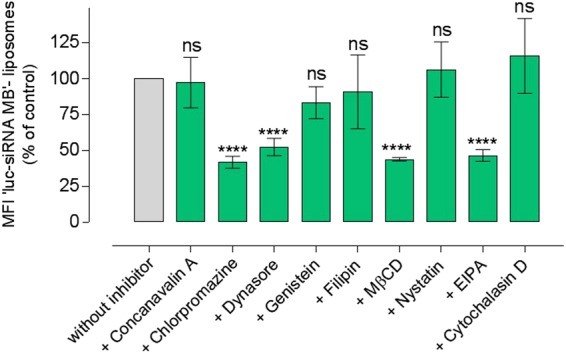
The effect of pharmacological inhibitors on the engagement of liposomes delivered luc-siRNA-molecular beacon (MB) with target mRNA in A549-luc cells. Luc-siRNA-liposomes prepared at an N/P ratio 3.125:1, DC-Chol:DOPE ratio of 1:1, applied at 1 μg of luc-siRNA per well and at 1 mM total lipid content. Fluorescence from flow cytometry experiments expressed relative to the control (cells without inhibitors representing 100%); data represent the mean ± SD (N = 2, n = 4), **** indicate a significant difference between the results (p < 0.0001) and ns indicates the difference is a non-statistically significant (p > 0.05) compared to the control. Confocal microscopy micrographs show cells treated with ‘luc-siRNA based Molecular Beacon’ (MB) liposomes in A549-luc cells in the absence or presence of certain inhibitors. Engaged ‘Luc-siRNA Molecular Beacon’ siRNA appears green, whereas nuclei appear blue, staining with DRAQ5.
Figure 4
Figure 4
The effect of pharmacological inhibitors on the luciferase knockdown by luc-siRNA-liposomes in A549-luc cells. Luc-siRNA-liposomes prepared at an N/P ratio 3.125:1, DC-Chol:DOPE ratio of 1:1, applied at 1 μg of luc-siRNA per well and 1 mM total lipid content. The luciferase activity assessed after 48 hours. Luciferase knockdown relative to the control (cells without inhibitors as 100%), data represents the mean ± SD (N = 2, n = 4), **** indicate a significant difference between the results (p < 0.0001) and ns indicates the difference is a non-statistically significant (p > 0.05) compared to the control.
Figure 5
Figure 5
The effect of endosomolytic agent, chloroquine, on the engagement of liposomes delivered luc-siRNA-molecular beacon (MB) with target mRNA luciferase and luciferase knockdown in A549-luc cells. luc-siRNA-liposomes prepared at an N/P ratio of 3.125:1, a DC-Chol: DOPE ratio of 1:1. Liposomes applied in the presence of chloroquine (100 μg/ml). Data presented relative to appropriate control, cells without chloroquine taken as 100%. Data represent the mean ± SD (N = 2, n = 4), **** indicate a significant difference between the results (p < 0.0001) and ns indicates the difference is a non-statistically significant (p > 0.05) compared to the control.

References

    1. Kumar LD, Clarke AR. Gene manipulation through the use of small interfering RNA (siRNA): from in vitro to in vivo applications. Advanced Drug Delivery Reviews. 2007;59:87–100. doi: 10.1016/j.addr.2007.03.009. - DOI - PubMed
    1. Hughes J, Yadava P, Mesaros R. Liposomal siRNA delivery. Methods in Molecular Biology. 2010;605:445–459. doi: 10.1007/978-1-60327-360-2_31. - DOI - PubMed
    1. Oh Y-K, Park TG. siRNA delivery systems for cancer treatment. Advanced Drug Delivery Reviews. 2009;61:850–862. doi: 10.1016/j.addr.2009.04.018. - DOI - PubMed
    1. Torchilin VP. Recent advances with liposomes as pharmaceutical carriers. Nature Reviews. Drug Discovery. 2005;4:145–60. doi: 10.1038/nrd1632. - DOI - PubMed
    1. Miller AD. Nonviral liposomes. Methods in Molecular Medicine. 2004;90:107–137. - PubMed

Publication types

LinkOut - more resources