


Quantitative account of social interactions in a mental health care ecosystem: cooperation, trust and collective action
- PMID: 29491363
- PMCID: PMC5830605
- DOI: 10.1038/s41598-018-21900-1
Quantitative account of social interactions in a mental health care ecosystem: cooperation, trust and collective action
Erratum in
-
Author Correction: Quantitative account of social interactions in a mental health care ecosystem: cooperation, trust and collective action.Sci Rep. 2018 Sep 26;8(1):14595. doi: 10.1038/s41598-018-32562-4. Sci Rep. 2018. PMID: 30254291 Free PMC article.
Abstract
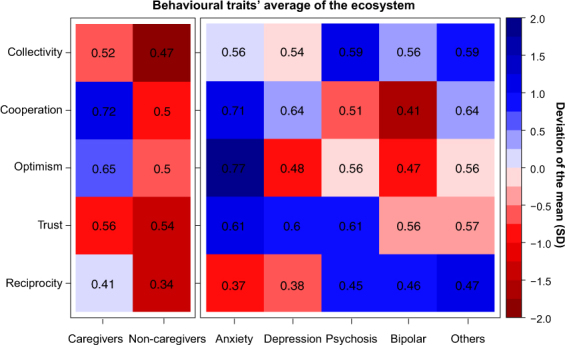
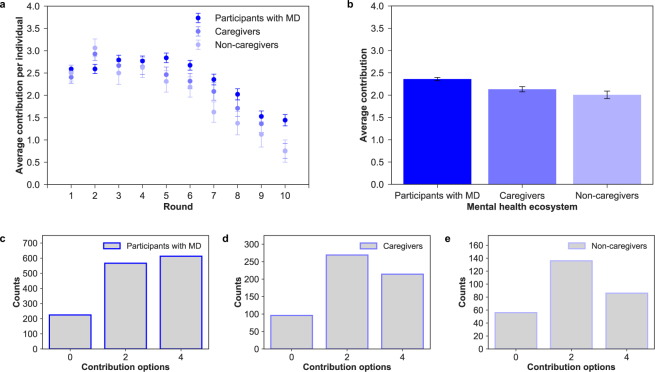
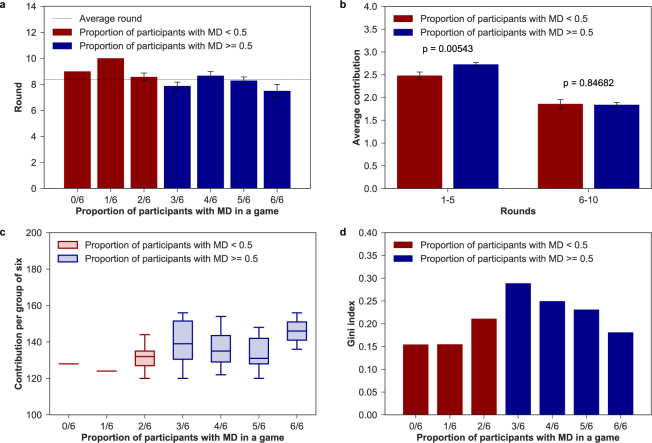
Mental disorders have an enormous impact in our society, both in personal terms and in the economic costs associated with their treatment. In order to scale up services and bring down costs, administrations are starting to promote social interactions as key to care provision. We analyze quantitatively the importance of communities for effective mental health care, considering all community members involved. By means of citizen science practices, we have designed a suite of games that allow to probe into different behavioral traits of the role groups of the ecosystem. The evidence reinforces the idea of community social capital, with caregivers and professionals playing a leading role. Yet, the cost of collective action is mainly supported by individuals with a mental condition - which unveils their vulnerability. The results are in general agreement with previous findings but, since we broaden the perspective of previous studies, we are also able to find marked differences in the social behavior of certain groups of mental disorders. We finally point to the conditions under which cooperation among members of the ecosystem is better sustained, suggesting how virtuous cycles of inclusion and participation can be promoted in a 'care in the community' framework.
Conflict of interest statement
The authors declare no competing interests.
Figures
References
-
- Insel, T. R., Collins, P. Y. & Hyman, S. E. Darkness invisible: The hidden global costs of mental illness. Foreign Affairs 94 (2015).
-
- White Ross G., Orr David M. R., Read Ursula M., Jain Sumeet. The Palgrave Handbook of Sociocultural Perspectives on Global Mental Health. London: Palgrave Macmillan UK; 2017. Situating Global Mental Health: Sociocultural Perspectives; pp. 1–27.
-
- World Health Organisation. The World Health Report 2001: mental health, new understanding, new hope. World Health Report 1–169 (2001).
-
- American Psychiatric Association. Diagnostic and statistical manual of mental disorders. Diagnostic and Statistical Manual of Mental Disorders 4th edition TR. (2000).
Publication types
MeSH terms
LinkOut - more resources
Full Text Sources
Other Literature Sources
Medical
