


Comorbidity in US patients with multiple sclerosis
- PMID: 29491723
- PMCID: PMC5815483
- DOI: 10.2147/PROM.S148387
Comorbidity in US patients with multiple sclerosis
Abstract
Objective: To assess the trends in the prevalence of comorbidities in US patients with multiple sclerosis (MS), and the association of demographic characteristics with the presence of comorbidities.
Study design: A retrospective analysis was conducted from a sample of 5 million patients from the IMS Health Real World Data Adjudicated Claims - US database.
Methods: Comorbidity in patients with MS was assessed by year (2006-2014), and logistic regression models evaluated the association of age, sex, and region with select comorbidities.
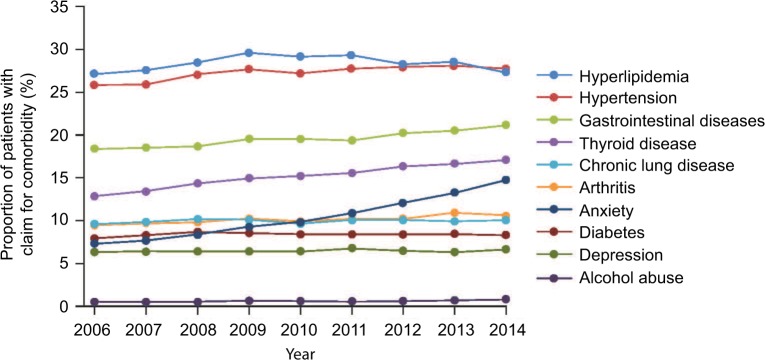
Results: The most common comorbidities from 2006 to 2014 were hyperlipidemia and hypertension (25.9%-29.7% of patients within an individual year), followed by gastrointestinal disease (18.4%-21.2% of patients) and thyroid disease (12.9%-17.1% of patients). The proportion with a claim for hyperlipidemia increased from 2006 to 2009, was stable from 2009 to 2011, and then declined from 2011 to 2014. The proportion with a claim for hypertension generally increased from 2006 to 2013, then declined from 2013 to 2014. The proportion with a claim for gastrointestinal disease, thyroid disease, and anxiety generally increased from 2006 to 2014. Claims for comorbidities were statistically significantly more likely among older age groups (p<0.05), with the exception of anxiety and alcohol abuse, which were statistically significantly less likely among older age groups. Claims for gastrointestinal disease (OR=0.75), thyroid disease (OR=0.36), chronic lung disease (OR=0.76), arthritis (OR=0.71), anxiety (OR=0.63), and depression (OR=0.69) were statistically significantly less likely among males versus females (all p<0.05). Claims for hyperlipidemia (OR=1.39), hypertension (OR=1.25), diabetes (OR=1.31), and alcohol abuse (OR=2.41) were significantly more likely among males (p<0.05). Many comorbidity claims were statistically significantly more likely in the Northeast and South compared with the Midwest and West.
Conclusion: This study provides select comorbidity claims estimates in US patients with MS, and thus highlights the importance of comprehensive patient care approaches.
Keywords: comorbidities; disease-modifying drugs; multiple sclerosis; prevalence.
Conflict of interest statement
Disclosure NCE has received compensation as a Health Services Research Consultant. MM and JM received research support from EMD Serono, Inc., for the presented analysis. ALP is an employee of EMD Serono, Inc., Rockland, MA, USA (a business of Merck KGaA, Darmstadt, Germany). The authors report no other conflicts of interest in this work.
Figures
References
-
- Luessi F, Siffrin V, Zipp F. Neurodegeneration in multiple sclerosis: novel treatment strategies. Expert Rev Neurother. 2012;12(9):1061–1076. - PubMed
-
- nationalmssociety.org [homepage on the Internet] MS Prevalence. National Multiple Sclerosis Society; [Accessed January 25, 2018]. Available from: http://www.nationalmssociety.org/About-the-Society/MS-Prevalence.
-
- Multiple Sclerosis International Federation . Atlas of MS 2013. Multiple Sclerosis International Federation; [Accessed January 25, 2018]. Available from: http://www.msif.org/wp-content/uploads/2014/09/Atlas-of-MS.pdf.
-
- nationalmssociety.org [homepage on the Internet] How Common Is It To Have MS With Other Medical Conditions? First Results from the MS “Comorbidities” Project. National Multiple Sclerosis Society; 2015. [Accessed January 25, 2018]. Available from: http://www.nationalmssociety.org/About-the-Society/News/How-Common-Is-It....
LinkOut - more resources
Full Text Sources
Other Literature Sources
