


Higher frequency of hamstring injuries in elite track and field athletes who had a previous injury to the ankle - a 17 years observational cohort study
- PMID: 29492109
- PMCID: PMC5828071
- DOI: 10.1186/s13047-018-0247-4
Higher frequency of hamstring injuries in elite track and field athletes who had a previous injury to the ankle - a 17 years observational cohort study
Abstract
Background: Inversion injury to the ankle and hamstring injuries are common problems in most sports. It is not known whether these injuries constitute a predisposing factor or a precursor of injury or re-injury of these anatomical locations. Therefore, we wished to test the hypothesis that a previous inversion ankle injury exerted a significant effect on the chance of an athlete suffering from a subsequent ipsilateral hamstring injury and vice versa.
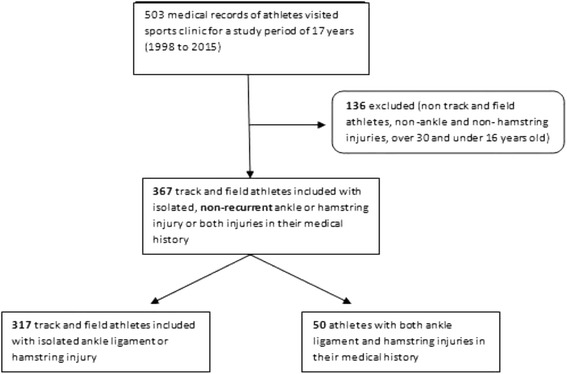
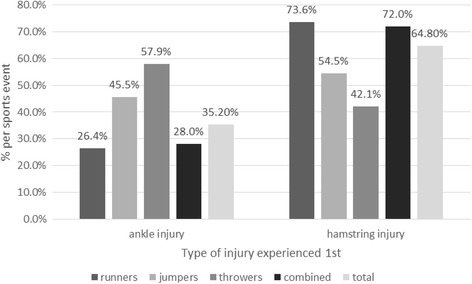
Methods: In an observational cohort study over 17 years (1998-2015), 367 elite track and field athletes, were grouped according to their first traumatic isolated ankle or hamstring injury. Fifty athletes experienced both injuries. The Mann-Whitney U and Chi-square tests (p < 0.05) were performed to test possible associations of ankle and hamstring injury with age, gender, athletics discipline, grade, and type of antecedent injury.
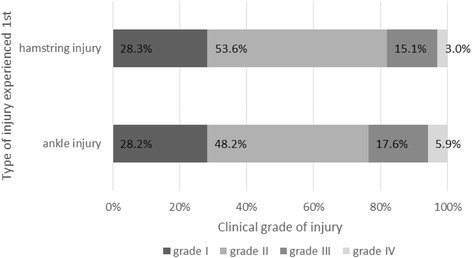
Results: Athletes with a preceding ankle injury had a statistically significantly higher chance of experiencing a subsequent hamstring injury compared with athletes who had experienced a hamstring injury as their first traumatic event (x2 = 4.245, p = 0.039). The proportion of both ankle and hamstring injury events was not statistically different between female (18%) and male (11%) athletes. Age and grade of injury did not influence the proportion of ankle and/or hamstring injury events.
Conclusion: There is a statistically significantly higher frequency of hamstring injuries in elite track and field athletes having experienced a previous ankle ligament injury.
Keywords: Ankle injuries; Hamstring injuries; Sports injuries; Track and field athletes.
Conflict of interest statement
Ethical approval for this retrospective uncontrolled study was granted and approved by the Greek Track and Field Federation Review Board. ART No. 1998–11. All athletes provided written informed consent prior to participating in the study.Participants and Greek Track and Field Federation were aware that findings will be disseminated at conferences and results will be published.The authors declare that they have no competing interests.Springer Nature remains neutral with regard to jurisdictional claims in published maps and institutional affiliations.
Figures

References
Publication types
MeSH terms
LinkOut - more resources
Full Text Sources
Other Literature Sources
Medical
