


Health-related quality of life and economic burden of vestibular loss in older adults
- PMID: 29492463
- PMCID: PMC5824117
- DOI: 10.1002/lio2.129
Health-related quality of life and economic burden of vestibular loss in older adults
Abstract
Objectives: Vestibular loss is a debilitating condition, and despite its high prevalence in older adults, the quality of life (QoL) burden of vestibular loss in older individuals has not been well-studied. This report quantifies the impact on overall QoL and identifies domains of health most affected. We hypothesize vestibular loss will be associated with impairment in diverse domains of health-related QoL.
Study design: Prospective, case-control study.
Methods: A convenience sample of 27 patients age ≥60 years with vestibular physiologic loss was recruited from an academic neurotology clinic. The patients did not have any identifiable cause of their vestibular loss other than aging. The convenience sample was compared to an age-matched cross-sectional sample of the general US population (n = 1266). The main outcome was QoL measured by the Ontario Health Utilities Index Mark III (HUI3).
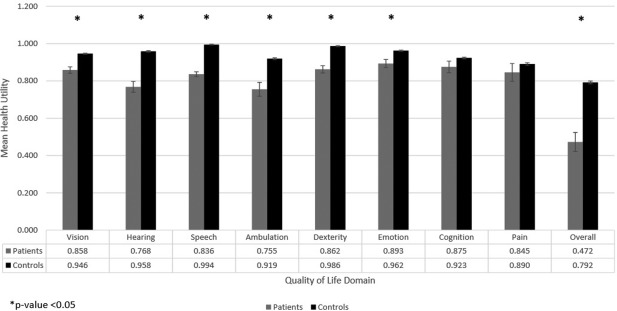
Results: Compared to the general population, patients with vestibular loss had significantly lower overall unadjusted HUI3 scores (-0.32, p < 0.001). Multivariate regression analysis showed vestibular loss was significantly associated with poorer performance in vision (-0.11 p < 0.0001), speech (-0.15, p < 0.0001), dexterity (-0.13, p < 0.0001), and emotion (-0.07, p = 0.0065). Adjusted aggregate HUI3 was also significantly lower for vestibular loss (-0.15, p = 0.0105). These QoL decrements resulted in an average loss of 1.30 Quality-Adjusted Life Years (QALYs). When using a $50,000/QALY willingness-to-pay threshold, vestibular loss was associated with a $64,929 lifetime economic burden per affected older adult, resulting in a total lifetime societal burden of $227 billion for the US population ≥60 years of age.
Conclusions: Loss of vestibular function with aging significantly decreases quality of life across multiple domains of well-being. These QoL reductions are responsible for heavy societal economic burdens of vestibular loss, which reveal potential benefits of prompt diagnosis and treatment of this condition.
Level of evidence: 3.
Keywords: Vestibular loss; aging; health‐related quality of life.
Figures
References
-
- Agrawal Y, Carey JP, Della Santina CC, Schubert MC, Minor LB. Disorders of balance and vestibular function in US adults: data from the National Health and Nutrition Examination Survey, 2001–2004. Arch Intern Med 2009;169(10):938–944. - PubMed
-
- Neuhauser HK, Radtke A, von Brevern M, Lezius F, Feldmann M, Lempert T. Burden of dizziness and vertigo in the community. Arch Intern Med 2008;168(19):2118–2124. - PubMed
-
- Whitehead SJ, Ali S. Health outcomes in economic evaluation: the QALY and utilities. Br Med Bull 2010;96(1):5–21. - PubMed
Grants and funding
LinkOut - more resources
Full Text Sources
Other Literature Sources
Research Materials