Practice Guideline
. 2018 Aug;28(8):3125-3137.
doi: 10.1007/s00330-017-5157-5. Epub 2018 Feb 28.

European Society of Urogenital Radiology (ESUR) Guidelines: MR Imaging of Leiomyomas

Affiliations
Practice Guideline

European Society of Urogenital Radiology (ESUR) Guidelines: MR Imaging of Leiomyomas

Rahel A Kubik-Huch et al. Eur Radiol. 2018 Aug.

Abstract

Objective: The aim of the Female Pelvic Imaging Working Group of the European Society of Urogenital Radiology (ESUR) was to develop imaging guidelines for MR work-up in patients with known or suspected uterine leiomyomas.

Methods: Guidelines for imaging uterine leiomyomas were defined based on a survey distributed to all members of the working group, an expert consensus meeting at European Congress of Radiology (ECR) 2017 and a critical review of the literature.

Results: The 25 returned questionnaires as well as the expert consensus meeting have shown reasonable homogeneity of practice among institutions. Expert consensus and literature review lead to an optimized MRI protocol to image uterine leiomyomas. Recommendations include indications for imaging, patient preparation, MR protocols and reporting criteria. The incremental value of functional imaging (DWI, DCE) is highlighted and the role of MR angiography discussed.

Conclusions: MRI offers an outstanding and reproducible map of the size, site and distribution of leiomyomas. A standardised imaging protocol and method of reporting ensures that the salient features are recognised. These imaging guidelines are based on the current practice among expert radiologists in the field of female pelvic imaging and also incorporate essentials of the current published MR literature of uterine leiomyomas.

Key points: • MRI allows comprehensive mapping of size and distribution of leiomyomas. • Basic MRI comprise T2W and T1W sequences centered to the uterus. • Standardized reporting ensures pivotal information on leiomyomas, the uterus and differential diagnosis. • MRI aids in differentiation of leiomyomas from other benign and malignant entities, including leiomyosarcoma.

Keywords: Genital diseases female; Guideline; Leiomyoma; Magnetic resonance imaging; Uterus.


Conflict of interest statement

Guarantor

The scientific guarantor of this publication is Professor Rosemarie Forstner, Salzburg, Austria

Conflict of interest

The authors of this manuscript declare no relationships with any companies, whose products or services may be related to the subject matter of the article.

Statistics and biometry

No complex statistical methods were necessary for this paper.

Informed consent

Written informed consent was not required for this study because no patient sensitive data were used

Ethical approval

Institutional Review Board approval was not required because the results are based on a survey only.

Methodology

• prospective

• observational

• multicentre study

Figures
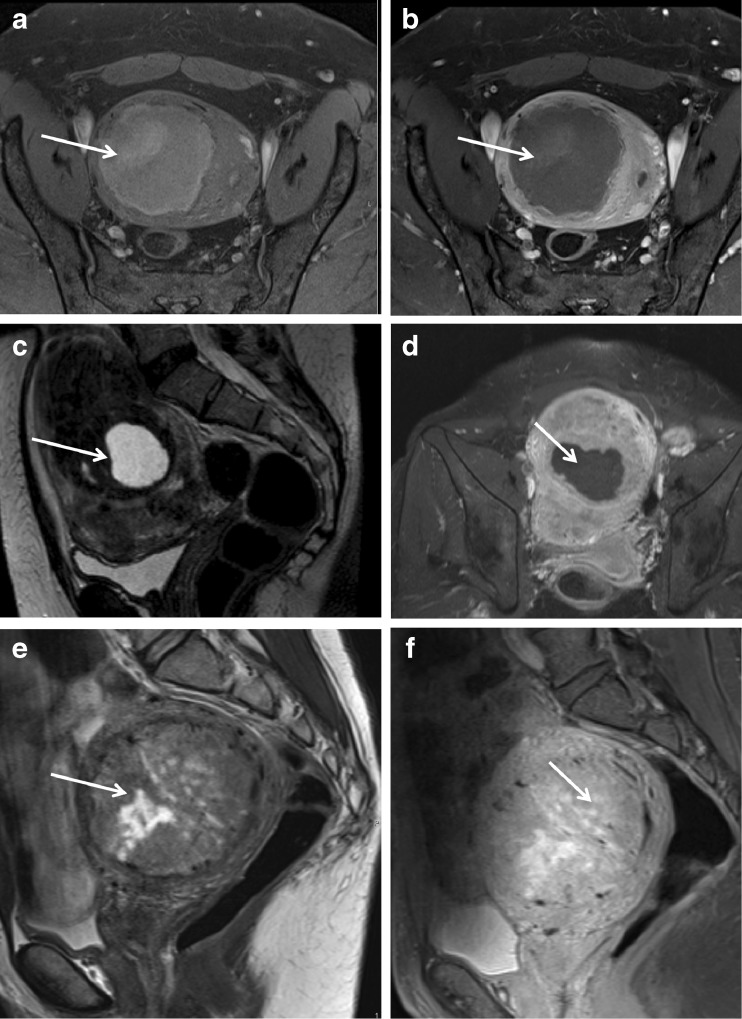
Fig. 1
Fig. 1
Different aspects of leiomyoma degeneration: Hemorrhagic degeneration after UFE. Axial T1-weighted fat saturated images, before (a) and after gadolinium administration (b) show a leiomyoma with increased signal on T1 and lack of enhancement, consistent with hemorrhagic degeneration. Cystic degeneration. Sagittal T2-weighted (c) and axial T1-weighted fat saturated contrast enhanced (d) images show a leiomyoma presenting a peripheral area with high T2 intensity signal and no enhancement, consistent with cystic degeneration (arrows). Myxoid degeneration. Sagittal T2-weighted (e) and T1-weighted fat saturated contrast enhanced (f) images show a leiomyoma presenting areas with high T2 intensity signal and enhancement after gadolinium administration (in contrast with the cystic degeneration), suggesting myxoid degeneration (arrows)
Fig. 2
Fig. 2
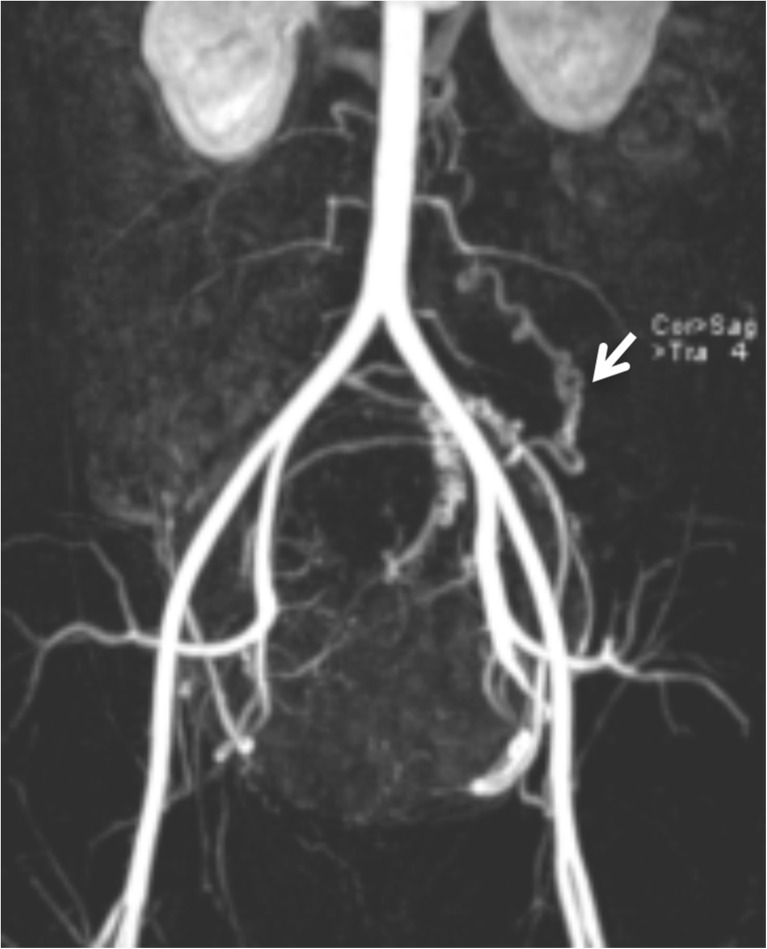
Ovarian artery parasitation. 3D reconstructed MRA image depicts an enlarged left ovarian artery (arrow) extending from the aorta to the pelvic midline, where a bulky leiomyoma is located, apparently contributing to the leiomyoma supply. Note the typical corkscrew appearance of the ovarian artery. The right ovarian artery is not seen as the normal caliber ovarian arteries are too small to be depicted by this imaging modality
Fig. 3
Fig. 3
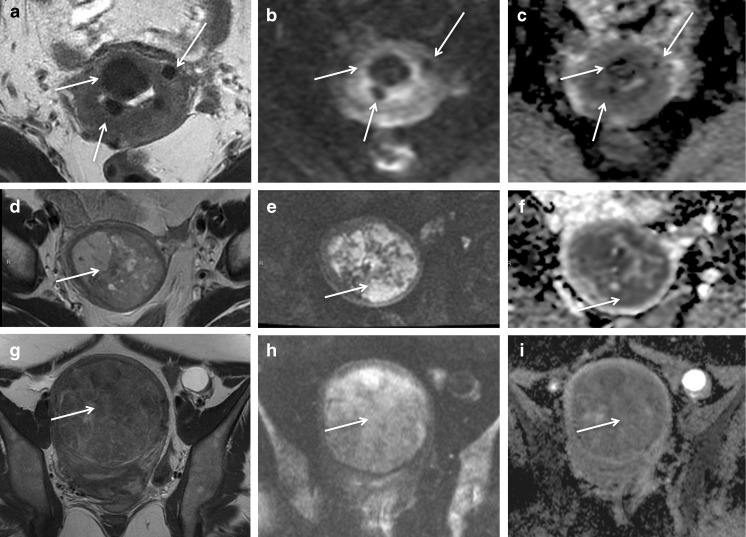
Leiomyomas and DWI. Oblique-axial T2-weighted (a) and b=800 diffusion-weighted (b) MR images and apparent diffusion coefficient map (c) of pelvis show multiple uterine leiomyomas (white arrows) that are hypointense in all three sequences, the so-called T2 blackout effect. (d) Axial T2-weighted MR image shows a heterogeneous hyperintense lesion (white arrow). (e) Axial diffusion-weighted MR image at b=800 shows large areas of increased signal intensity (white arrow) in mass. (f) Apparent diffusion coefficient map shows restriction (white arrow). The measured ADC is 0.7. Histopathologic examination confirmed the diagnosis of leiomyosarcoma. (g) Oblique axial T2-weighted MR image shows a well-defined lesion (white arrow) of intermediate to high signal intensity. (h) and (i), Oblique-axial diffusion-weighted image (b=800) shows high signal intensity (white arrow) and restriction on the corresponding ADC map (white arrow), with a measured ADC of 1.25. Histopathologic result was cellular leiomyoma
Fig. 4
Fig. 4
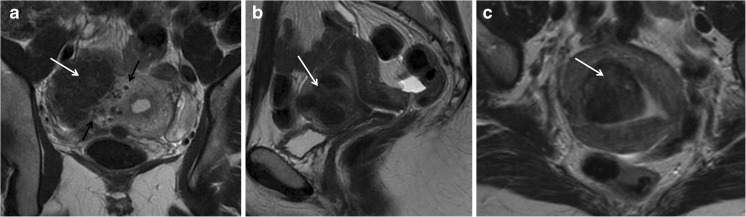
Leiomyoma FIGO classification according to LM location: (a) Axial oblique T2-weighted image showing a subserosal leiomyoma being less than 50% intramural (MRI FIGO 6) (white arrow). Note the bridging vessels feeding the lesion (black arrow). (b) Sagittal T2-weighted image showing an intramural leiomyoma (MRI FIGO 4). (c) Axial oblique T2-weighted image shows a submucosal leiomyoma being less than 50% intramural (MRI FIGO 1)
Fig. 5
Fig. 5
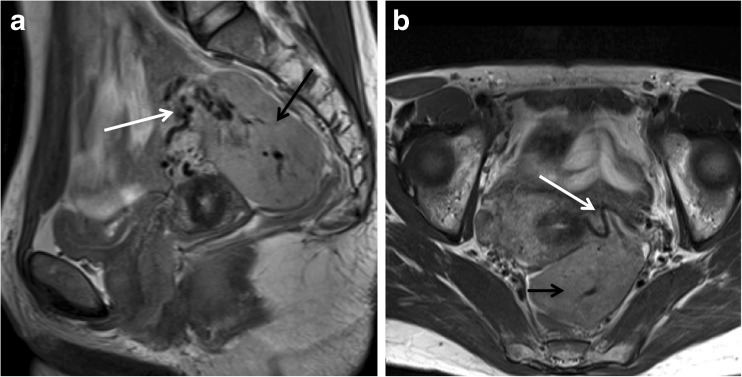
Sagittal and axial T2-weighted images showing a pedunculated subserosal leiomyoma (MRI FIGO 7) within the pouch of Douglas (black arrow). The bridging vessels sign confirms the uterine origin of the mass (white arrow)
Fig. 6
Fig. 6
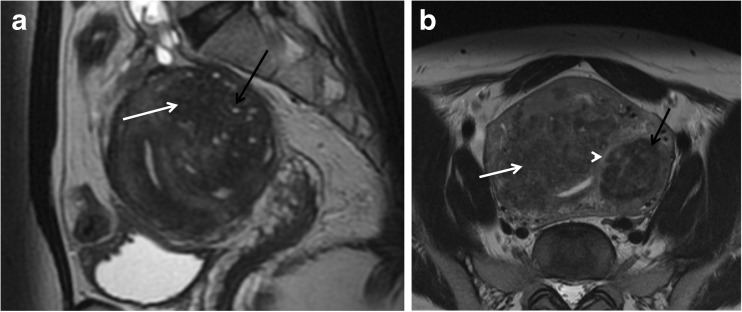
Differences between leiomyomas and adenomyoma/adenomyosis. (a) Sagittal T2W image shows a poorly defined border, oval-shaped, low-signal mass (white arrow) with hyperintense T2 foci embedded in the lesion (black arrow), consistent with an adenomyoma. (b) Axial oblique T2W image demonstrates an ill-defined thickening of the junctional zone with hyperintense T2 foci, consistent with adenomyosis (white arrow). Nearby there is a T2 hypointense lesion, with a well-defined margin in keeping with an intramural leiomyoma (black arrow). Notice the thin T2 hyperintense rim surrounding the lesion, indicating a pseudocapsule of edema secondary to some degree of venous or lymphatic obstruction, typical for leiomyomas (arrowhead). Coexistence of adenomyosis and leiomyomas is not rare

References

    1. Gupta S. Manyonda IT (2009) Acute complications of fibroids. Best Pract Res Clin Obstet Gynaecol. 2009;23:609–617. doi: 10.1016/j.bpobgyn.2009.01.012. - DOI - PubMed
    1. Roche O, Chavan N, Aquilina J, Rockall A. Radiological appearances of gynecological emergencies. Insights Imaging. 2012;3:265–275. doi: 10.1007/s13244-012-0157-0. - DOI - PMC - PubMed
    1. Spencer JA, Forstner R, Cunha TM, Kinkel K. ESUR guidelines for MR imaging of the sonographically indeterminate adnexal mass: an algorithmic approach. Eur Radiol. 2009;20:25–35. doi: 10.1007/s00330-009-1584-2. - DOI - PubMed
    1. Silberzweig JE, Powell DK, Matsumoto AH, Spies JB. Management of uterine fibroids: a focus on uterine-sparing interventional techniques. Radiology. 2016;280:675–692. doi: 10.1148/radiol.2016141693. - DOI - PubMed
    1. Spielmann AL, Keogh C, Forster BB, Martin ML, Machan LS. Comparison of MRI and sonography in the preliminary evaluation for fibroid embolization. AJR Am J Roentgenol. 2006;187:1499–1504. doi: 10.2214/AJR.05.1476. - DOI - PubMed

Publication types