Tegumentary leishmaniasis and coinfections other than HIV
- PMID: 29494584
- PMCID: PMC5832191
- DOI: 10.1371/journal.pntd.0006125
Tegumentary leishmaniasis and coinfections other than HIV
Abstract
Background: Tegumentary leishmaniasis (TL) is a disease of skin and/or mucosal tissues caused by Leishmania parasites. TL patients may concurrently carry other pathogens, which may influence the clinical outcome of TL.
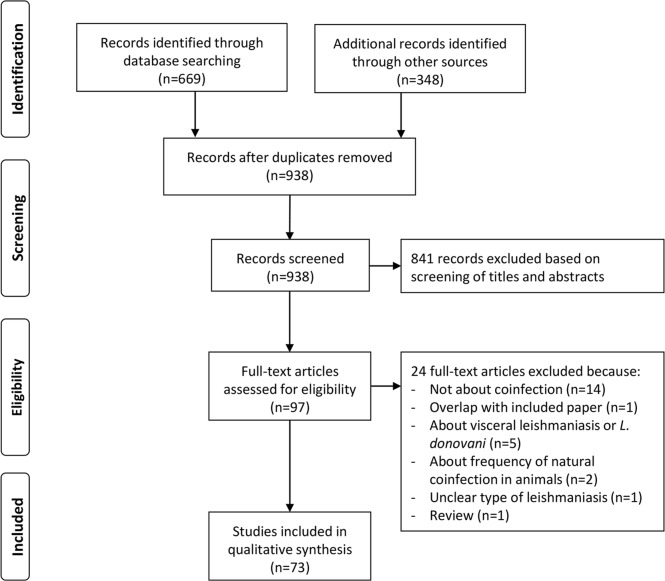
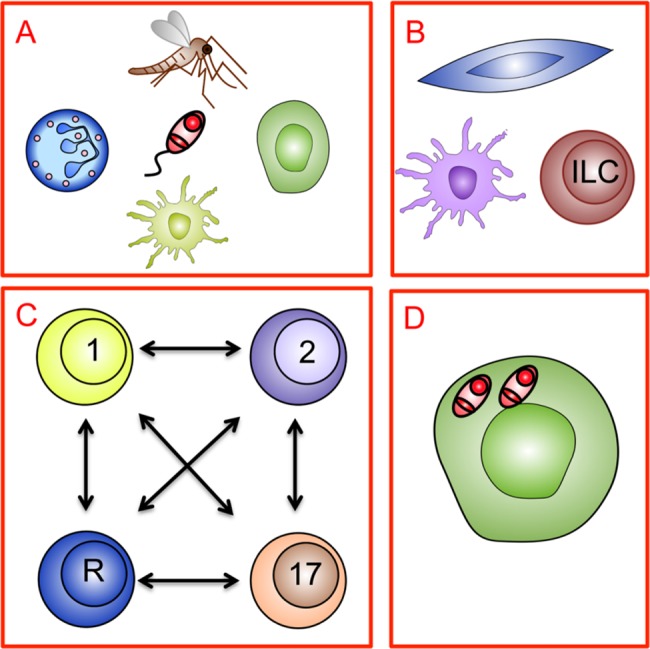
Methodology and principal findings: This review focuses on the frequency of TL coinfections in human populations, interactions between Leishmania and other pathogens in animal models and human subjects, and implications of TL coinfections for clinical practice. For the purpose of this review, TL is defined as all forms of cutaneous (localised, disseminated, or diffuse) and mucocutaneous leishmaniasis. Human immunodeficiency virus (HIV) coinfection, superinfection with skin bacteria, and skin manifestations of visceral leishmaniasis are not included. We searched MEDLINE and other databases and included 73 records: 21 experimental studies in animals and 52 studies about human subjects (mainly cross-sectional and case studies). Several reports describe the frequency of Trypanosoma cruzi coinfection in TL patients in Argentina (about 41%) and the frequency of helminthiasis in TL patients in Brazil (15% to 88%). Different hypotheses have been explored about mechanisms of interaction between different microorganisms, but no clear answers emerge. Such interactions may involve innate immunity coupled with regulatory networks that affect quality and quantity of acquired immune responses. Diagnostic problems may occur when concurrent infections cause similar lesions (e.g., TL and leprosy), when different pathogens are present in the same lesions (e.g., Leishmania and Sporothrix schenckii), or when similarities between phylogenetically close pathogens affect accuracy of diagnostic tests (e.g., serology for leishmaniasis and Chagas disease). Some coinfections (e.g., helminthiasis) appear to reduce the effectiveness of antileishmanial treatment, and drug combinations may cause cumulative adverse effects.
Conclusions and significance: In patients with TL, coinfection is frequent, it can lead to diagnostic errors and delays, and it can influence the effectiveness and safety of treatment. More research is needed to unravel how coinfections interfere with the pathogenesis of TL.
Conflict of interest statement
The authors have declared that no competing interests exist.
Figures
References
-
- Akhoundi M, Kuhls K, Cannet A, Votypka J, Marty P, Delaunay P, et al. A Historical overview of the classification, evolution, and dispersion of Leishmania parasites and sandflies. PLoS Negl Trop Dis. 2016;10(3):e0004349 doi: 10.1371/journal.pntd.0004349 - DOI - PMC - PubMed
-
- Murray H, Berman J, Davies C, Saravia N. Advances in leishmaniasis. Lancet. 2005;366(9496):1561–1577. doi: 10.1016/S0140-6736(05)67629-5 - DOI - PubMed
-
- Reithinger R, Dujardin JC, Louzir H, Pirmez C, Alexander B, Brooker S. Cutaneous leishmaniasis. Lancet Infect Dis. 2007;7(9):581–596. doi: 10.1016/S1473-3099(07)70209-8 - DOI - PubMed
-
- Cromptom DWT, editor (World Health Organization/Department of control of neglected tropical diseases). Sustaining the drive to overcome the global impact of neglected tropical diseases: second WHO report on neglected tropical diseases. Geneva: World Health Organization; 2013. 140 p. [Cited on 7 February 2018]. Available from: http://www.who.int/neglected_diseases/9789241564540/en/.
-
- O'Neal SE, Guimarães LH, Machado PR, Alcântara L, Morgan DJ, Passos S, et al. Influence of helminth infections on the clinical course of and immune response to Leishmania braziliensis cutaneous leishmaniasis. J Infect Dis. 2007;195(1):142–148. doi: 10.1086/509808 - DOI - PubMed
Publication types
MeSH terms
Grants and funding
LinkOut - more resources
Full Text Sources
Other Literature Sources
Molecular Biology Databases