


The effect of increasing the sulfation level of chondroitin sulfate on anticoagulant specific activity and activation of the kinin system
- PMID: 29494632
- PMCID: PMC5832253
- DOI: 10.1371/journal.pone.0193482
The effect of increasing the sulfation level of chondroitin sulfate on anticoagulant specific activity and activation of the kinin system
Abstract
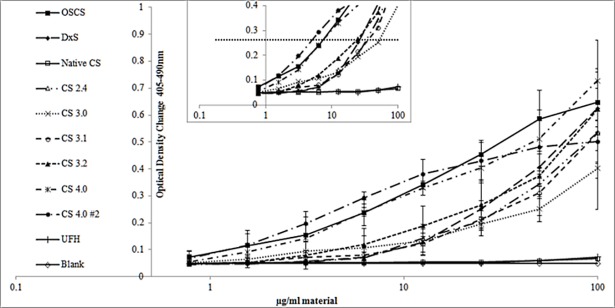
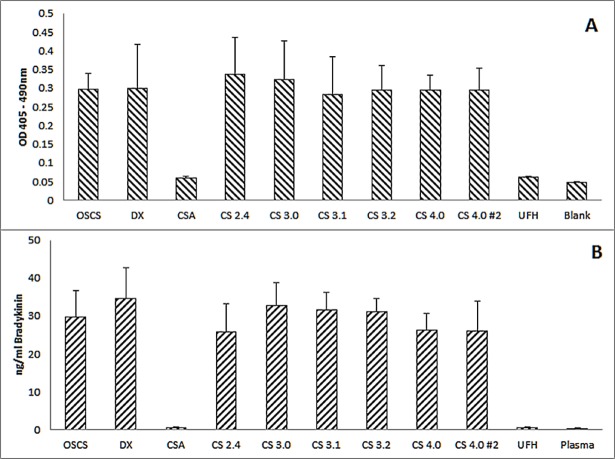
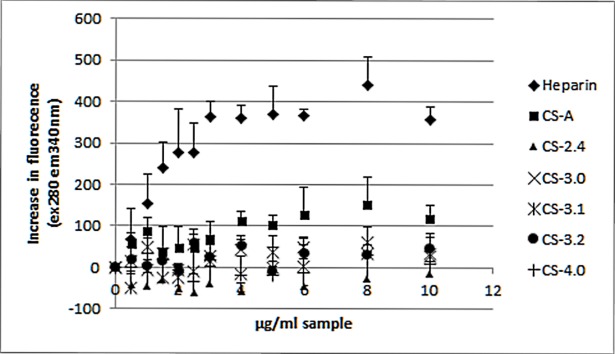
Oversulfated chondroitin sulfate (OSCS) was identified as a contaminant in certain heparin preparations as the cause of adverse reactions in patients. OSCS was found to possess both plasma anticoagulant activity and the ability to activate prekallikrein to kallikrein. Differentially sulfated chondroitin sulfates were prepared by synthetic modification of chondroitin sulfate and were compared to the activity of OSCS purified from contaminated heparin. Whilst chondroitin sulfate was found to have minimal anticoagulant activity, increasing sulfation levels produced an anticoagulant response which we directly show for the first time is mediated through heparin cofactor II. However, the tetra-sulfated preparations did not possess any higher anticoagulant activity than several tri-sulfated variants, and also had lower heparin cofactor II mediated activity. Activation of prekallikrein was concentration dependent for all samples, and broadly increased with the degree of sulfation, though the di-sulfated preparation was able to form more kallikrein than some of the tri-sulfated preparations. The ability of the samples to activate the kinin system, as measured by bradykinin, was observed to be through kallikrein generation. These results show that whilst an increase in sulfation of chondroitin sulfate did cause an increase in anticoagulant activity and activation of the kinin system, there may be subtler structural interactions other than sulfation at play given the different responses observed.
Conflict of interest statement
Figures
References
-
- McMahon AW, Pratt RG, Hammad TA, Kozlowski S, Zhou E, Lu S, et al. Description of hypersensitivity adverse events following administration of heparin that was potentially contaminated with oversulfated chondroitin sulfate in early 2008. Pharmacoepidemiol Drug Saf. 2010;19(9):921–33. doi: 10.1002/pds.1991 - DOI - PubMed
-
- Guerrini M, Beccati D, Shriver Z, Naggi A, Viswanathan K, Bisio A, et al. Oversulfated chondroitin sulfate is a contaminant in heparin associated with adverse clinical events. Nat Biotechnol. 2008;26(6):669–75. doi: 10.1038/nbt1407 - DOI - PMC - PubMed
-
- Kishimoto TK, Viswanathan K, Ganguly T, Elankumaran S, Smith S, Pelzer K, et al. Contaminated heparin associated with adverse clinical events and activation of the contact system. N Engl J Med. 2008;358(23):2457–67. doi: 10.1056/NEJMoa0803200 - DOI - PMC - PubMed
-
- Adam A, Montpas N, Keire D, Desormeaux A, Brown NJ, Marceau F, et al. Bradykinin forming capacity of oversulfated chondroitin sulfate contaminated heparin in vitro. Biomaterials. 2010;31(22):5741–8. doi: 10.1016/j.biomaterials.2010.03.074 - DOI - PMC - PubMed
-
- Corbier A, Le BN, Rampe D, Meng H, Lorenz M, Vicat P, et al. Oversulfated chondroitin sulfate and OSCS-contaminated heparin cause dose- and route-dependent hemodynamic effects in the rat. Toxicol Sci. 2011;121(2):417–27. doi: 10.1093/toxsci/kfr072 - DOI - PubMed
MeSH terms
Substances
LinkOut - more resources
Full Text Sources
Other Literature Sources
Medical
