. 2018 Apr:150:25-35.
doi: 10.1016/j.nlm.2018.02.013. Epub 2018 Feb 26.

Distinct recruitment of the hippocampal, thalamic, and amygdalar neurons projecting to the prelimbic cortex in male and female rats during context-mediated renewal of responding to food cues

Affiliations

Distinct recruitment of the hippocampal, thalamic, and amygdalar neurons projecting to the prelimbic cortex in male and female rats during context-mediated renewal of responding to food cues

Lauren C Anderson et al. Neurobiol Learn Mem. 2018 Apr.

Abstract

Persistent responding to food cues may underlie the difficulty to resist palatable foods and to maintain healthy eating habits. Renewal of responding after extinction is a model of persistent food seeking that can be used to study the underlying neural mechanisms. In context-mediated renewal, a return to the context in which the initial cue-food learning occurred induces robust responding to the cues that were extinguished elsewhere. Previous work found sex differences in context-mediated renewal and in the recruitment of the ventromedial prefrontal cortex (vmPFC) during that behavior. Males exhibited renewal of responding to food cues and had higher Fos induction in the prelimbic area (PL) of the vmPFC, while females failed to exhibit renewal of responding and had lower Fos induction in the PL. The main aim of the current study was to determine key components of the PL circuitry mediating renewal. The focus was on inputs from three areas important in appetitive associative learning and contextual processing: the amygdala, ventral hippocampal formation, and the paraventricular nucleus of the thalamus. The goal was to determine whether neurons from these areas that send direct projections to the PL (identified with a retrograde tracer) are selectively activated (Fos induction) during renewal and whether they are differently recruited in males and females. The Fos induction patterns demonstrated that the PL-projecting neurons in each of these areas were recruited in a sex-specific way that corresponded to the behavioral differences between males and females. These pathways were selectively activated in the male experimental group-the only group that showed renewal behavior. The findings suggest the pathways from the ventral hippocampal formation, paraventricular nucleus of the thalamus, and basolateral amygdala to the PL mediate renewal in males. The lack of recruitment in females suggests that under activation of these pathways may underlie their lack of renewal.

Keywords: Appetitive conditioning; Hippocampal formation; Paraventricular nucleus of the thalamus; Renewal; Sex differences; Ventromedial prefrontal cortex.


Figures

Figure 1
Figure 1
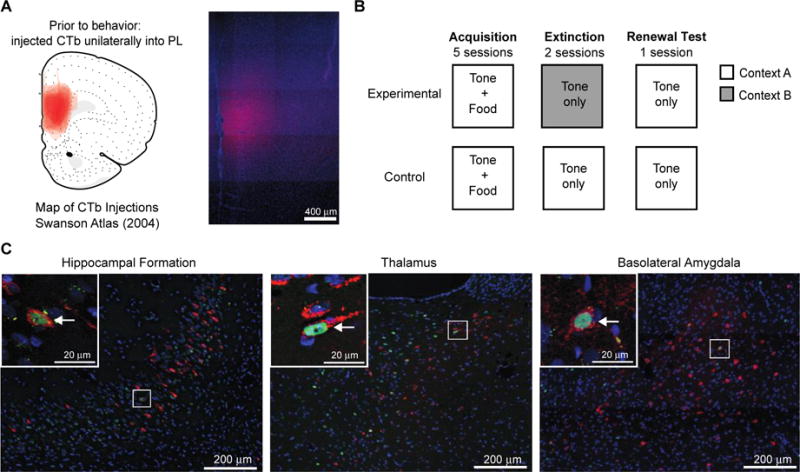
Experimental Design. (A) Map of all CTb injections in the PL of male and female rats (left) and a representative image (right). (B) Between-subjects context-dependent renewal protocol. (C) Representative images of CTb and Fos labeling in the hippocampal formation (CA1v), paraventricular nucleus of the thalamus and the basolateral amygdala. Insets in upper left of each image show magnified area in corresponding rectangles. Fos-positive (green), CTb-positive (red), double-labeled (CTb+Fos) neurons (arrow).
Figure 2
Figure 2
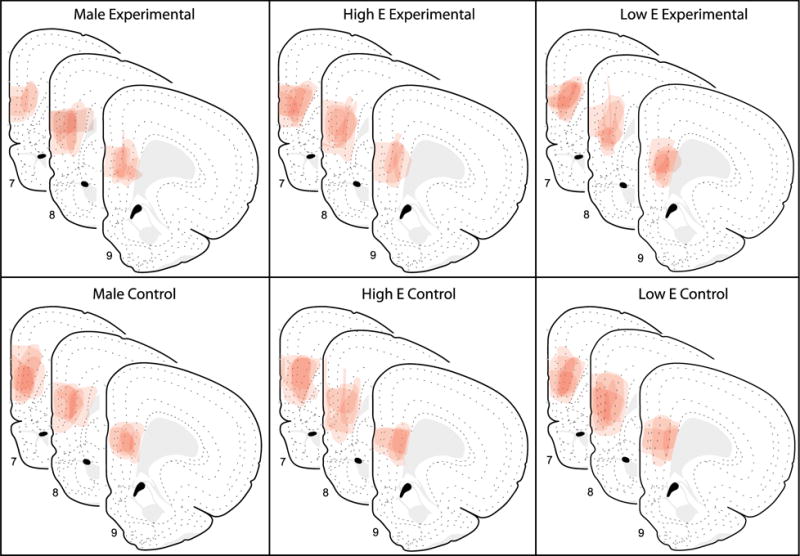
Illustration of CTb placements in the PL across groups. The extent of CTb injections in the PL for each group is shown on modified Swanson atlas templates (Swanson (2004); atlas levels 7, 8, 9; +3.6, +3.2 and +2.8 mm from bregma, respectively).
Figure 3
Figure 3
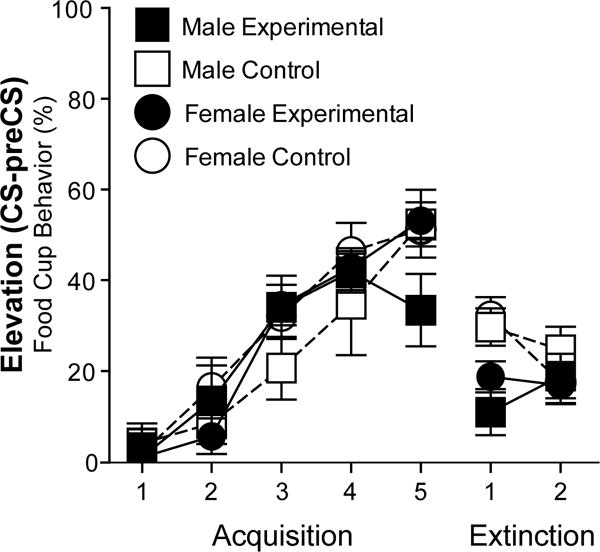
Conditioned responses during acquisition and extinction. Elevation scores represent percentage of time rats expressed food cup behavior (mean ± SEM) during CS above the baseline (preCS) during each Acquisition and Extinction training session.
Figure 4
Figure 4
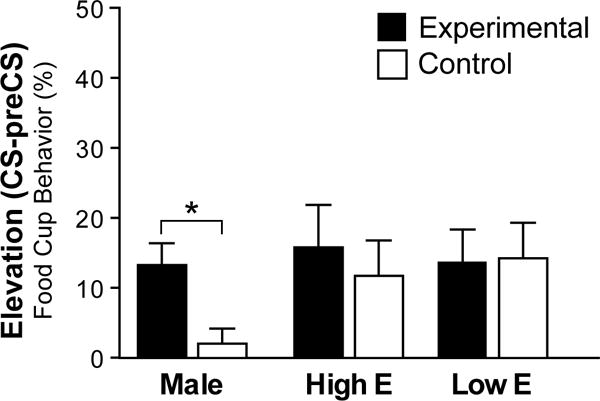
Conditioned responses during the test for renewal. Elevation scores represent percentage of time rats expressed food cup behavior during CS minus preCS during the test for renewal. Bars are mean ± SEM. * indicates p < 0.01.
Figure 5
Figure 5
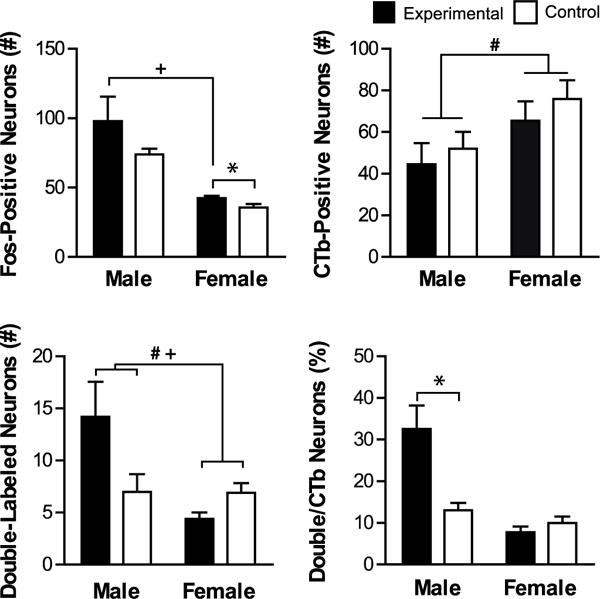
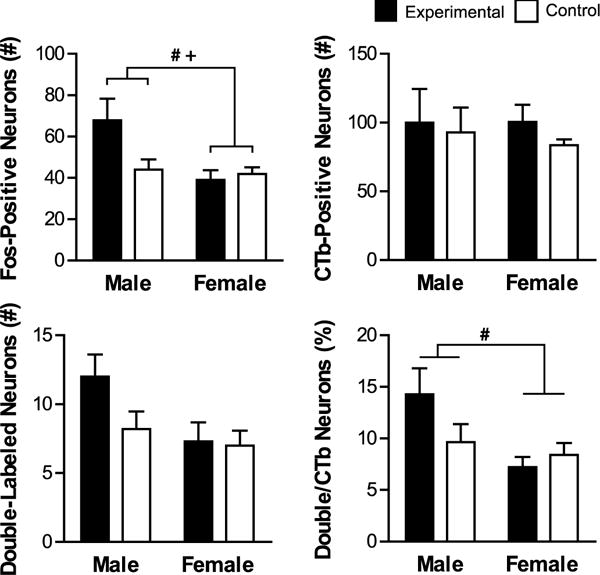
Fos induction in SUBv-PL projecting neurons. Shown are mean values (± SEM) for total number of Fos-positive, CTb-positive, and double-labeled (CTb + Fos) neurons, as well as percentage of CTb neurons that were double-labeled. # denotes significant main effect of Sex and + denotes significant main effect of Sex by Group. * denotes significant difference between experimental and same-sex control. p < 0.05.
Figure 6
Figure 6
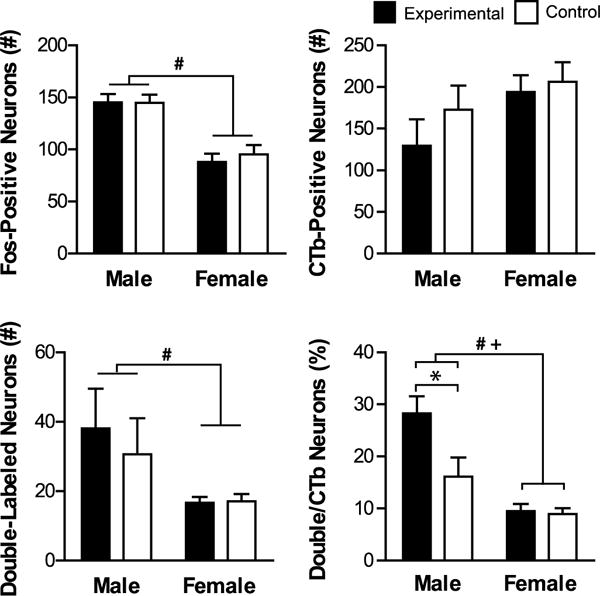
Fos induction in CA1v-PL projecting neurons. Shown are mean values (± SEM) for total number of Fos-positive, CTb-positive, and double-labeled (CTb + Fos) neurons, as well as percentage of CTb neurons that were double-labeled. # denotes significant main effect of Sex and + denotes significant main effect of Sex by Group. * denotes significant difference between experimental and same-sex control. p < 0.05.
Figure 7
Figure 7
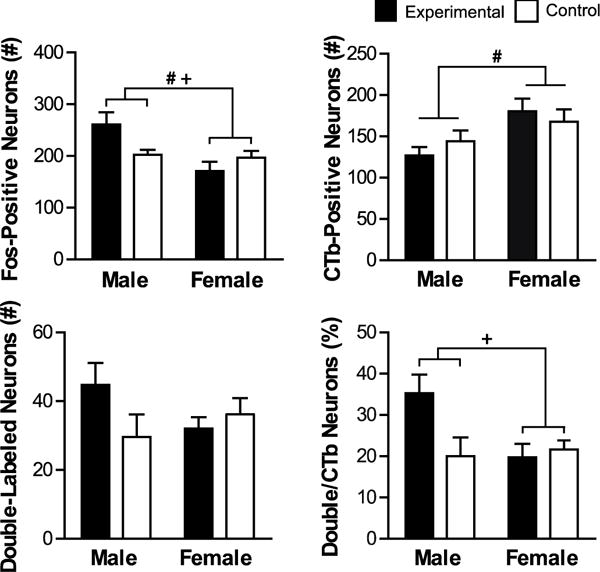
Fos induction in PVTa-PL projecting neurons. Shown are mean values (± SEM) for total number of Fos-positive, CTb-positive, and double-labeled (CTb + Fos) neurons, as well as percentage of CTb neurons that were double-labeled. # denotes significant main effect of Sex and + denotes significant main effect of Sex by Group. p <0.05.
Figure 8
Figure 8
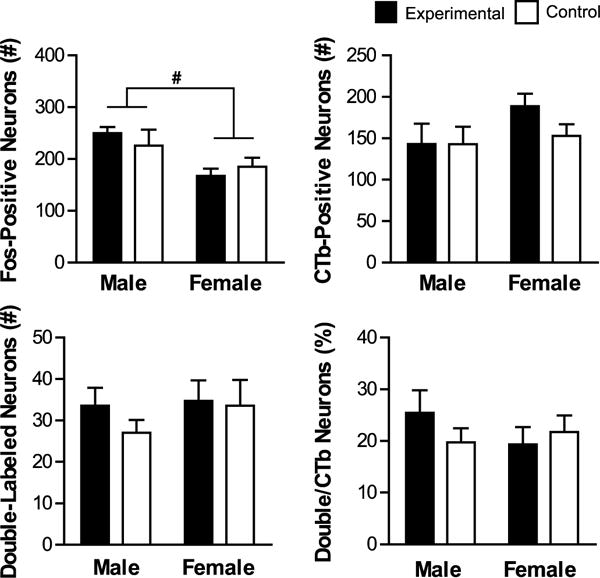
Fos induction in PVTp-PL projecting neurons. Shown are mean values (± SEM) for total number of Fos-positive, CTb-positive, and double-labeled (CTb + Fos) neurons, as well as percentage of CTb neurons that were double-labeled. # denotes significant main effect of Sex. p < 0.05.
Figure 9
Figure 9
Fos induction in BLAa-PL projecting neurons. Shown are mean values (± SEM) for total number of Fos-positive, CTb-positive, and double-labeled (CTb + Fos) neurons, as well as percentage of CTb neurons that were double-labeled. # denotes significant main effect of Sex and + denotes significant main effect of Sex by Group. p < 0.05.

References

    1. Anderson LC, Petrovich GD. Renewal of conditioned responding to food cues in rats: Sex differences and relevance of estradiol. Physiol Behav. 2015;151:338–344. doi: 10.1016/j.physbeh.2015.07.035. - DOI - PMC - PubMed
    1. Anderson LC, Petrovich GD. Sex specific recruitment of a medial prefrontal cortex-hippocampal-thalamic system during context-dependent renewal of responding to food cues in rats. Neurobiol Learn Mem. 2016;139:11–21. doi: 10.1016/j.nlm.2016.12.004. - DOI - PMC - PubMed
    1. Anderson LC, Petrovich GD. Ventromedial prefrontal cortex mediates sex-specific persistent cognitive drive for food. Sci Rep. 2017 submitted. - PMC - PubMed
    1. Bhatnagar S, Dallman MF. The paraventricular nucleus of the thalamus alters rhythms in core temperature and energy balance in a state-dependent manner. Brain Res. 1999;851(1-2):66–75. - PubMed
    1. Boutelle KN, Bouton ME. Implications of learning theory for developing programs to decrease overeating. Appetite. 2015 doi: 10.1016/j.appet.2015.05.013. - DOI - PMC - PubMed

Publication types