. 2018 Apr;28(4):561-568.
doi: 10.1101/gr.233940.117. Epub 2018 Mar 1.

Selective maternal seeding and environment shape the human gut microbiome

Affiliations

Selective maternal seeding and environment shape the human gut microbiome

Katri Korpela et al. Genome Res. 2018 Apr.

Abstract

Vertical transmission of bacteria from mother to infant at birth is postulated to initiate a life-long host-microbe symbiosis, playing an important role in early infant development. However, only the tracking of strictly defined unique microbial strains can clarify where the intestinal bacteria come from, how long the initial colonizers persist, and whether colonization by other strains from the environment can replace existing ones. Using rare single nucleotide variants in fecal metagenomes of infants and their family members, we show strong evidence of selective and persistent transmission of maternal strain populations to the vaginally born infant and their occasional replacement by strains from the environment, including those from family members, in later childhood. Only strains from the classes Actinobacteria and Bacteroidia, which are essential components of the infant microbiome, are transmitted from the mother and persist for at least 1 yr. In contrast, maternal strains of Clostridia, a dominant class in the mother's gut microbiome, are not observed in the infant. Caesarean-born infants show a striking lack of maternal transmission at birth. After the first year, strain influx from the family environment occurs and continues even in adulthood. Fathers appear to be more frequently donors of novel strains to other family members than receivers. Thus, the infant gut is seeded by selected maternal bacteria, which expand to form a stable community, with a rare but stable continuing strain influx over time.


Figures

Figure 1.
Figure 1.
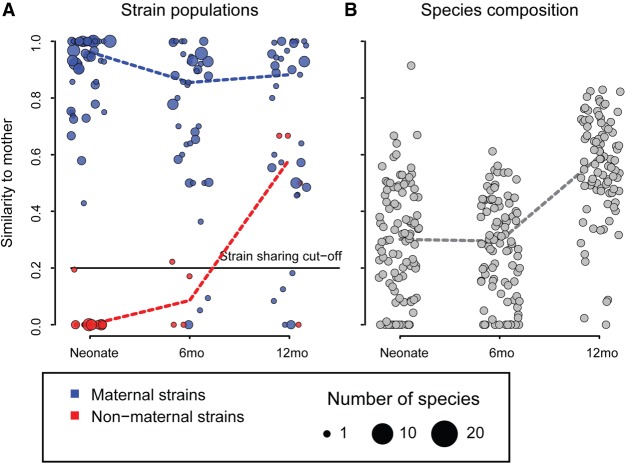
Similarity to mother over time of vaginally born infants (n = 114), measured as rmSNV similarity (A) and species composition similarity (B). Strains were classified as originally maternal if rmSNV similarity to mother was >0.2 (strain sharing cut-off) in the first neonatal sample available for each pair. Maternal/nonmaternal strains were summarized in each circle as median per individual. Even if the similarity to the mother increased in later time points, the original distinction of maternal/nonmaternal was kept for each child-mother pair through all further time points.
Figure 2.
Figure 2.
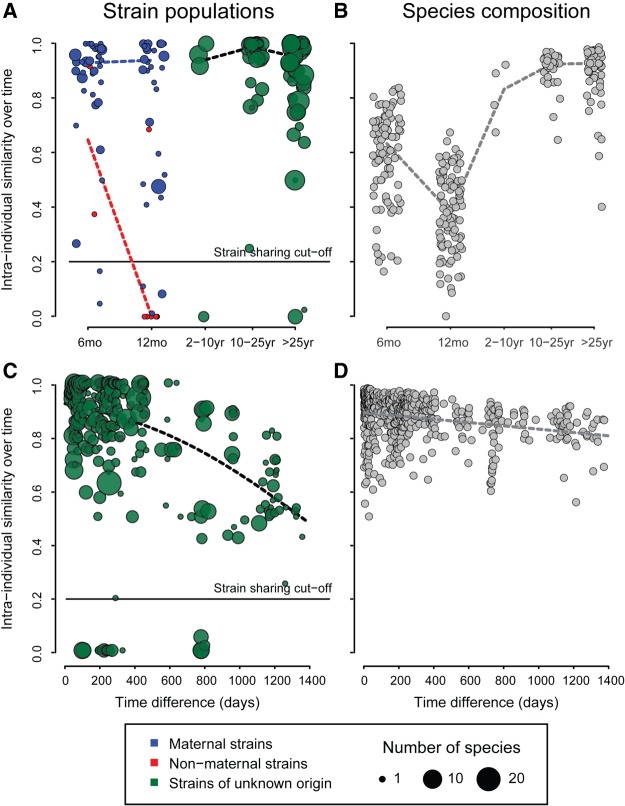
Intra-individual similarity over time. Panels A and B show similarity to previous time points at different ages (median over all time points per individual, including vaginally born infants and children, and adults irrespective of birth mode; N = 282). Panels C and D show intra-individual similarity by time difference between samples in >1-yr-olds (N = 304).
Figure 3.
Figure 3.
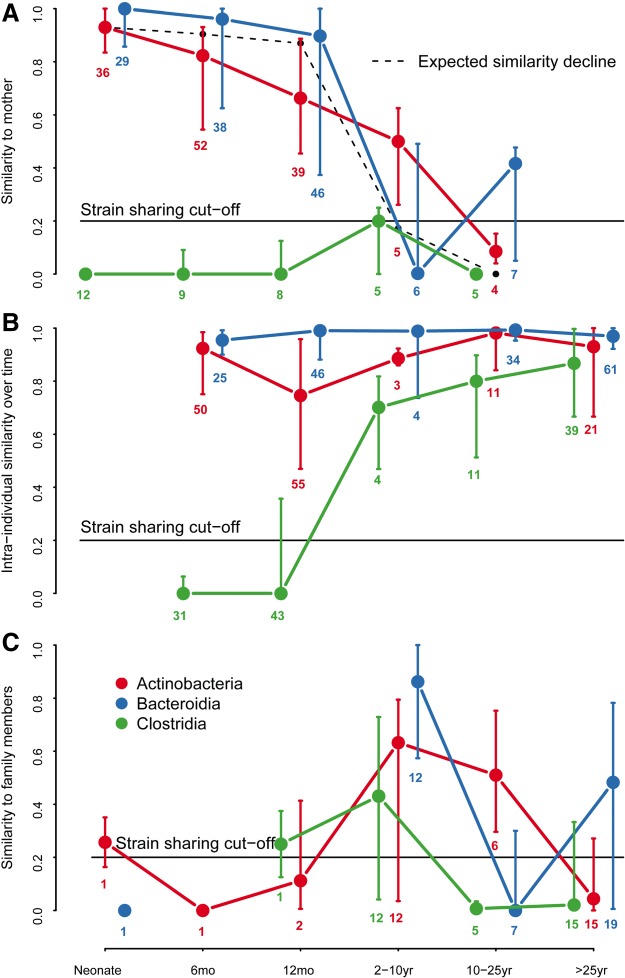
Phylogenetic signal in strain transmission and stability. (A) Strain population (rmSNV profile) similarity of vaginally born infants to mother. (B) Intra-individual rmSNV similarity over time in vaginally born infants and children, and adults regardless of birth mode. (C) Strain population (rmSNV) similarity to other family members. The symbols represent age group medians ± inter-quartile range per bacterial class. The number of individuals included in each group is indicated. Expected similarity decline is based on the intra-individual similarity decline in Figure 2C.
Figure 4.
Figure 4.
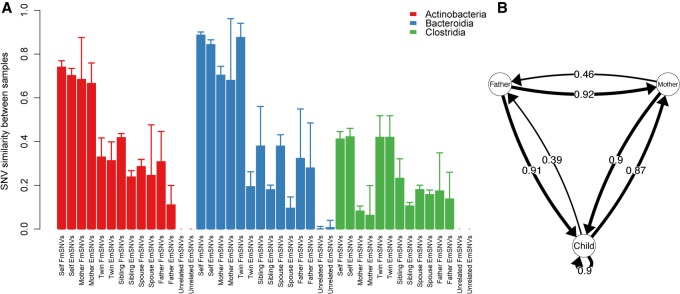
Strain similarity and transmissions within families. (A) The bars indicate mean ± SD. Two sets of rare marker SNVs were defined per pair of individuals: rare marker SNVs, which were allowed to be shared with other family members (marked here as Family marker SNVs, FmSNVs), and exclusive marker SNVs (EmSNVs), which were only shared between the compared pair. (B) The arrows indicate the cases where novel SNVs emerging in the focal individual were observed in previous time points of a given family member. The arrow from child to child indicates transmission between siblings. The numbers on the arrows represent the proportion of identified transmission events between the indicated pair of family members (number of observed transmission events/total number of family member comparisons).

References

    1. Aagaard K, Ma J, Antony K, Ganu R, Petrosino J, Versalovic J. 2014. The placenta harbors a unique microbiome. Sci Transl Med 6: 237ra65. - PMC - PubMed
    1. Albesharat R, Ehrmann MA, Korakli M, Yazaji S, Vogel RF. 2011. Phenotypic and genotypic analyses of lactic acid bacteria in local fermented food, breast milk and faeces of mothers and their babies. Syst Appl Microbiol 34: 148–155. - PubMed
    1. Asnicar F, Manara S, Zolfo M, Truong DT, Scholz M, Armanini F, Ferretti P, Gorfer V, Pedrotti A, Tett A, et al. 2017. Studying vertical microbiome transmission from mothers to infants by strain-level metagenomic profiling. mSystems 2: e00164–16. - PMC - PubMed
    1. Bäckhed F, Roswall J, Peng Y, Feng Q, Jia H, Kovatcheva-Datchary P, Li Y, Xia Y, Xie H, Zhong H, et al. 2015. Dynamics and stabilization of the human gut microbiome during the first year of life. Cell Host Microbe 17: 690–703. - PubMed
    1. Bokulich N, Chung J, Battaglia T, Henderson N, Jay M, Li H, Lieber A, Wu F, Perez-Perez G, Chen Y, et al. 2016. Antibiotics, birth mode, and diet shape microbiome maturation during early life. Sci Trans Med 8: 343. - PMC - PubMed

Publication types

Substances