Review
. 2018 Mar 1;10(3):a021972.
doi: 10.1101/cshperspect.a021972.

Myosin-Driven Intracellular Transport

Affiliations
Review

Myosin-Driven Intracellular Transport

Margaret A Titus. Cold Spring Harb Perspect Biol. .

Abstract

The delivery of intracellular material within cells is crucial for maintaining normal function. Myosins transport a wide variety of cargo, ranging from vesicles to ribonuclear protein particles (RNPs), in plants, fungi, and metazoa. The properties of a given myosin transporter are adapted to move on different actin filament tracks, either on the disordered actin networks at the cell cortex or along highly organized actin bundles to distribute their cargo in a localized manner or move it across long distances in the cell. Transport is controlled by selective recruitment of the myosin to its cargo that also plays a role in activation of the motor.


Figures

Figure 1.
Figure 1.
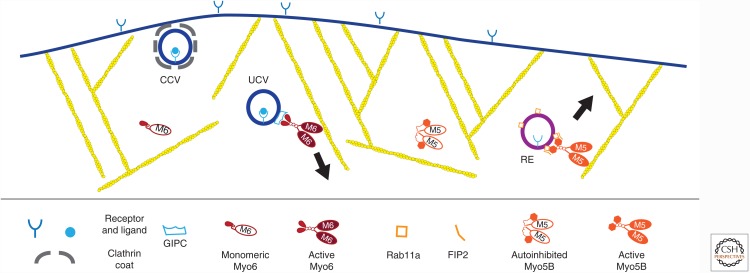
Myosin-based transport of endocytic vesicles. Following the formation of a clathrin-coated vesicle (CCV), it is uncoated (forming an uncoated vesicle, UCV) and myosin VI is recruited through binding to the adaptor GIPC. Recycling endosomes (RE) return membrane receptors and channels (not shown) to the plasma membrane by myosin Vb–based transport. Note that the actin filaments (shown in yellow) are oriented with their barbed ends toward the membrane.
Figure 2.
Figure 2.
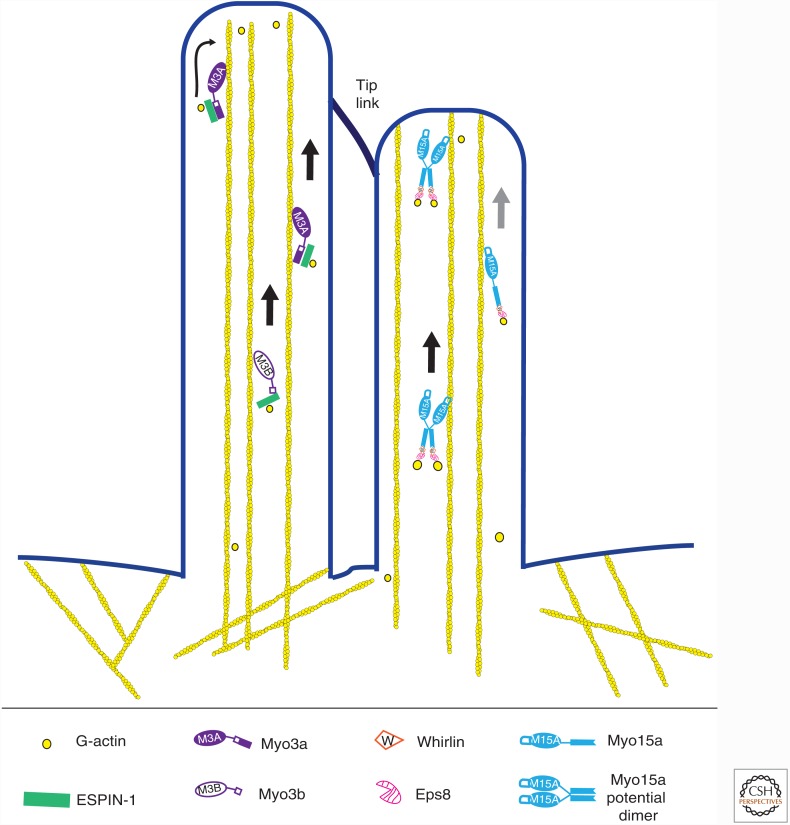
Transport of actin elongation proteins in stereocilia. Two different myosins, myosin IIIA/B and myosin XVA, move up the polarized actin core of the stereocilium (shown in yellow), which is oriented with barbed ends pointed toward the membrane at the tip. Each myosin carries a cargo that includes an adaptor protein(s) (Espin-1 for myosin III, whirlin and Eps8 for myosin XVA) and an actin monomer that is added at the tip. Note that, as it is not known whether myosin XVA is a dimer, it might move as a processive dimer or by facilitated diffusion (gray arrow) if it is monomer.
Figure 3.
Figure 3.
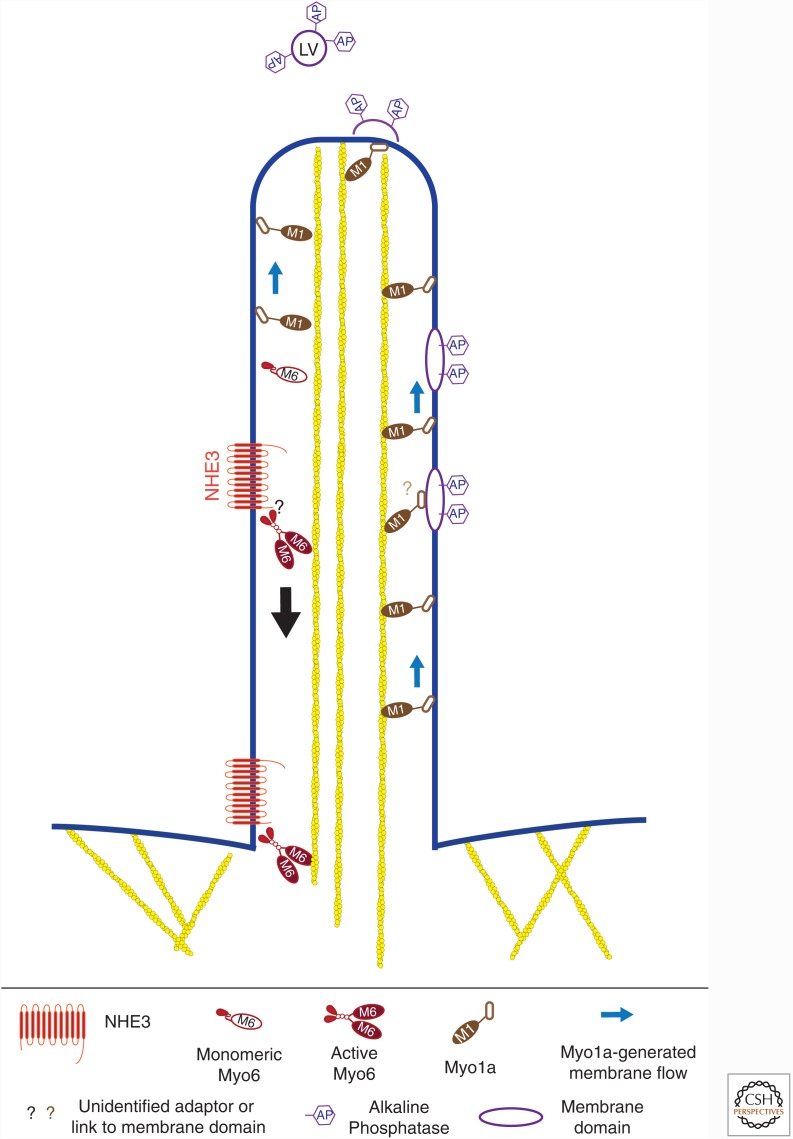
Myosin-based transport in microvilli. The drawing illustrates the tip-to-base movement of the sodium-hydrogen exchanger (NHE3) powered by myosin VI (Myo6). Note that myosin VI is monomeric and that binding to its cargo promotes dimerization. In contrast, myosin Ia (Myo1a) binds directly to membrane lipids and may directly move components in the opposite direction, from base to tip, or effect changes in membrane tension to promote the shedding of vesicles (LV) enriched for alkaline phosphatase (AP) into the lumen of the gut.
Figure 4.
Figure 4.
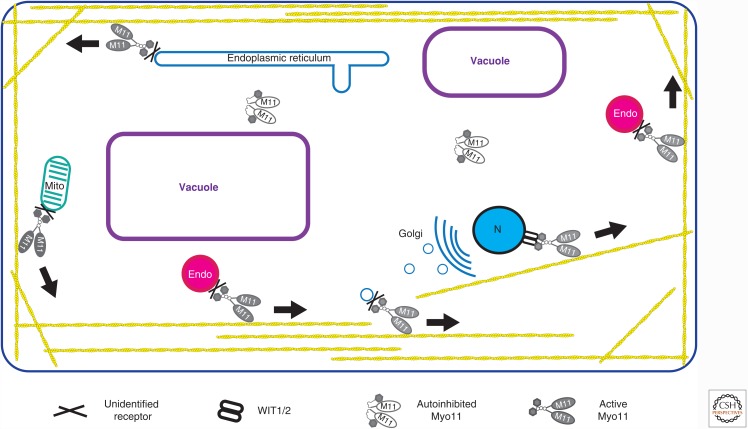
Cytoplasmic streaming and nuclear movement in plant cells. The drawing shows the movements of a variety of organelles, including the nucleus (N), endocytic vesicles (Endo), Golgi, endoplasmic reticulum, and mitochondria (Mito). Note that these are likely to be driven by several different myosin XI isoforms, and a given organelle can be associated with more than one type of myosin XI. The adapter(s) linking myosin XI to each organelle are not known, but the WIT1/2 proteins are known to recruit myosin XI-i to the nuclear membrane in Arabidopsis (Tamura et al. 2013).

References

    1. Ameen N, Apodaca G. 2007. Defective CFTR apical endocytosis and enterocyte brush border in myosin VI-deficient mice. Traffic 8: 998–1006. - PubMed
    1. Arjonen A, Kaukonen R, Mattila E, Rouhi P, Högnäs G, Sihto H, Miller BW, Morton JP, Bucher E, Taimen P, et al. 2014. Mutant p53-associated myosin-X upregulation promotes breast cancer invasion and metastasis. J Clin Invest 124: 1069–1082. - PMC - PubMed
    1. Aronov S, Gelin-Licht R, Zipor G, Haim L, Safran E, Gerst JE. 2007. mRNAs encoding polarity and exocytosis factors are cotransported with the cortical endoplasmic reticulum to the incipient bud in Saccharomyces cerevisiae. Mol Cell Biol 27: 3441–3455. - PMC - PubMed
    1. Aschenbrenner L, Lee TT, Hasson T. 2003. Myo6 facilitates the translocation of endocytic vesicles from cell peripheries. Mol Biol Cell 14: 2728–2743. - PMC - PubMed
    1. Aschenbrenner L, Naccache SN, Hasson T. 2004. Uncoated vesicles require the unconventional myosin, Myo6, for rapid transport through actin barriers. Mol Biol Cell 15: 2253–2263. - PMC - PubMed

Publication types

LinkOut - more resources