


A Couple-Based Psychological Treatment for Chronic Pain and Relationship Distress
- PMID: 29497271
- PMCID: PMC5826564
- DOI: 10.1016/j.cbpra.2017.02.003
A Couple-Based Psychological Treatment for Chronic Pain and Relationship Distress
Abstract
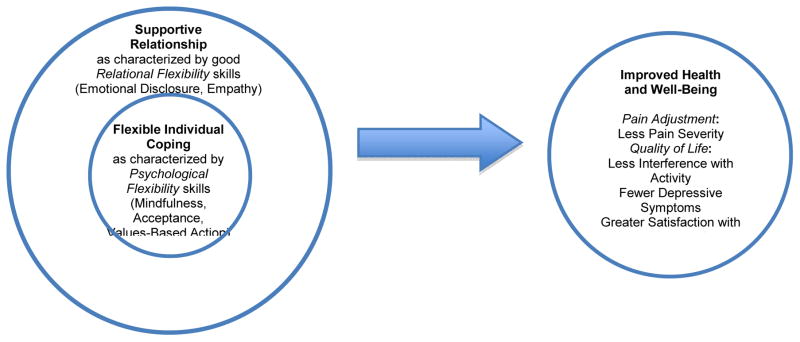
Chronic pain impacts individuals with pain as well as their loved ones. Yet, there has been little attention to the social context in individual psychological treatment approaches to chronic pain management. With this need in mind, we developed a couple-based treatment, "Mindful Living and Relating," aimed at alleviating pain and suffering by promoting couples' psychological and relational flexibility skills. Currently, there is no integrative treatment that fully harnesses the power of the couple, treating both the individual with chronic pain and the spouse as two individuals who are each in need of developing greater psychological and relational flexibility to improve their own and their partners' health. Mindfulness, acceptance, and values-based action exercises were used to promote psychological flexibility. The intervention also targets relational flexibility, which we define as the ability to interact with one's partner, fully attending to the present moment, and responding empathically in a way that serves one's own and one's partner's values. To this end, the intervention also included exercises aimed at applying psychological flexibility skills to social interactions as well as emotional disclosure and empathic responding exercises to enhance relational flexibility. The case presented demonstrates that healthy coping with pain and stress may be most successful and sustainable when one is involved in a supportive relationship with someone who also practices psychological flexibility skills and when both partners use relational flexibility skills during their interactions.
Keywords: chronic pain; couple therapy; couple-based interventions; couples; psychological flexibility; relational flexibility.
Figures
References
-
- Abramowitz JS, Baucom DH, Boeding S, Wheaton MG, Pukay-Martin ND, Fabricant LE, Paprocki C, Fischer MS. Treating obsessive-compulsive disorder in intimate relationships: a pilot study of couple-based cognitive-behavior therapy. Behavior Therapy. 2013;44(3):395–407. doi: 10.1016/j.beth.2013.02.005. - DOI - PubMed
-
- Barnes S, Brown KW, Krusemark E, Campbell WK, Rogge RD. The role of mindfulness in romantic relationship satisfaction and responses to relationship stress. Journal of Marital and Family Therapy. 2007;33(4):482–500. doi:10.1111/j.1752- 0606.2007.00033.x. - PubMed
-
- Baucom DH, Kirby JS, Kelly JT. Couple-based interventions to assist partners with psychological and medical problems. In: Halwehg K, Grawe-Gerber M, Baucom D, editors. Enhancing Couples: The Shape of Couple Therapy to Come. Cambridge, MA: Hogrefe Publishing; 2009. pp. 79–94.
Grants and funding
LinkOut - more resources
Full Text Sources
Other Literature Sources