. 2018 Feb 13:9:67.
doi: 10.3389/fmicb.2018.00067. eCollection 2018.

Phylogenomics and Comparative Genomic Studies Robustly Support Division of the Genus Mycobacterium into an Emended Genus Mycobacterium and Four Novel Genera

Affiliations

Phylogenomics and Comparative Genomic Studies Robustly Support Division of the Genus Mycobacterium into an Emended Genus Mycobacterium and Four Novel Genera

Radhey S Gupta et al. Front Microbiol. .

Erratum in

Abstract

The genus Mycobacterium contains 188 species including several major human pathogens as well as numerous other environmental species. We report here comprehensive phylogenomics and comparative genomic analyses on 150 genomes of Mycobacterium species to understand their interrelationships. Phylogenetic trees were constructed for the 150 species based on 1941 core proteins for the genus Mycobacterium, 136 core proteins for the phylum Actinobacteria and 8 other conserved proteins. Additionally, the overall genome similarity amongst the Mycobacterium species was determined based on average amino acid identity of the conserved protein families. The results from these analyses consistently support the existence of five distinct monophyletic groups within the genus Mycobacterium at the highest level, which are designated as the "Tuberculosis-Simiae," "Terrae," "Triviale," "Fortuitum-Vaccae," and "Abscessus-Chelonae" clades. Some of these clades have also been observed in earlier phylogenetic studies. Of these clades, the "Abscessus-Chelonae" clade forms the deepest branching lineage and does not form a monophyletic grouping with the "Fortuitum-Vaccae" clade of fast-growing species. In parallel, our comparative analyses of proteins from mycobacterial genomes have identified 172 molecular signatures in the form of conserved signature indels and conserved signature proteins, which are uniquely shared by either all Mycobacterium species or by members of the five identified clades. The identified molecular signatures (or synapomorphies) provide strong independent evidence for the monophyly of the genus Mycobacterium and the five described clades and they provide reliable means for the demarcation of these clades and for their diagnostics. Based on the results of our comprehensive phylogenomic analyses and numerous identified molecular signatures, which consistently and strongly support the division of known mycobacterial species into the five described clades, we propose here division of the genus Mycobacterium into an emended genus Mycobacterium encompassing the "Tuberculosis-Simiae" clade, which includes all of the major human pathogens, and four novel genera viz. Mycolicibacterium gen. nov., Mycolicibacter gen. nov., Mycolicibacillus gen. nov. and Mycobacteroides gen. nov. corresponding to the "Fortuitum-Vaccae," "Terrae," "Triviale," and "Abscessus-Chelonae" clades, respectively. With the division of mycobacterial species into these five distinct groups, attention can now be focused on unique genetic and molecular characteristics that differentiate members of these groups.

Keywords: Mycobacterium classification; abscessus-chelonae clade; conserved signature indels and signature proteins; fortuitum-vaccae clade; phylogenomic analysis; slow-growing and fast-growing mycobacteria; terrae clade; triviale clade.


Figures
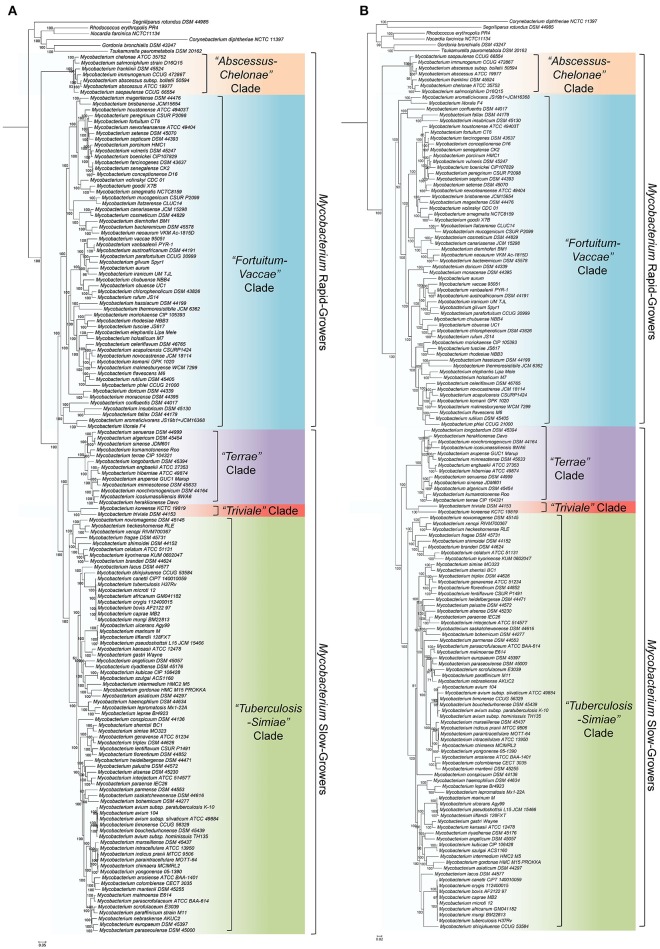
Figure 1
Figure 1
(A) Maximum-likelihood phylogenetic tree for 150 Mycobacterium species based on the concatenated sequence of 1941 core proteins from the genus Mycobacterium. (B) A maximum-likelihood phylogenetic tree based on the 136 proteins consistuting the phyloeco set for the phylum Actinobacteria. Both of these trees were rooted using the sequences from the Corynebacteriales species. Trees were constructed as described in the Methods section. SH-like statistical support values and the bootstrap value are marked on the nodes. The major clades as well as the clusters of slow-growing and fast-growing Mycobacterium species are labeled. Some slow-growing species, which branched within the rapid-growing species are marked with*.
Figure 2
Figure 2
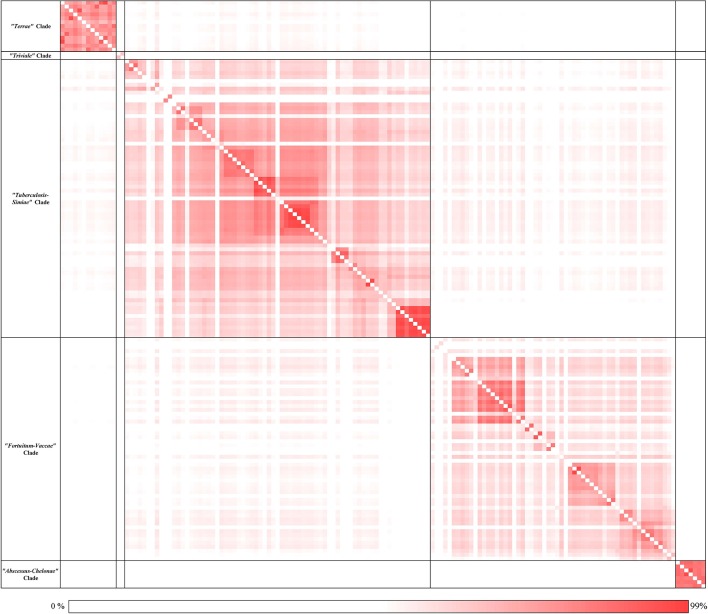
A matrix of the average Amino Acid Identity for the 150 Mycobacterium genomes used in this study. A darker shade represents higher similarity between the pair of genomes. The average amino acid identity between each pair of genomes was calculated as described in the Methods section. The numerical values underlying this matrix are provided in Supplementary Figure 3.
Figure 3
Figure 3
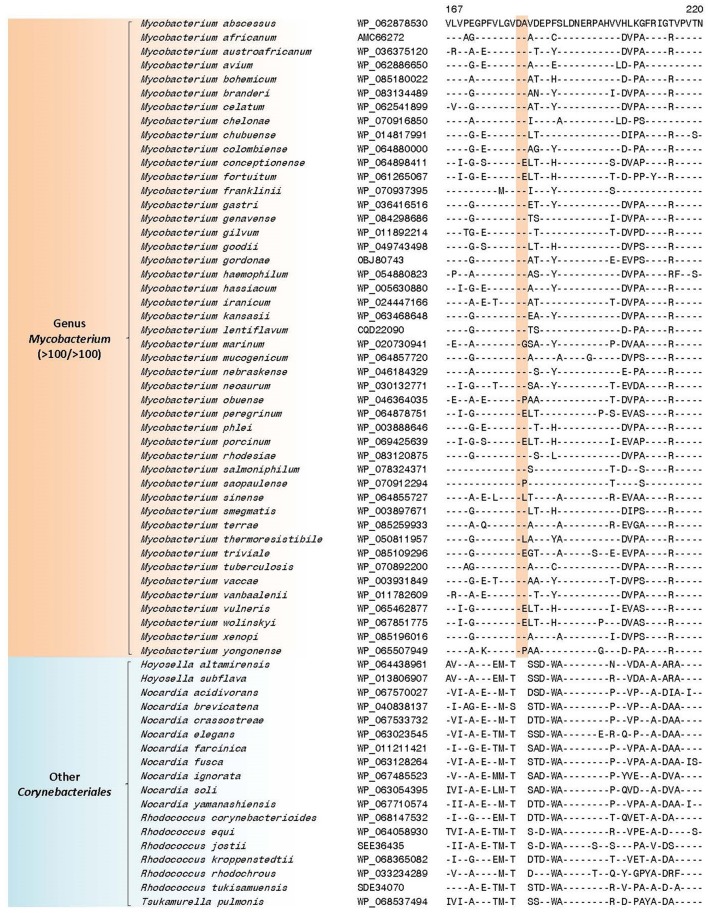
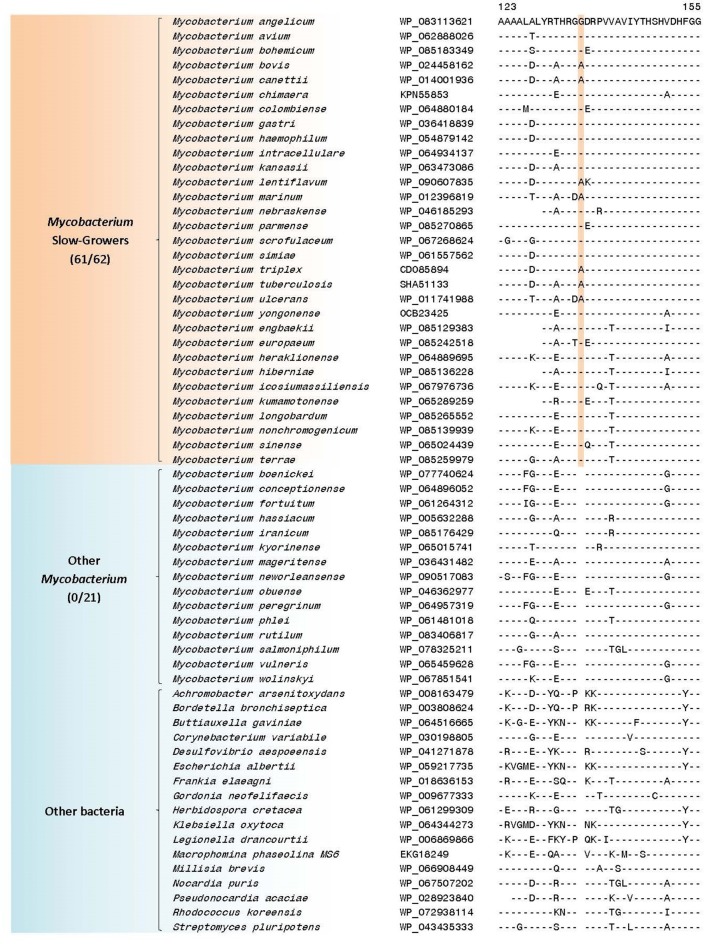
Partial sequence alignment of a conserved region of the ergothioneine biosynthesis protein EgtB showing a two amino acid insertion (boxed) exclusively found in members of the genus Mycobacterium and not present in other Corynebacteriales. Dashes (-) in all alignments denote identity with the amino acid shown in the top sequence. Sequence information for only limited numbers of species is presented in this figure; a detailed alignment for this CSI is shown in Supplementary Figure 4. Information for additional CSIs specific for the genus Mycobacterium are provided in Supplementary Figures 4–13 and summarized in Table 1.
Figure 4
Figure 4
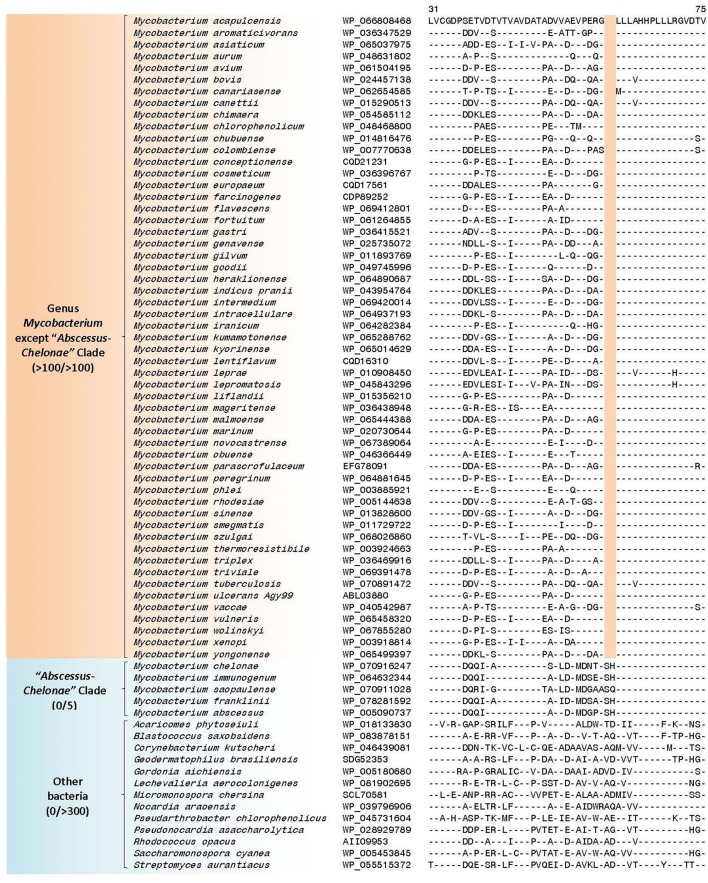
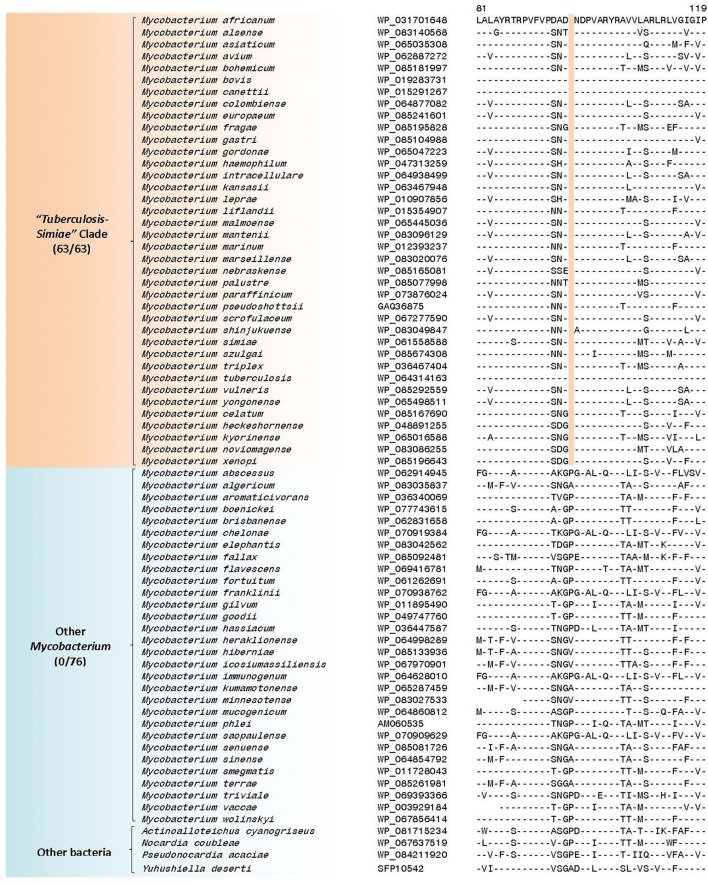
A partial sequence alignment of a conserved region of Nif3-like protein exhibiting a two amino acid deletion that is specific for members of the genus Mycobacterium except members of the “Abscessus-Chelonae” clade; a detailed alignment for this CSI is shown in Supplementary Figure 14. Information for additional CSIs specific for the genus Mycobacterium are provided in Supplementary Figures 14–17 and summarized in Table 1. Dashes (-) in all alignments denote identity with the amino acid shown in the top sequence.
Figure 5
Figure 5
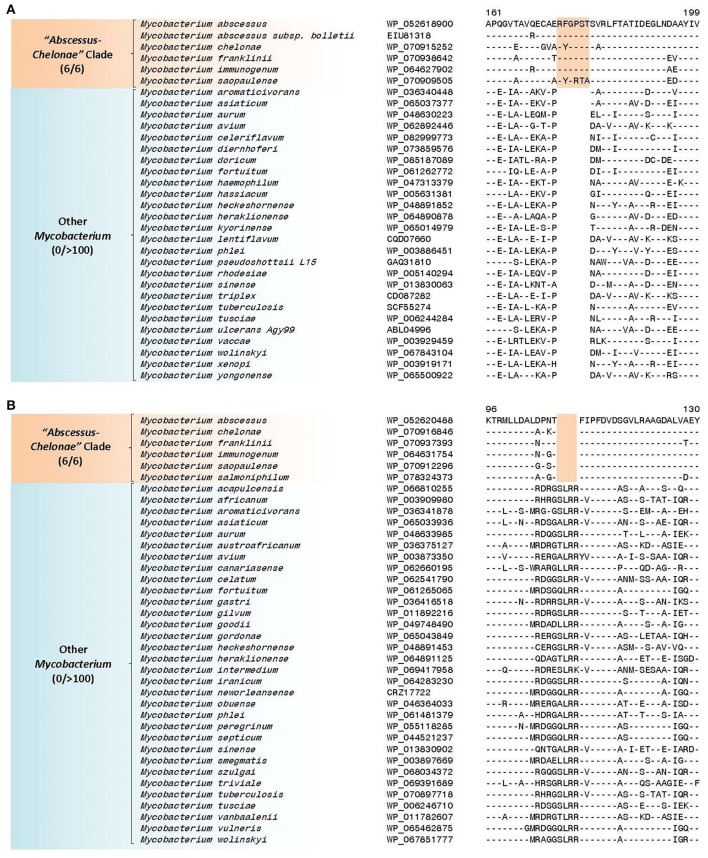
(A) Partial sequence alignment of the protein uracil phosphoribosyltransferase showing a six amino acid insertion that is specific for the “Abscessus-Chelonae” clade; (B) Sequence alignment of L-histidine N(alpha)-methyltransferase showing a four amino acid deletion that is also specific for the “Abscessus-Chelonae” clade. More detailed alignments for these CSIs are shown in Supplementary Figures 18, 19 respectively. Additional CSIs that are specific for this clade are summarized in Table 3 and sequences of these are provided in Supplementary Figures 15, 18–43.
Figure 6
Figure 6
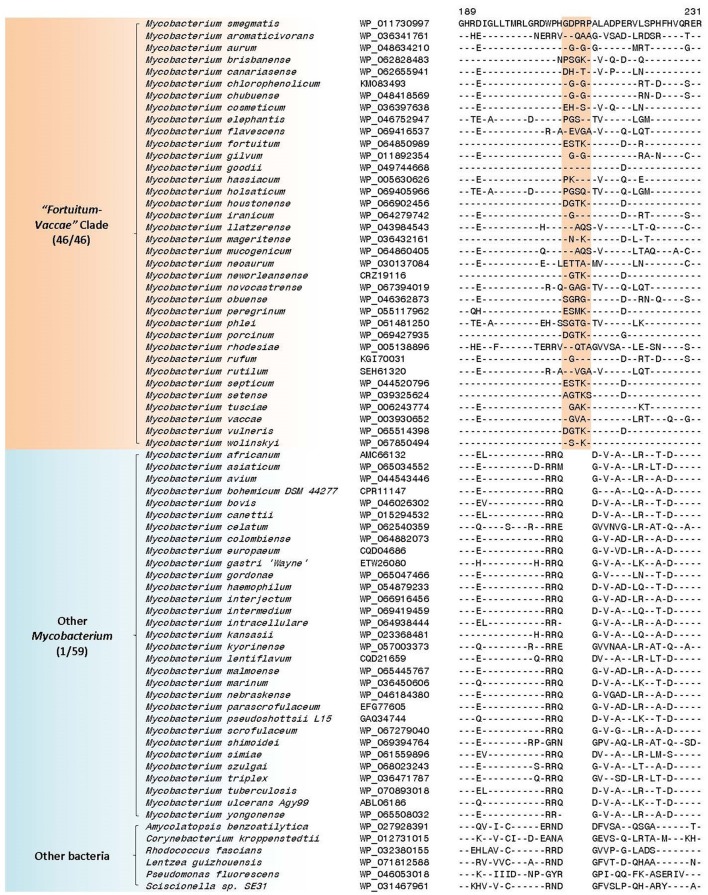
A partial sequence alignment of a conserved region of LacI family transcriptional regulator showing a five amino acid insertion that is specific for the “Fortuitum-Vaccae” clade; a more detailed alignment of this CSI is shown in Supplementary Figure 44. Sequence information for additional CSIs that are specific for this clade is shown in Supplementary Figures 44–47 and summarized in Table 4.
Figure 7
Figure 7
A partial sequence alignment of a conserved region of the protein alkyl/aryl sulfatase showing a one amino acid insertion that is specific for the Mycobacterium slow-growers (i.e., “Tuberculosis-Simiae” + “Terrae”) clade; a detailed alignment of this CSI is shown in Supplementary Figure 48. Additional CSIs that are specific for this clade are summarized in Table 4 and their sequence alignments are shown in Supplementary Figures 48–50.
Figure 8
Figure 8
Partial sequence alignment of a conserved region of a hypothetical protein showing a one amino acid deletion exclusively found in members of the “Tuberculosis-Simiae” clade; a detailed alignment of this CSI is shown in Supplementary Figure 51. Additional CSIs that are specific for this clade are shown in Supplementary Figures 51–53 and information for them is summarized in Table 4.
Figure 9
Figure 9
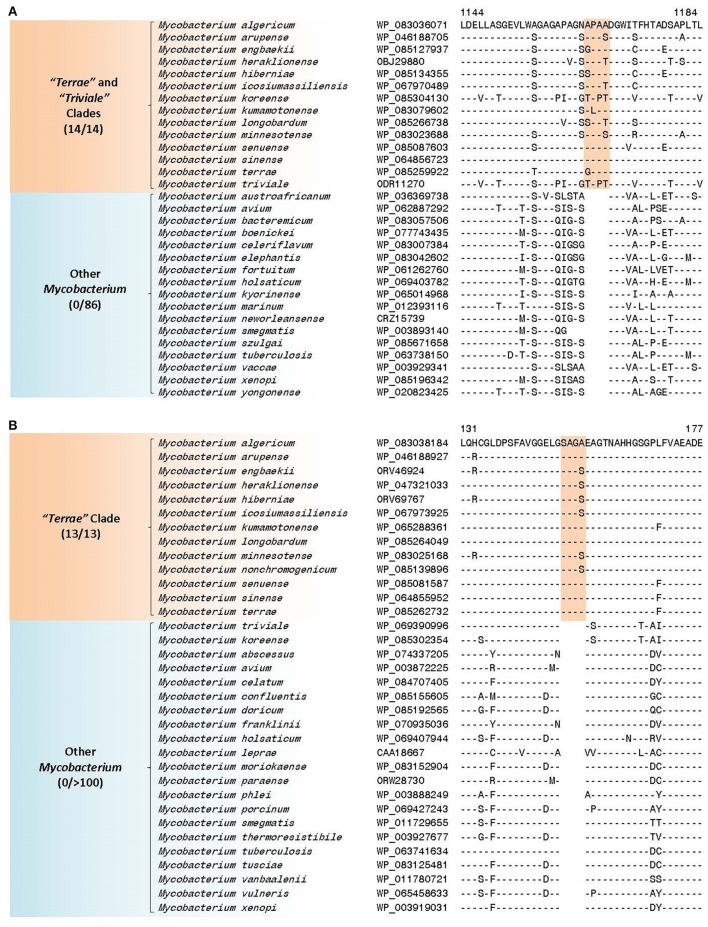
Partial sequence alignment of a conserved region of (A) ATP-dependent helicase showing a four amino acid insertion that is specific for the “Terrae” + “Triviale” clades and (B) UDP-N-acetylmuramate—L-alanine ligase showing a four amino acid insertion that is specific for only the members of the “Terrae” clade but lacking in members of the “Triviale” clade as well as other mycobacteria. More detailed alignments of these CSIs are shown in Supplementary Figures 54 and 74, respectively. Additional CSIs that are specific for this clade are shown in Supplementary Figures 35, 54–84 and summarized in Table 6.
Figure 10
Figure 10
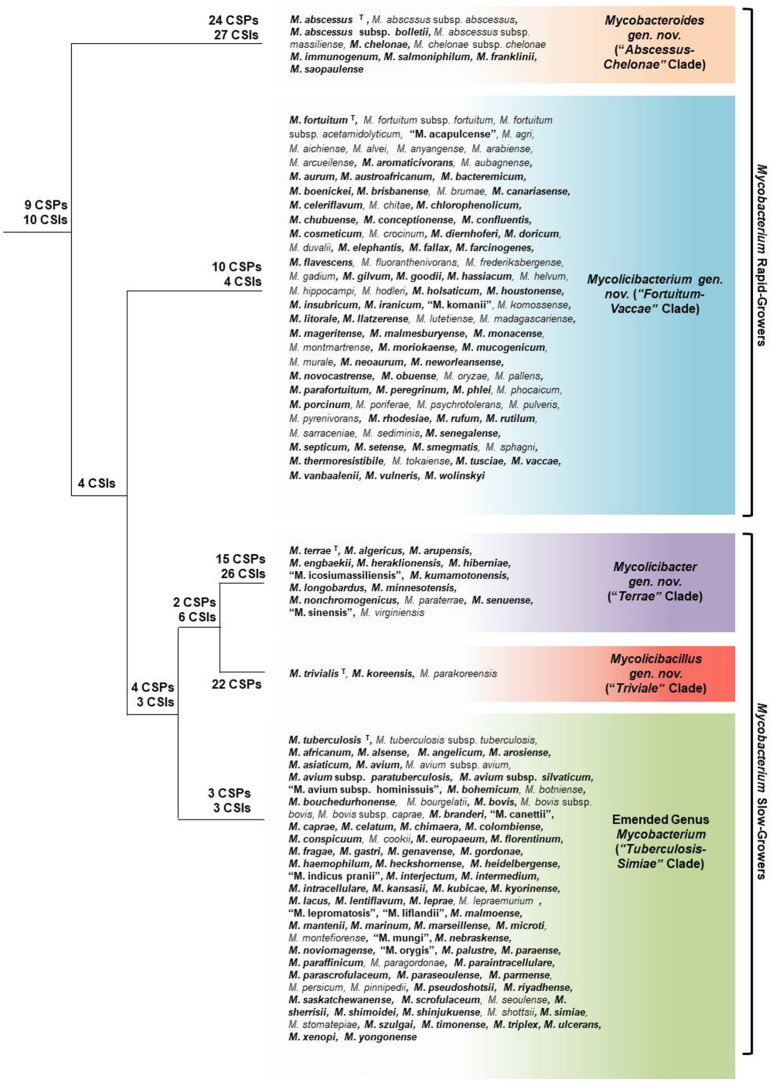
A summary diagram depicting the overall relationships among the major groups of mycobacterial species. The numbers of identified CSIs and CSPs, which are specific for different clades are marked on the nodes. The names of the five main clades of mycobacterial species identified in this work, viz. “Tuberculosis-Simiae,” “Terrae,”Triviale,” “Fortuitum-Vaccae,” and “Abscessus-Chelonae”, along with their proposed or emended names and the species which are part of these clades are marked. Species which have had their genomes analyzed in this study are bolded. The superscript letter T beside a species indicates that it is the type species of the genus. The placements of other mycobacterial species, whose genomes have not been sequenced into these clades are based on their branching in the 16S rRNA tree (Supplmentary Figure 2). The species whose names are not italicized and are placed within quotation marks have not yet been validly published.

Comment in

References

    1. Adékambi T., Drancourt M. (2004). Dissection of phylogenetic relationships among 19 rapidly growing Mycobacterium species by 16S rRNA, hsp65, sodA, recA and rpoB gene sequencing. Int. J. Syst. Evol. Microbiol. 54, 2095–2105. 10.1099/ijs.0.63094-0 - DOI - PubMed
    1. Adékambi T., Berger P., Raoult D., Drancourt M. (2006a). rpoB gene sequence-based characterization of emerging non-tuberculous mycobacteria with descriptions of Mycobacterium bolletii sp. nov., Mycobacterium phocaicum sp. nov. and Mycobacterium aubagnense sp. nov. Int. J. Syst. Evol. Microbiol. 56, 133–143. 10.1099/ijs.0.63969-0 - DOI - PubMed
    1. Adékambi T., Stein A., Carvajal J., Raoult D., Drancourt M. (2006b). Description of Mycobacterium conceptionense sp. nov., a Mycobacterium fortuitum group organism isolated from a posttraumatic osteitis inflammation. J. Clin. Microbiol. 44, 1268–1273. 10.1128/JCM.44.4.1268-1273.2006 - DOI - PMC - PubMed
    1. Adékambi T., Stein A., Carvajal J., Raoult D., Drancourt M. (2006c). Mycobacterium conceptionense sp. nov. in: list of new names and new combinations previously effectively, but not Validly, Published. List no. 111. Int. J. Syst. Evol. Microbiol. 56, 2025–2027. 10.1099/ijs.0.64643-0 - DOI - PubMed
    1. Adeolu M., Alnajar S., Naushad S., Gupta S. (2016). Genome-based phylogeny and taxonomy of the ‘Enterobacteriales’: proposal for Enterobacterales ord. nov. divided into the families Enterobacteriaceae, Erwiniaceae fam. nov., Pectobacteriaceae fam. nov., Yersiniaceae fam. nov., Hafniaceae fam. nov., Morganellaceae fam. nov., and Budviciaceae fam. nov. Int. J. Syst. Evol. Microbiol. 66, 5575–5599. 10.1099/ijsem.0.001485 - DOI - PubMed