


17-DMAG inhibits the multiplication of several Babesia species and Theileria equi on in vitro cultures, and Babesia microti in mice
- PMID: 29499568
- PMCID: PMC6114103
- DOI: 10.1016/j.ijpddr.2018.02.005
17-DMAG inhibits the multiplication of several Babesia species and Theileria equi on in vitro cultures, and Babesia microti in mice
Abstract
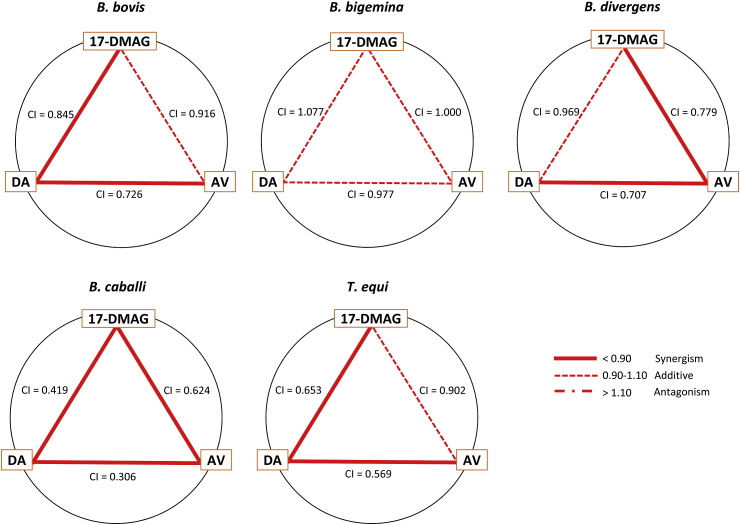
Heat shock protein 90 (Hsp90) is a chaperone protein that stabilizes cells during stress or non-stress responses. Previous reports have shown that Hsp90 is a potential drug target to suppress the multiplication of several protozoan parasites. In this study, 17-dimethylaminoethylamino-17-demethoxygeldanamycin (17-DMAG), an Hsp90 inhibitor, was evaluated for its inhibitory effect on five in vitro cultures of Babesia and Theileria species, including B. bovis, B. bigemina, B. divergens, B. caballi, and T. equi, and on the multiplication of a B. microti-infected mouse model. 17-DMAG showed the inhibitory effect in all of the species tested. The half maximum inhibition concentration (IC50) of 17-DMAG on B. bovis, B. bigemina, B. divergens, B. caballi, and T. equi was 77.6 ± 2.9, 62.4 ± 1.9, 183.8 ± 3.2, 88.5 ± 9.6, and 307.7 ± 7.2 nM, respectively. The toxicity assay on MDBK and NIH/3T3 cell lines showed that 17-DMAG affected the viability of cells with an IC50 of 15.5 ± 4 and 8.8 ± 2 μM, respectively. Since the IC50s were much lower on the parasites than on the host cell lines, the selectivity index were high for all tested species. Furthermore, the two-drug combination of 17-DMAG with diminazene aceturate (DA) and atovaquone (AV) showed synergism or addition on in vitro cultures of Babesia and Theileria parasites. In the mouse model, 17-DMAG at a concentration of 30 mg/kg BW effectively inhibited the multiplication of B. microti. Moreover, if combined with DA or AV, 17-DMAG showed a comparable inhibition at the half dose. Taken together, these results indicate that 17-DMAG is a potent drug for treating piroplamosis. The data warrant further evaluation of 17-DMAG as an antibabesial drug and as an option in combination with atovaquone for the treatment of human babesiosis.
Keywords: 17-DMAG; Babesia; Chemotherapeutic; Hsp90 inhibitor; Theileria.
Copyright © 2018. Published by Elsevier Ltd.
Figures




References
-
- Avarzed A., Igarashi I., Kanemaru T., Hirumi K., Omata Y., Saito A., Oyamada T., Nagasawa H., Toyoda Y., Suzuki N. Improved in vitro cultivation of Babesia caballi. J. Vet. Med. Sci. 1997;59:479–481. - PubMed
-
- Baldissera M.D., Grando T.H., Souza C.F., Cossetin L.F., Sagrillo M.R., Nascimento K., da Silva A.P., Dalla Lana D.F., Da Silva A.S., Stefani L.M., Monteiro S.G. Nerolidol nanospheres increases its trypanocidal efficacy against Trypanosoma evansi: new approach against diminazene aceturate resistance and toxicity. Exp. Parasitol. 2016;166:144–149. - PubMed
-
- Banumathy G., Singh V., Pavithra S.R., Tatu U. Heat shock protein 90 function is essential for Plasmodium falciparum growth in human erythrocytes. J. Biol. Chem. 2003;278:18336–18345. - PubMed
Publication types
MeSH terms
Substances
LinkOut - more resources
Full Text Sources
Other Literature Sources
