


Effects of combined high-intensity aerobic interval training program and Mediterranean diet recommendations after myocardial infarction (INTERFARCT Project): study protocol for a randomized controlled trial
- PMID: 29499766
- PMCID: PMC5834904
- DOI: 10.1186/s13063-018-2529-3
Effects of combined high-intensity aerobic interval training program and Mediterranean diet recommendations after myocardial infarction (INTERFARCT Project): study protocol for a randomized controlled trial
Abstract
Background: Exercise therapy has long been used for rehabilitation purposes after myocardial infarction (MI) and the benefit of regular physical exercise is also well-established. High-intensity interval training (HIIT) has been proposed to be more effective than continuous exercise for improving exercise capacity and health-related adaptations to low-volume (LV) and HIIT are also known. Furthermore, the Mediterranean diet (Mediet) has been widely reported to be a model of healthy eating for its contribution to a favorable health status and a better quality of life, reducing overall mortality. This study will investigate the effects of different HIIT programs (high-volume [HV] vs LV) and Mediet recommendations in clinical condition, cardiorespiratory fitness, biomarkers, ventricular function, and perception of quality of life after MI, and compared to an attention control group that is recommended to Mediet and physical activity without supervision sessions.
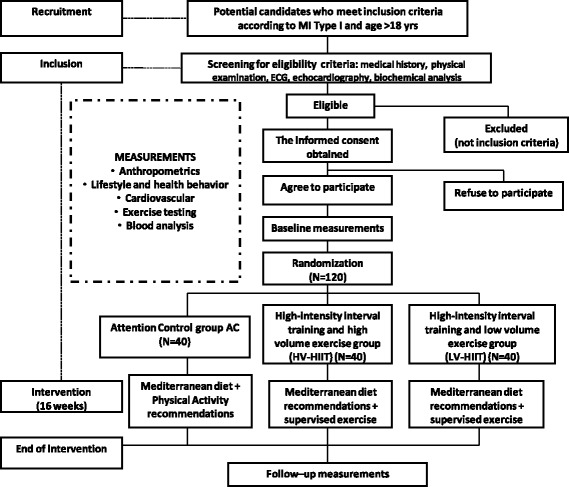
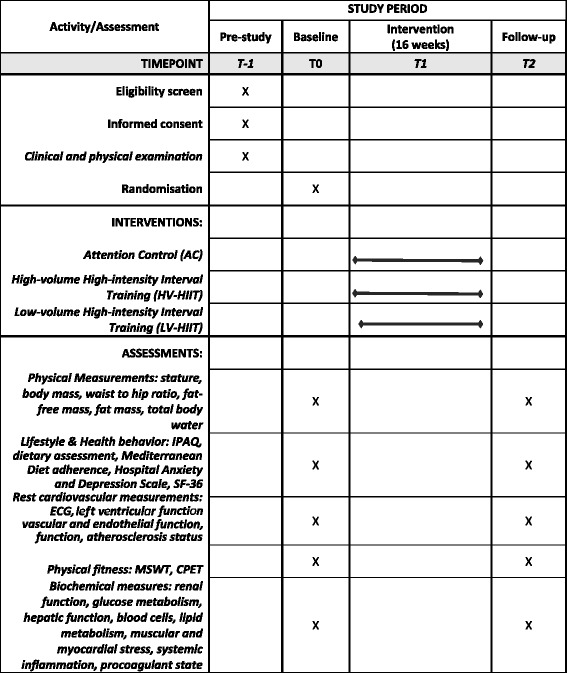
Methods/design: In this randomized controlled trial, cardiorespiratory fitness, anthropometry, central and peripheral cardiovascular variables, biochemical and nutritional condition, and quality of life will be assessed before and after 16 weeks of intervention in 177 participants diagnosed with MI type 1. All participants will be randomly (1:1:1) assigned to the attention control group or two exercise groups (Mediet recommendations plus supervised aerobic exercise two days/week: (1) HV (40 min) HIIT group and (2) LV (20 min) HIIT group.
Discussion: This study will be the first clinical trial comparing the effects of two different volumes of HIIT programs with Mediet recommendations for people after MI. The results of this study will provide good evidence for physical rehabilitation in this population.
Trial registration: ClinicalTrials.gov, NCT02876952 . Registered on 24 August 2016.
Keywords: Cardiorespiratory fitness; Exercise design; Health status; Low-volume training.
Conflict of interest statement
Ethics approval and consent to participate
The study conforms to the Declaration of Helsinki and has been approved by The Ethics Committee of the University of the Basque Country (UPV/EHU, CEISH, 2016) and the Ethics Committee of Clinical Investigation of Burgos University Hospital (CEIC 1462). All participants gave written informed consent.
Consent for publication
Not applicable.
Competing interests
The authors declare that they have no competing interests.
Publisher’s Note
Springer Nature remains neutral with regard to jurisdictional claims in published maps and institutional affiliations.
Figures
References
-
- Task Force on the management of ST-segment elevation acute myocardial infarction of the European Society of Cardiology (ESC) Steg PG, James SK, Atar D, Badano LP, Blomstrom-Lundqvist C, et al. ESC Guidelines for the management of acute myocardial infarction in patients presenting with ST-segment elevation. Eur Heart J. 2012;33:2569–2619. doi: 10.1093/eurheartj/ehs215. - DOI - PubMed
-
- Ribeiro F, Oliveira NL, Silva G, Campos L, Miranda F, Teixeira M, et al. Exercise-based cardiac rehabilitation increases daily physical activity of patients following myocardial infarction: subanalysis of two randomised controlled trials. Physiotherapy. 2017;103:59–65. doi: 10.1016/j.physio.2015.12.002. - DOI - PubMed
-
- Peixoto TC, Begot I, Bolzan DW, Machado L, Reis MS, Papa V, et al. Early exercise-based rehabilitation improves health-related quality of life and functional capacity after acute myocardial infarction: a randomized controlled trial. Can J Cardiol. 2015;31:308–313. doi: 10.1016/j.cjca.2014.11.014. - DOI - PubMed
Publication types
MeSH terms
Associated data
LinkOut - more resources
Full Text Sources
Other Literature Sources
Medical
