


Longitudinal Examination of the Bullying-Sexual Violence Pathway across Early to Late Adolescence: Implicating Homophobic Name-Calling
- PMID: 29500577
- PMCID: PMC6098975
- DOI: 10.1007/s10964-018-0827-4
Longitudinal Examination of the Bullying-Sexual Violence Pathway across Early to Late Adolescence: Implicating Homophobic Name-Calling
Abstract
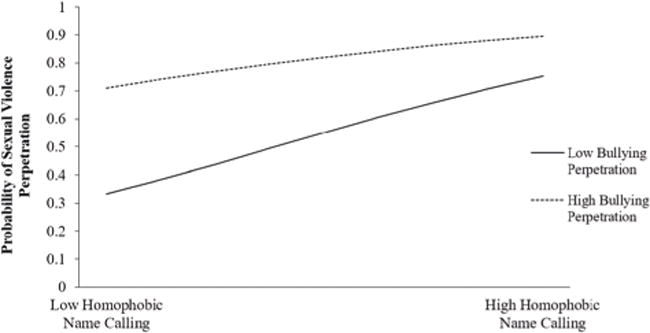
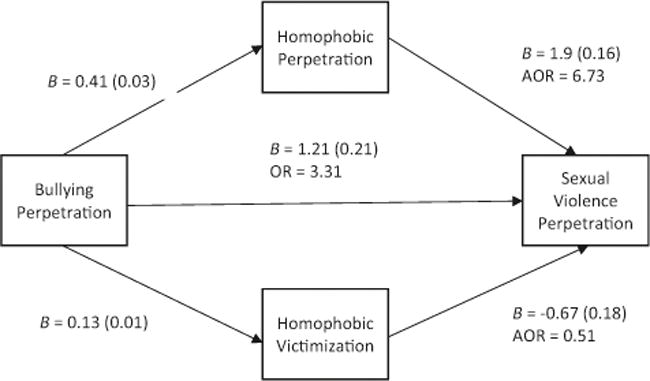
The Bully-Sexual Violence Pathway theory has indicated that bullying perpetration predicts sexual violence perpetration among males and females over time in middle school, and that homophobic name-calling perpetration moderates that association among males. In this study, the Bully-Sexual Violence Pathway theory was tested across early to late adolescence. Participants included 3549 students from four Midwestern middle schools and six high schools. Surveys were administered across six time points from Spring 2008 to Spring 2013. At baseline, the sample was 32.2% White, 46.2% African American, 5.4% Hispanic, and 10.2% other. The sample was 50.2% female. The findings reveal that late middle school homophobic name-calling perpetration increased the odds of perpetrating sexual violence in high school among early middle school bullying male and female perpetrators, while homophobic name-calling victimization decreased the odds of high school sexual violence perpetration among females. The prevention of bullying and homophobic name-calling in middle school may prevent later sexual violence perpetration.
Keywords: Adolescents; Bullying; Homophobic name-calling; Middle school; Sexual violence.
Conflict of interest statement
Figures
References
-
- Achenbach TM. Manual for the youth self-report and 1991 profile. Burlington: Department of Psychiatry, University of Vermont; 1991.
-
- Basile KC, DeGue S, Jones K, Freire K, Dills J, Smith SG, et al. STOP SV: a technical package to prevent sexual violence. Atlanta, GA: National Center for Injury Prevention and Control, Centers for Disease Control and Prevention; 2016.
-
- Basile KC, Espelage DL, Rivers I, McMahon PM, Simon TR. The theoretical and empirical links between bullying behavior and male sexual violence perpetration. Aggression and Violent Behavior. 2009;14(5):336–347.
-
- Basile KC, Smith SG, Breiding MJ, Black MC, Mahendra RR. Sexual violence surveillance: uniform de finitions and recommended data elements, version 2.0. Atlanta, GA: National Center for Injury Prevention and Control, Centers for Disease Control and Prevention; 2015.
-
- Birkett M, Espelage DL. Homophobic name-calling, peer-groups, and masculinity: the socialization of homophobic behavior in adolescents. Social Development. 2015;24:184–205. doi: 10.1111/sode.12085. . - DOI
MeSH terms
Grants and funding
LinkOut - more resources
Full Text Sources
Other Literature Sources
Medical
