


Review
doi: 10.1016/j.ceb.2018.02.009.
Epub 2018 Feb 28.
Subcellular scaling: does size matter for cell division?
Affiliations
- PMID: 29501026
- PMCID: PMC5988940
- DOI: 10.1016/j.ceb.2018.02.009
Item in Clipboard
Review
Subcellular scaling: does size matter for cell division?
Curr Opin Cell Biol.
2018 Jun.
Abstract
Among different species or cell types, or during early embryonic cell divisions that occur in the absence of cell growth, the size of subcellular structures, including the nucleus, chromosomes, and mitotic spindle, scale with cell size. Maintaining correct subcellular scales is thought to be important for many cellular processes and, in particular, for mitosis. In this review, we provide an update on nuclear and chromosome scaling mechanisms and their significance in metazoans, with a focus on Caenorhabditis elegans, Xenopus and mammalian systems, for which a common role for the Ran (Ras-related nuclear protein)-dependent nuclear transport system has emerged.
Copyright © 2018 Elsevier Ltd. All rights reserved.
Figures
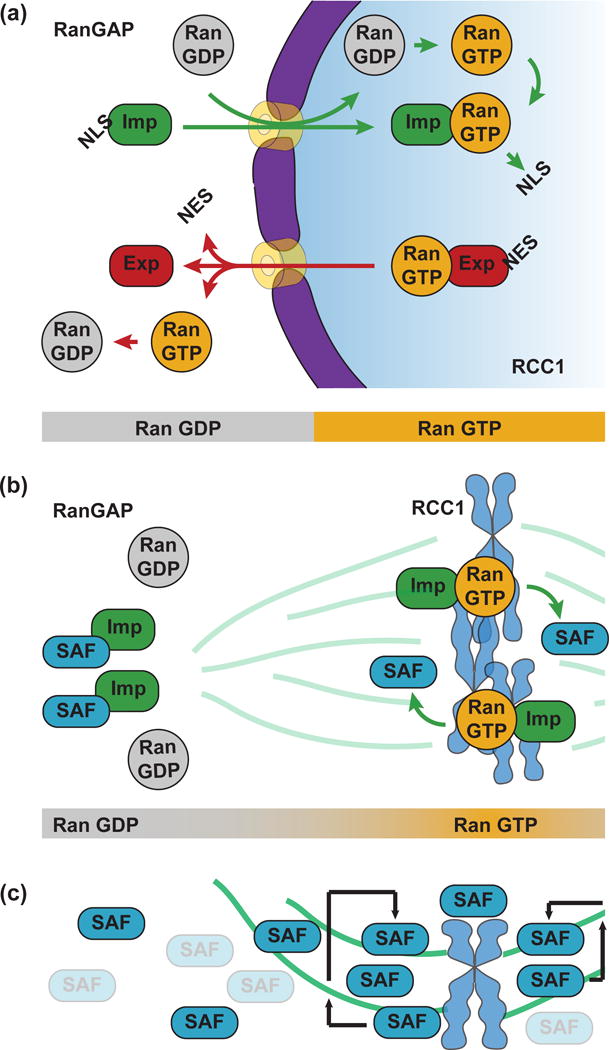
The RanGTP pathway and spindle assembly. (a) In interphase, Ran is GTP-bound in the nucleus due to the chromatin-associated RanGEF, RCC1, and GDP-bound in the cytoplasm due to cytoplasmic RanGAP. Proteins harboring an NLS are imported into the nucleus by importins and released when importins interact with RanGTP. Proteins containing an NES are exported out of the nucleus by RanGTP-bound exportins and released by GTP hydrolysis. (b) In mitosis, chromosome-bound RCC1 creates a Ran-GTP gradient near the chromosomes where NLS-containing SAFs are released from importins, promoting microtubule nucleation and stabilization. (c) Following microtubule nucleation by SAFs, the interaction between SAFs and microtubules leads to a feedback that further enriches SAFs on microtubules.
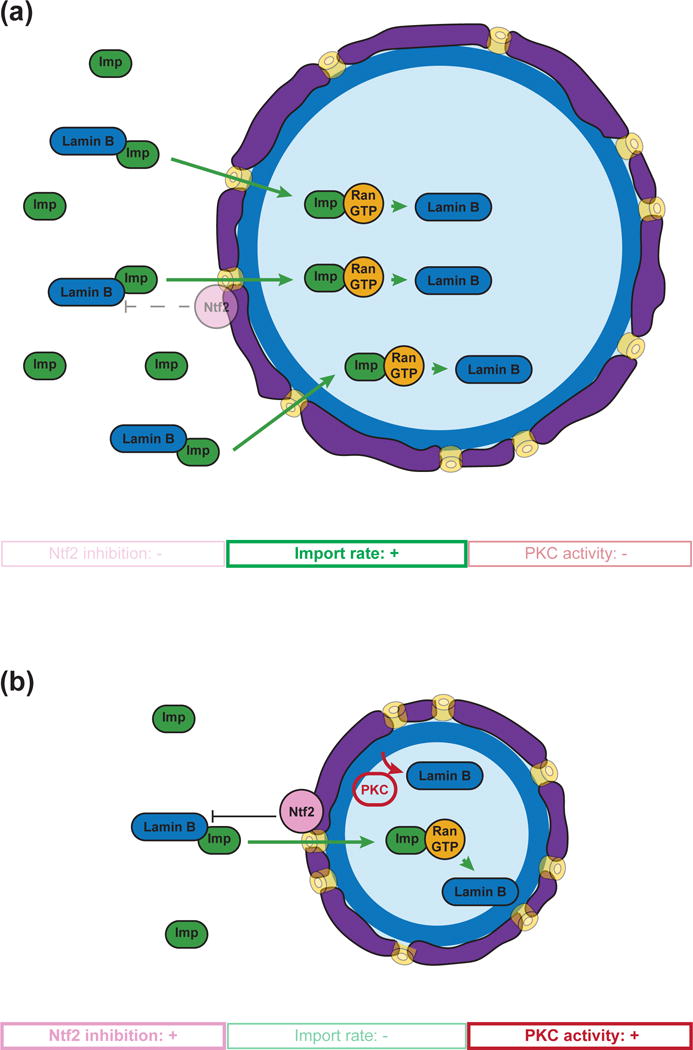
Mechanisms of nuclear scaling. (a) Nuclear import of lamins promotes nuclear growth. (b) Reduced import rate of lamins and PKC-driven lamin removal scale nuclei smaller. Moreover, Ran-dependent association of Ntf2 to the nuclear pore also affects nuclear size by inhibiting lamin import, perhaps by reducing the diameter of the nuclear pore complex.
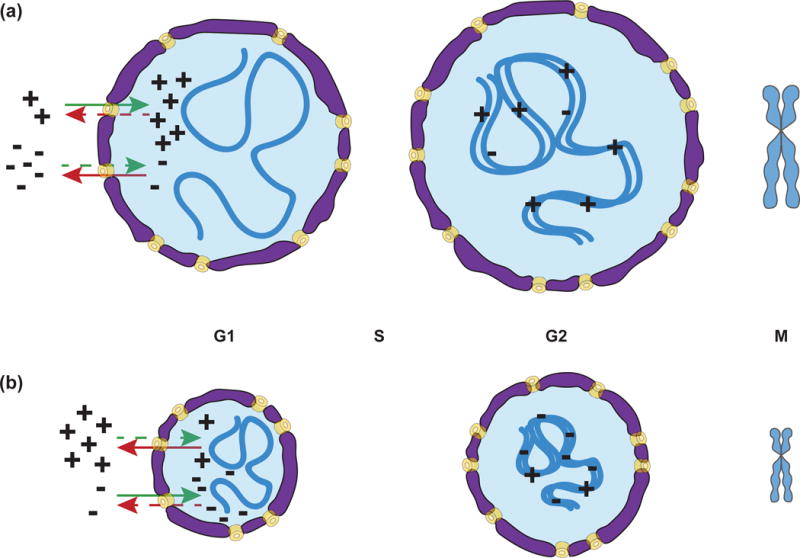
A possible model for chromosome scaling. Scaling factors that increase (+) or decrease (−) chromosome size are differentially imported/exported in interphase leading to more (+) factors and/or less (−) factors in large nuclei (a) and vice-versa in small nuclei (b). Scaling factors are then loaded during DNA replication and thus set chromosome size for mitosis.
References
-
- Oh D, Yu C-H, Needleman DJ. Spatial organization of the Ran pathway by microtubules in mitosis. Proc Natl Acad Sci. 2016;113:8729–8734. Using modeling and by manipulating cultured cells, Oh et al. revealed that the interaction between SAFs and microtubules leads to a feedback mechanism that spatially amplifies spindle assembly factors to render spindle size independent of the RanGTP gradient. - PMC - PubMed
Publication types
MeSH terms
Grants and funding
LinkOut - more resources
Full Text Sources
Other Literature Sources
Miscellaneous
