


Effect of Prostate Cancer Severity on Functional Outcomes After Localized Treatment: Comparative Effectiveness Analysis of Surgery and Radiation Study Results
- PMID: 29501451
- PMCID: PMC7643873
- DOI: 10.1016/j.eururo.2018.02.012
Effect of Prostate Cancer Severity on Functional Outcomes After Localized Treatment: Comparative Effectiveness Analysis of Surgery and Radiation Study Results
Abstract
Background: Whether prostate cancer severity modifies patient-reported functional outcomes after radical prostatectomy (RP) or external beam radiotherapy (EBRT) for localized cancer is unknown.
Objective: The purpose of this study was to determine whether differences in predicted function over time between RP and EBRT varied by risk group.
Design, setting, and participants: The Comparative Effectiveness Analysis of Surgery and Radiation (CEASAR) study is a prospective, population-based, observational study that enrolled men with localized prostate cancer in 2011-2012. Among 2117 CEASAR participants who underwent RP or EBRT, 817 had low-risk, 902 intermediate-risk, and 398 high-risk disease.
Outcome measurements and statistical analysis: Patient-reported, disease-specific function was measured using the 26-item Expanded Prostate Index Composite (at baseline and 6, 12, and 36 mo). Predicted function was estimated using regression models and compared by disease risk.
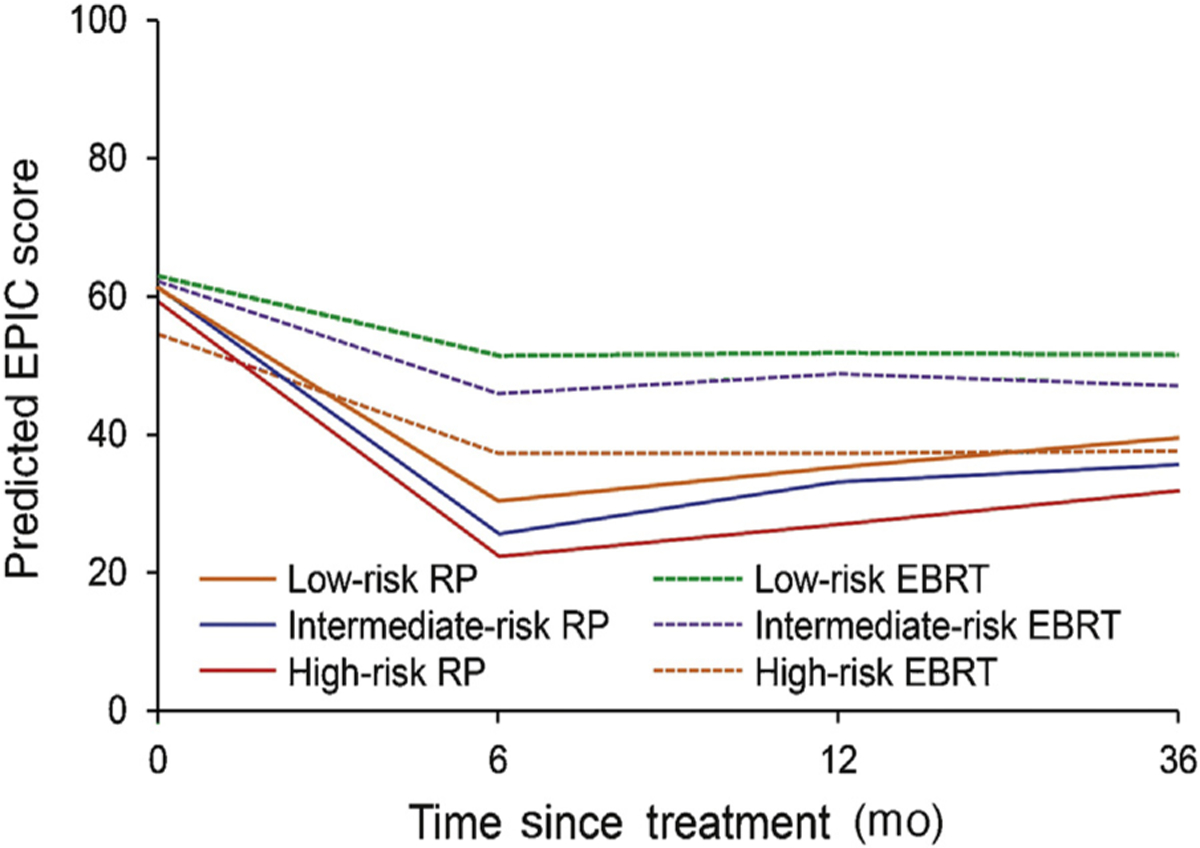
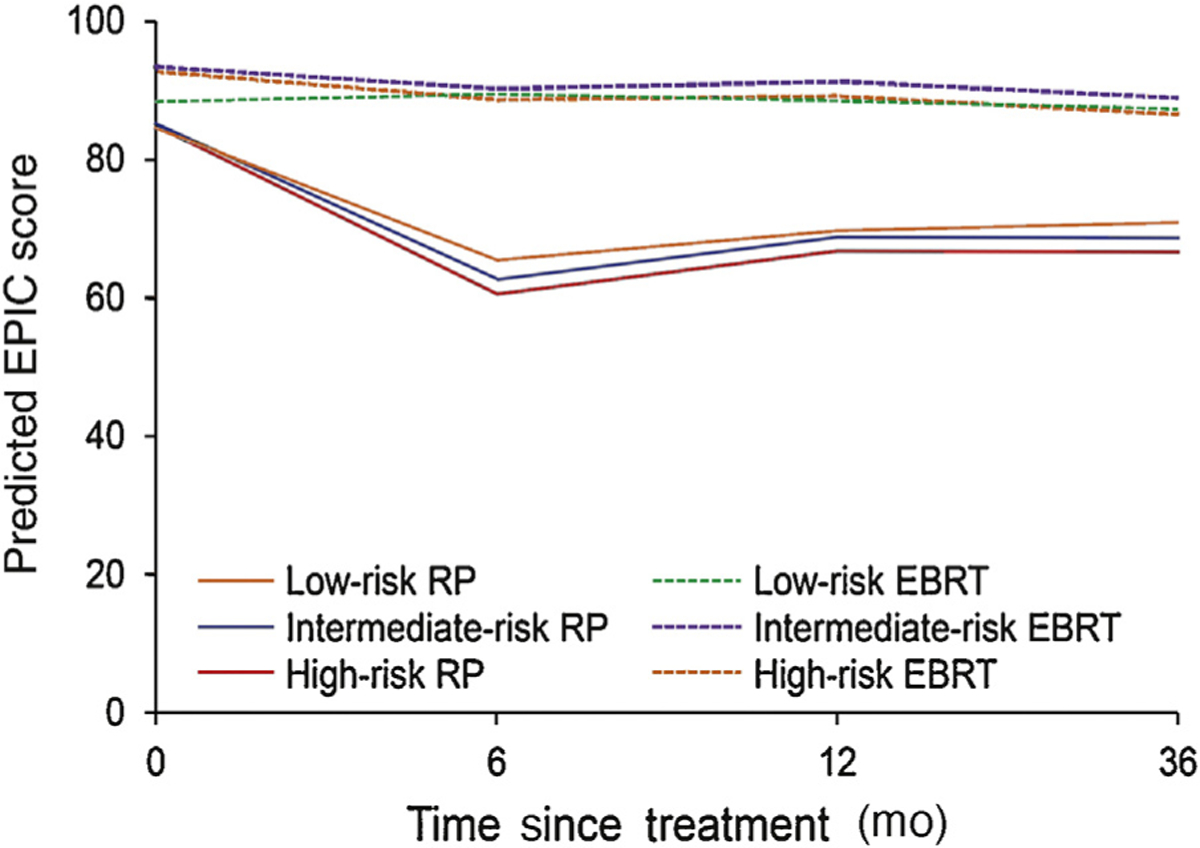
Results and limitations: Low-risk EBRT patients reported 3-yr sexual function scores 12 points higher than those of low-risk RP patients (RP, 39 points [95% confidence interval {CI}, 37-42] vs EBRT, 52 points [95% CI, 47-56]; p<0.001). The difference in 3-yr scores for high-risk patients was not clinically significant (RP, 32 points [95% CI, 28-35] vs EBRT, 38 points [95% CI, 33-42]; p=0.03). However, when using a commonly used binary definition of sexual function (erections firm enough for intercourse), no major differences were noted between RP and EBRT at 3 yr across low-, intermediate-, and high-risk disease strata. No clinically significant interactive effects between treatment and cancer severity were observed for incontinence, bowel, irritative voiding, and hormone domains. The primary limitation is the lack of firmly established thresholds for clinically significant differences in Expanded Prostate Index Composite domain scores.
Conclusions: For men with low-risk prostate cancer, EBRT was associated with higher sexual function scores at 3 yr than RP; however, for men with high-risk prostate cancer, no clinically significant difference was noted. Men with high-risk prostate cancer should be counseled that EBRT and RP carry similar sexual function outcomes at 3 yr.
Patient summary: In this report, we studied the urinary, sexual, bowel, and hormonal functions of patients 3 yr after undergoing prostate cancer surgery or radiation. We found that for patients with high-risk disease, sexual function was similar between surgery and radiation. We conclude that high-risk patients undergoing radiation therapy should be counseled that sexual function may not be as good as low-risk patients undergoing radiation.
Keywords: Comparative effectiveness; Disease risk; Patient-reported function; Prostate cancer; Radiation; Surgery.
Copyright © 2018 European Association of Urology. Published by Elsevier B.V. All rights reserved.
Figures
Comment in
-
The New Standard: Personalised Information about the Risks and Benefits of Treatment Strategies for Localised Prostate Cancer.Eur Urol. 2018 Jul;74(1):34-36. doi: 10.1016/j.eururo.2018.03.018. Epub 2018 Apr 13. Eur Urol. 2018. PMID: 29656852 No abstract available.
References
-
- D’Amico AV, Whittington R, Malkowicz SB, et al. Biochemical outcome after radical prostatectomy, external beam radiation therapy, or interstitial radiation therapy for clinically localized prostate cancer. JAMA 1998;280:969–74. - PubMed
-
- Wilke DR, Parker C, Andonowski A, et al. Testosterone and erectile function recovery after radiotherapy and long-term androgen deprivation with luteinizing hormone-releasing hormone agonists. BJU Int 2006;97:963–8. - PubMed
-
- Walsh PC, Marschke P, Ricker D, Burnett AL. Patient-reported urinary continence and sexual function after anatomic radical prostatectomy. Urology 2000;55:58–61. - PubMed
Publication types
MeSH terms
Grants and funding
LinkOut - more resources
Full Text Sources
Other Literature Sources
Medical
