


Bacteria-like mesoporous silica-coated gold nanorods for positron emission tomography and photoacoustic imaging-guided chemo-photothermal combined therapy
- PMID: 29501970
- PMCID: PMC5880312
- DOI: 10.1016/j.biomaterials.2018.02.043
Bacteria-like mesoporous silica-coated gold nanorods for positron emission tomography and photoacoustic imaging-guided chemo-photothermal combined therapy
Abstract
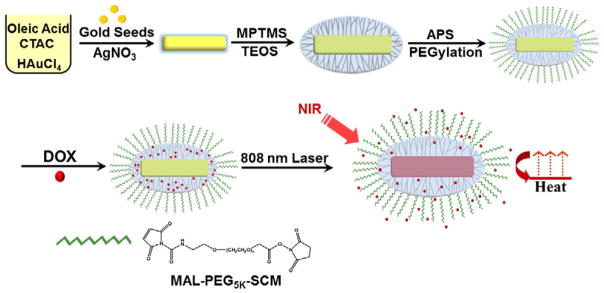
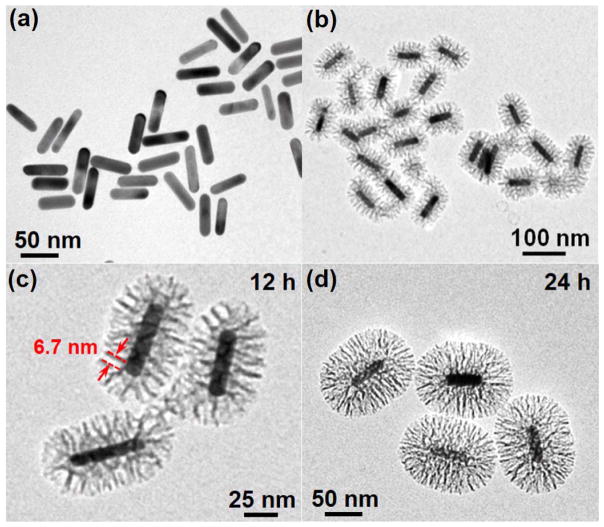
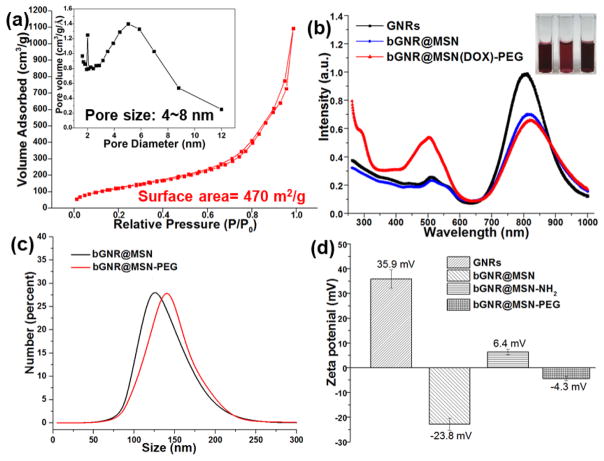
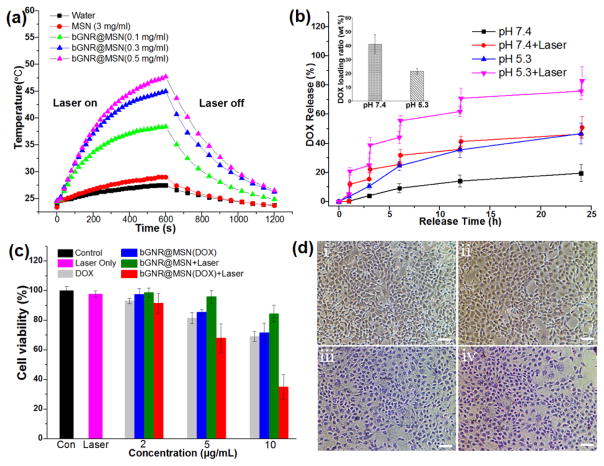
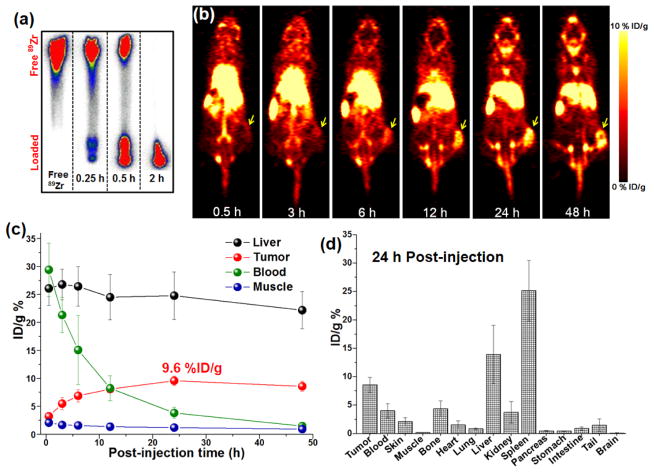
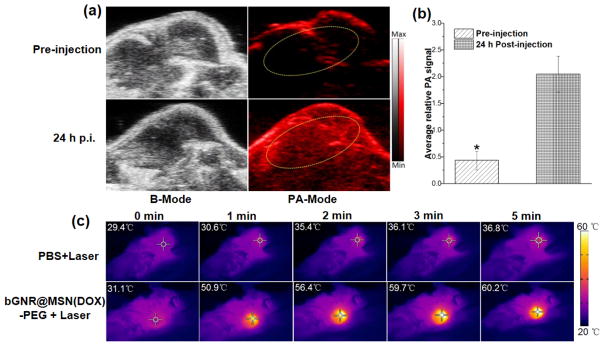
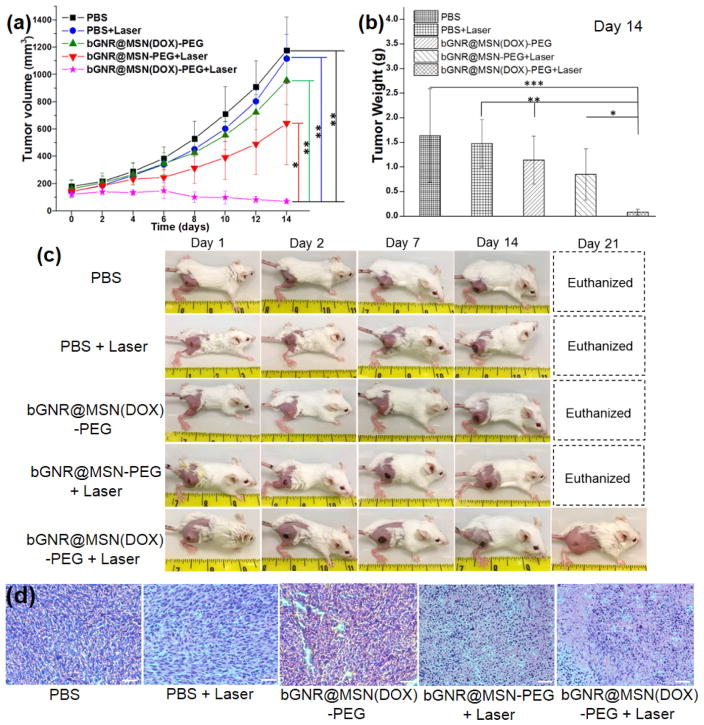
Mesoporous silica nanoshell (MSN) coating has been demonstrated as a versatile surface modification strategy for various kinds of inorganic functional nanoparticles, such as gold nanorods (GNRs), to achieve not only improved nanoparticle stability but also concomitant drug loading capability. However, limited drug loading capacity and low tumor accumulation rate in vivo are two major challenges for the biomedical applications of MSN-coated GNRs (GNR@MSN). In this study, by coating uniformly sized GNRs with MSN in an oil-water biphase reaction system, we have successfully synthesized a new bacteria-like GNR@MSN (i.e., bGNR@MSN) with a significantly enlarged pore size (4-8 nm) and surface area (470 m2/g). After PEGylation and highly efficient loading of doxorubicin (DOX, 40.9%, w/w), bGNR@MSN were used for positron emission tomography (PET, via facile and chelator-free 89Zr-labeling) and photoacoustic imaging-guided chemo-photothermal cancer therapy in vivo. PET imaging showed that 89Zr-labeled bGNR@MSN(DOX)-PEG can passively target to the 4T1 murine breast cancer-bearing mice with high efficiency (∼10 %ID/g), based on enhanced permeability and retention effect. Significantly enhanced chemo-photothermal combination therapy was also achieved due to excellent photothermal effect and near-infrared-light-triggered drug release by bGNR@MSN(DOX)-PEG at the tumor site. The promising results indicate great potential of bGNR@MSN-PEG nanoplatforms for future cancer diagnosis and therapy.
Keywords: Cancer; Chemo-photothermal therapy; Gold nanorods; Mesoporous silica nanoparticles; Positron emission tomography; Theranostics.
Copyright © 2018 Elsevier Ltd. All rights reserved.
Conflict of interest statement
Notes
The authors declare no competing financial interest.
Figures
References
-
- Nguyen SC, Zhang Q, Manthiram K, Ye X, Lomont JP, Harris CB, Weller H, Alivisatos AP. Study of heat transfer dynamics from gold nanorods to the environment via time-resolved infrared spectroscopy. ACS Nano. 2016;10:2144–2151. - PubMed
-
- Tan SF, Anand U, Mirsaidov U. Interactions and attachment pathways between functionalized gold nanorods. ACS Nano. 2017;11:1633–1640. - PubMed
-
- Xu C, Yang D, Mei L, Lu B, Chen L, Li Q, Zhu H, Wang T. Encapsulating gold nanoparticles or nanorods in graphene oxide shells as a novel gene vector. ACS Appl Mater Interfaces. 2013;5:2715–2724. - PubMed
-
- Burrows ND, Lin W, Hinman JG, Dennison JM, Vartanian AM, Abadeer NS, Grzincic EM, Jacob LM, Li J, Murphy CJ. Surface chemistry of gold nanorods. Langmuir. 2016;32:9905–9921. - PubMed
Publication types
MeSH terms
Substances
Grants and funding
LinkOut - more resources
Full Text Sources
Other Literature Sources
Research Materials
Miscellaneous
