


Excision of Nucleopolyhedrovirus Form Transgenic Silkworm Using the CRISPR/Cas9 System
- PMID: 29503634
- PMCID: PMC5820291
- DOI: 10.3389/fmicb.2018.00209
Excision of Nucleopolyhedrovirus Form Transgenic Silkworm Using the CRISPR/Cas9 System
Abstract
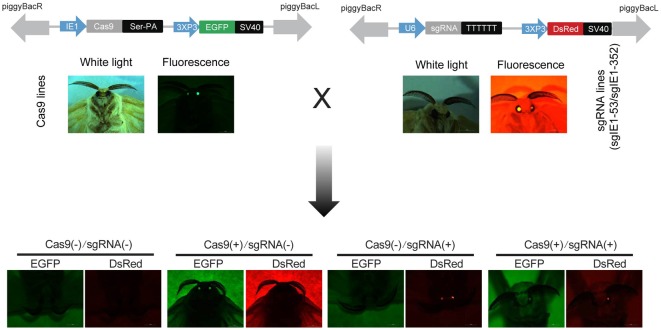
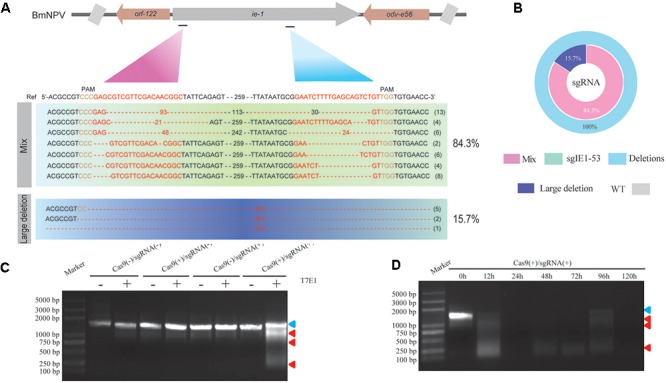
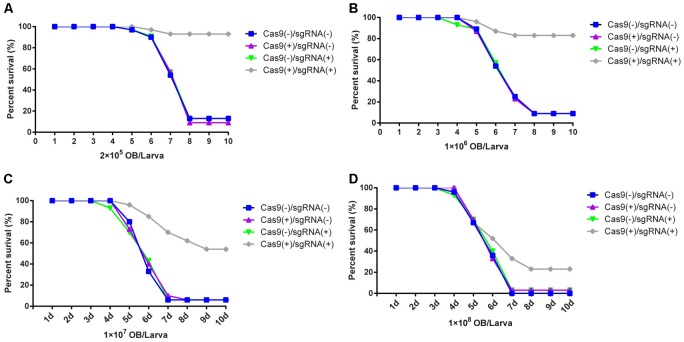
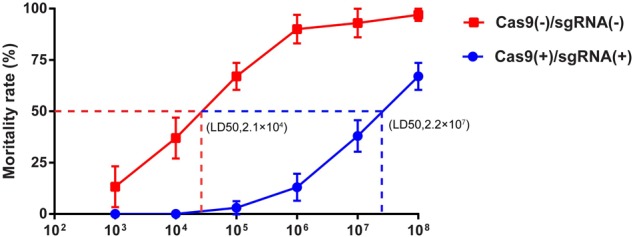
The CRISPR/Cas9-mediated genome engineering has been shown to efficiently suppress infection by disrupting genes of the pathogen. We recently constructed transgenic lines expressing CRISPR/Cas9 and the double sgRNA target Bombyx mori nucleopolyhedrovirus (BmNPV) immediate early-1 (ie-1) gene in the silkworm, respectively, and obtained four transgenic hybrid lines by G1 generation hybridization: Cas9(-)/sgRNA(-), Cas9(+)/sgRNA(-), Cas9(-)/sgRNA(+), and Cas9(+)/sgRNA(+). We demonstrated that the Cas9(+)/sgRNA(+) transgenic lines effectively edited the target site of the BmNPV genome, and large fragment deletion was observed after BmNPV infection. Further antiviral analysis of the Cas9(+)/sgRNA(+) transgenic lines shows that the median lethal dose (LD50) is 1,000-fold higher than the normal lines after inoculation with occlusion bodies. The analysis of economic characters and off-target efficiency of Cas9(+)/sgRNA(+) transgenic hybrid line showed no significant difference compared with the normal lines. Our findings indicate that CRISPR/Cas9-mediated genome engineering more effectively targets the BmNPV genomes and could be utilized as an insect antiviral treatment.
Keywords: BmNPV; Bombyx mori; CRISPR/Cas9; antiviral therapy; transgenic.
Figures
References
-
- Arakawa T., Furuta Y., Miyazawa M., Kato M. (2002). Flufenoxuron, an insect growth regulator, promotes peroral infection by nucleopolyhedrovirus (BmNPV) budded particles in the silkworm, Bombyx mori L. J. Virol. Methods 100 141–147. - PubMed
-
- Burkard C., Lillico S. G., Reid E., Jackson B., Mileham A. J., Ait-Ali T., et al. (2017). Precision engineering for PRRSV resistance in pigs: macrophages from genome edited pigs lacking CD163 SRCR5 domain are fully resistant to both PRRSV genotypes while maintaining biological function. PLOS Pathog. 13:e1006206. 10.1371/journal.ppat.1006206 - DOI - PMC - PubMed
LinkOut - more resources
Full Text Sources
Other Literature Sources
