Regenerative agriculture: merging farming and natural resource conservation profitably
- PMID: 29503771
- PMCID: PMC5831153
- DOI: 10.7717/peerj.4428
Regenerative agriculture: merging farming and natural resource conservation profitably
Abstract
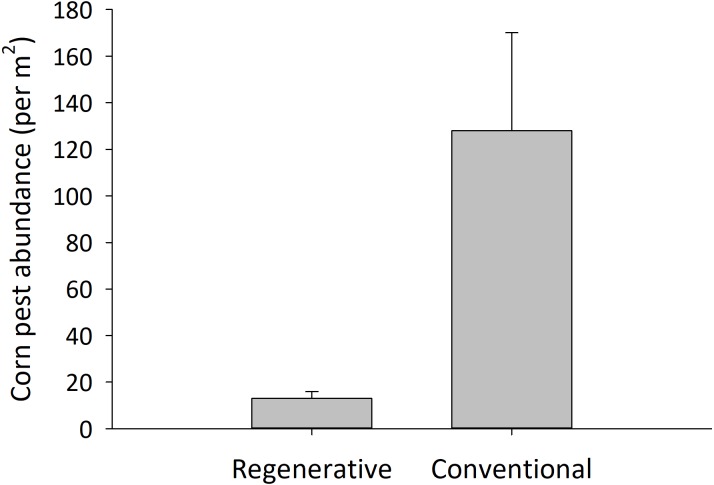
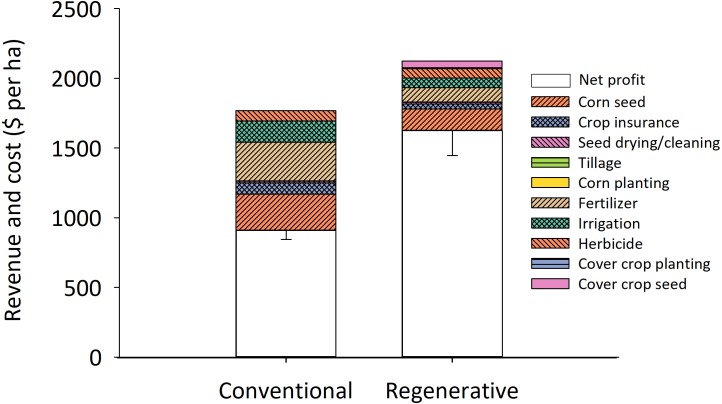
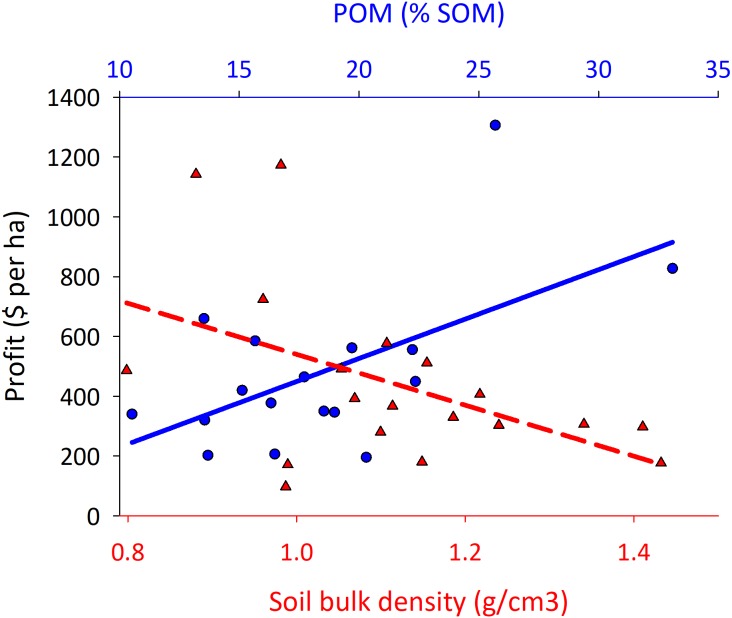
Most cropland in the United States is characterized by large monocultures, whose productivity is maintained through a strong reliance on costly tillage, external fertilizers, and pesticides (Schipanski et al., 2016). Despite this, farmers have developed a regenerative model of farm production that promotes soil health and biodiversity, while producing nutrient-dense farm products profitably. Little work has focused on the relative costs and benefits of novel regenerative farming operations, which necessitates studying in situ, farmer-defined best management practices. Here, we evaluate the relative effects of regenerative and conventional corn production systems on pest management services, soil conservation, and farmer profitability and productivity throughout the Northern Plains of the United States. Regenerative farming systems provided greater ecosystem services and profitability for farmers than an input-intensive model of corn production. Pests were 10-fold more abundant in insecticide-treated corn fields than on insecticide-free regenerative farms, indicating that farmers who proactively design pest-resilient food systems outperform farmers that react to pests chemically. Regenerative fields had 29% lower grain production but 78% higher profits over traditional corn production systems. Profit was positively correlated with the particulate organic matter of the soil, not yield. These results provide the basis for dialogue on ecologically based farming systems that could be used to simultaneously produce food while conserving our natural resource base: two factors that are pitted against one another in simplified food production systems. To attain this requires a systems-level shift on the farm; simply applying individual regenerative practices within the current production model will not likely produce the documented results.
Keywords: Agroecology; Biodiversity; Conservation agriculture; Corn; Pest management; Profit; Soil organic matter; Yield.
Conflict of interest statement
Jonathan G. Lundgren is the CEO for Blue Dasher Farm and director of the Ecdysis Foundation. Claire E. LaCanne is an employee of the University of Minnesota, and was a graduate student for South Dakota State University during her thesis program (this work is part of that thesis).
Figures
References
-
- Barbosa P, Hines J, Kaplan I, Martinson H, Szczepaniec A, Szendrei Z. Associational resistance and susceptibility: having right or wrong neighbors. Annual Review of Ecology, Evolution & Systematics. 2009;40:1–20. doi: 10.1146/annurev.ecolsys.110308.120242. - DOI
-
- Beman JM, Chow C-E, King AL, Feng Y, Fuhrman JA, Andersson A, Bates NR, Popp BN, Hutchings DA. Global declines in oceanic nitrification rates as a consequence of ocean acidification. Proceedings of the National Academy of Sciences of the United States of America. 2011;108:208–213. doi: 10.1073/pnas.1011053108. - DOI - PMC - PubMed
-
- Bullock DG. Crop rotation. Critical Reviews in Plant Sciences. 1992;11:309–326. doi: 10.1080/07352689209382349. - DOI
LinkOut - more resources
Full Text Sources
Other Literature Sources