


Comparison of 3 He and 129 Xe MRI for evaluation of lung microstructure and ventilation at 1.5T
- PMID: 29504181
- PMCID: PMC6175321
- DOI: 10.1002/jmri.25992
Comparison of 3 He and 129 Xe MRI for evaluation of lung microstructure and ventilation at 1.5T
Abstract
Background: To support translational lung MRI research with hyperpolarized 129 Xe gas, comprehensive evaluation of derived quantitative lung function measures against established measures from 3 He MRI is required. Few comparative studies have been performed to date, only at 3T, and multisession repeatability of 129 Xe functional metrics have not been reported.
Purpose/hypothesis: To compare hyperpolarized 129 Xe and 3 He MRI-derived quantitative metrics of lung ventilation and microstructure, and their repeatability, at 1.5T.
Study type: Retrospective.
Population: Fourteen healthy nonsmokers (HN), five exsmokers (ES), five patients with chronic obstructive pulmonary disease (COPD), and 16 patients with nonsmall-cell lung cancer (NSCLC).
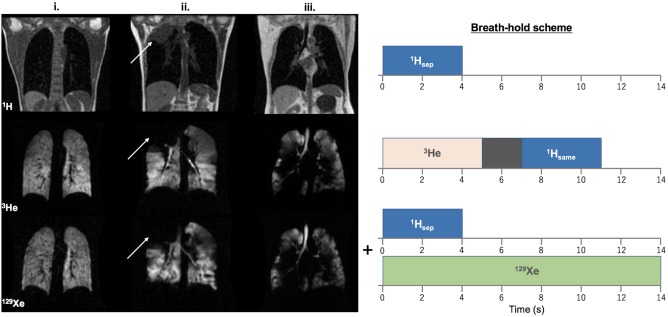
Field strength/sequence: 1.5T. NSCLC, COPD patients and selected HN subjects underwent 3D balanced steady-state free-precession lung ventilation MRI using both 3 He and 129 Xe. Selected HN, all ES, and COPD patients underwent 2D multislice spoiled gradient-echo diffusion-weighted lung MRI using both hyperpolarized gas nuclei.
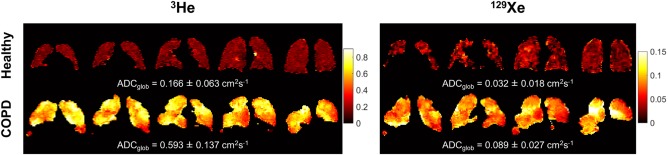
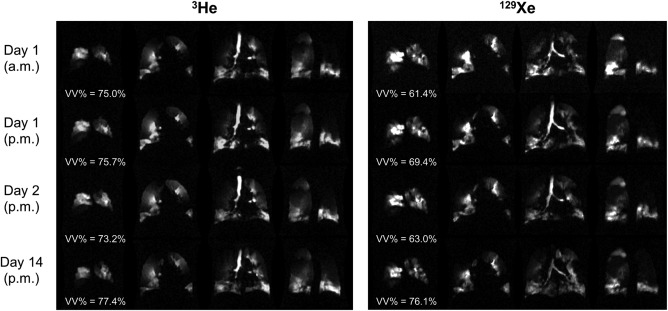
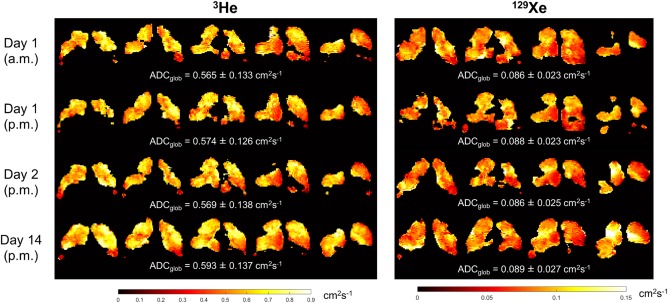
Assessment: Ventilated volume percentages (VV%) and mean apparent diffusion coefficients (ADC) were derived from imaging. COPD patients performed the whole MR protocol in four separate scan sessions to assess repeatability. Same-day pulmonary function tests were performed.
Statistical tests: Intermetric correlations: Spearman's coefficient. Intergroup/internuclei differences: analysis of variance / Wilcoxon's signed rank. Repeatability: coefficient of variation (CV), intraclass correlation (ICC) coefficient.
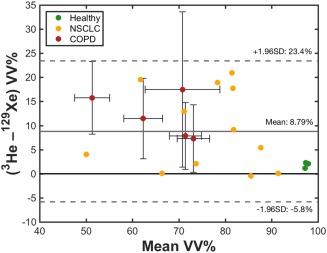
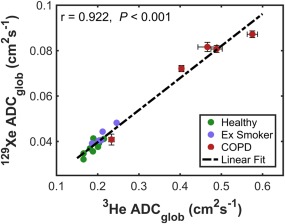
Results: A significant positive correlation between 3 He and 129 Xe VV% was observed (r = 0.860, P < 0.001). VV% was larger for 3 He than 129 Xe (P = 0.001); average bias, 8.79%. A strong correlation between mean 3 He and 129 Xe ADC was obtained (r = 0.922, P < 0.001). MR parameters exhibited good correlations with pulmonary function tests. In COPD patients, mean CV of 3 He and 129 Xe VV% was 4.08% and 13.01%, respectively, with ICC coefficients of 0.541 (P = 0.061) and 0.458 (P = 0.095). Mean 3 He and 129 Xe ADC values were highly repeatable (mean CV: 2.98%, 2.77%, respectively; ICC: 0.995, P < 0.001; 0.936, P < 0.001). DATA CONCLUSION: 129 Xe lung MRI provides near-equivalent information to 3 He for quantitative lung ventilation and microstructural MRI at 1.5T.
Level of evidence: 3 Technical Efficacy Stage 2 J. Magn. Reson. Imaging 2018.
Keywords: chronic obstructive pulmonary disease; helium-3; hyperpolarized gas; lung MRI; lung cancer; repeatability; xenon-129.
© 2018 The Authors Journal of Magnetic Resonance Imaging published by Wiley Periodicals, Inc. on behalf of International Society for Magnetic Resonance in Medicine.
Figures
References
-
- Kirby M, Svenningsen S, Owrangi A, et al. Hyperpolarized 3 He and 129 Xe MR imaging in healthy volunteers and patients with chronic obstructive pulmonary disease. Radiology 2012;265:600–610. - PubMed
Grants and funding
LinkOut - more resources
Full Text Sources
Other Literature Sources
Research Materials
