


Advancing diabetes management in adolescents: Comparative effectiveness of mobile self-monitoring blood glucose technology and family-centered goal setting
- PMID: 29504207
- PMCID: PMC6476179
- DOI: 10.1111/pedi.12648
Advancing diabetes management in adolescents: Comparative effectiveness of mobile self-monitoring blood glucose technology and family-centered goal setting
Abstract
Background: As adolescents gain autonomy, it remains important for parents to be involved with diabetes management to avoid deterioration in glycemic control. Technologies for self-monitoring of blood glucose (SMBG) allow for remote monitoring in real-time by parents. This research compared 3 strategies for improving SMBG and diabetes self-care in the short-term. These strategies were: (1) health information technology (HIT)-enhanced blood glucose meter that shared blood glucose data among patients, their parent, and care providers, and allowed for text messaging; (2) family-centered goal setting; and (3) a combination of (1) and (2).
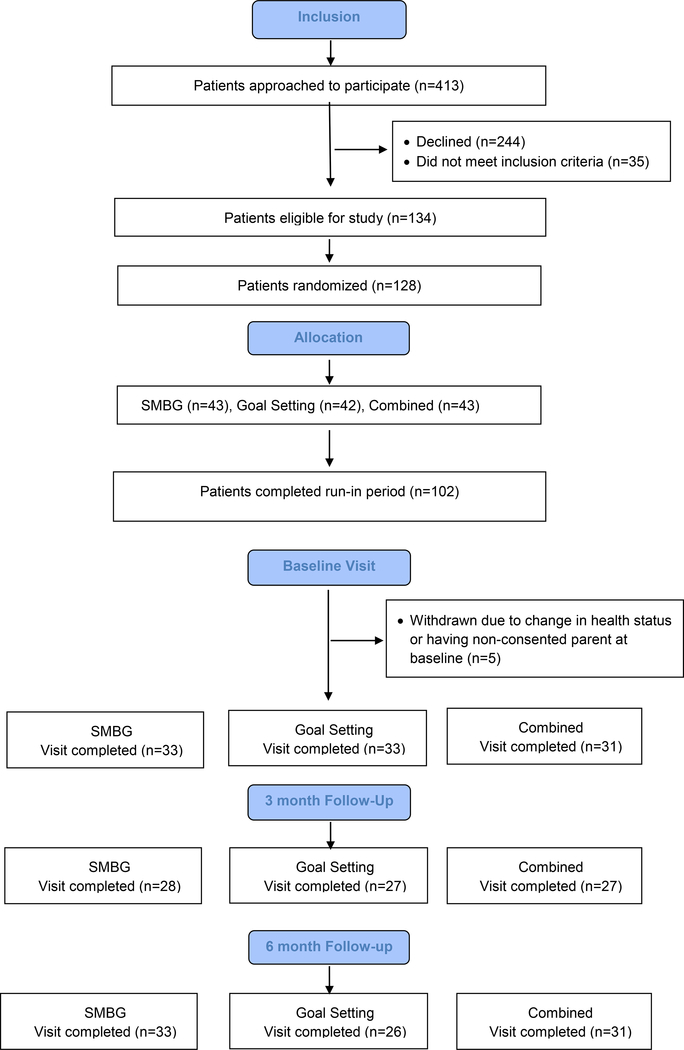
Methods: One hundred twenty-eight participants enrolled; 97 adolescent-parent pairs attended clinic at 3-month intervals during the 6-month intervention. Differences between treatment groups were evaluated using analysis of variance (ANOVAs) for continuous variables and χ2 tests for frequencies. Within patient changes were evaluated using paired t tests.
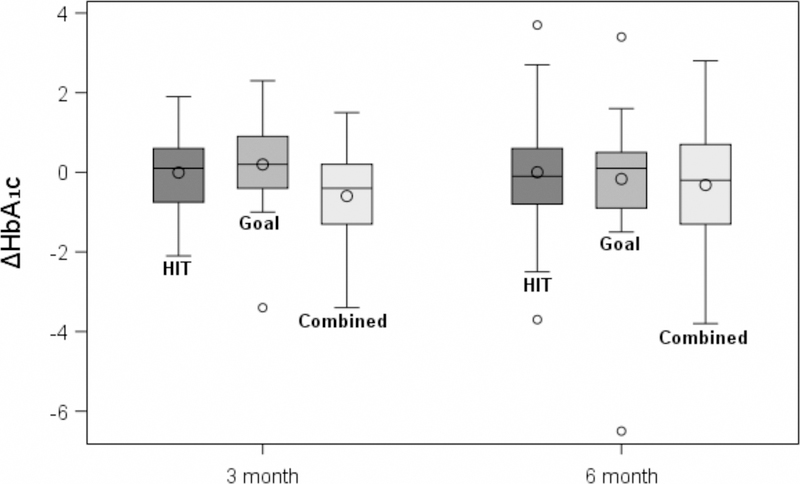
Results: Participants in the HIT-enhanced SMBG group had no change in mean glycosylated hemoglobin (HbA1c). Participants assigned to family-centered goal setting had a non-significant decrease in HbA1c of -0.3% (P = .26) from baseline to 6 months. Participants in the combined approach had a significant decrease in HbA1c of -0.6% (P = .02) from baseline to 3 months, but the decrease of -0.4% at 6 months was non-significant (P = .51). The change in HbA1c from baseline to 3 months was greater for the combined approach than for the HIT-enhanced SMBG (P = .05) or family-centered goal setting (P = .01).
Conclusions: Our data suggest that utilizing the family-centered goal setting strategy when implementing HIT-enhanced diabetes technology deserves further study.
Keywords: adherence; blood glucose self-monitoring; patient-centered care; self-care; type 1 diabetes mellitus.
© 2018 John Wiley & Sons A/S. Published by John Wiley & Sons Ltd.
Figures
References
-
- Ingerski LM, Anderson BJ, Dolan LM, & Hood KK (2010) Blood glucose monitoring and glycemic control in adolescence: contribution of diabetes-specific responsibility and family conflict. The Journal of adolescent health : official publication of the Society for Adolescent Medicine 47(2):191–197. - PMC - PubMed
Publication types
MeSH terms
Substances
Grants and funding
LinkOut - more resources
Full Text Sources
Other Literature Sources
Medical
Research Materials
