


Effectiveness and neural mechanisms of home-based telerehabilitation in patients with stroke based on fMRI and DTI: A study protocol for a randomized controlled trial
- PMID: 29504985
- PMCID: PMC5779754
- DOI: 10.1097/MD.0000000000009605
Effectiveness and neural mechanisms of home-based telerehabilitation in patients with stroke based on fMRI and DTI: A study protocol for a randomized controlled trial
Abstract
Background: Stroke is one of leading diseases causing adult death and disability worldwide. Home-based telerehabilitation has become a novel approach for stroke patients as effective as conventional rehabilitation, and more convenient and economical than conventional rehabilitation. However, there is no study assessing the mechanism of home-based telerehabilitation in promoting motor recovery among stroke patients with hemiplegic.
Aims: This study is designed to determine the efficacy and explore the mechanism of motor recovery after home-based telerehabilitation in stroke patients with motor deficits.
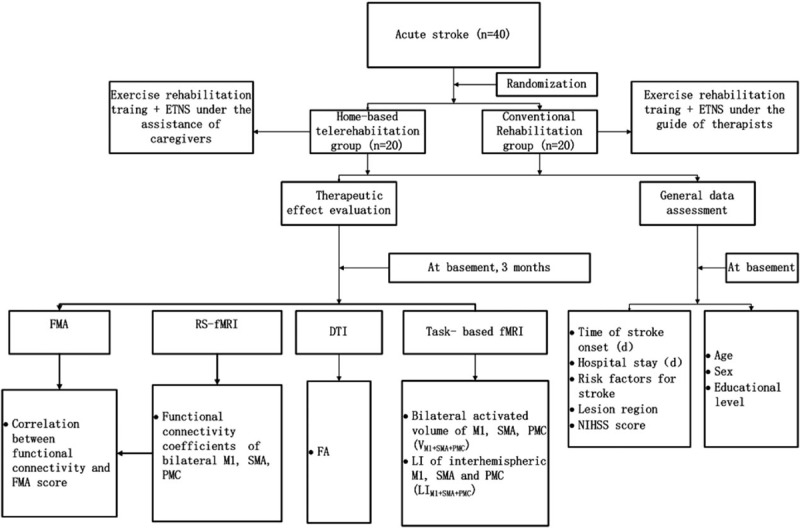
Methods/design: In a single-blinded randomized controlled pilot study, patients with acute subcortical stroke (n = 40) are assigned to receive home-based telerehabilitation or conventional rehabilitation. Task-based or resting-state functional magnetic resonance imaging (rs-fMRI), diffusion tensor imaging (DTI), and Fugl-Meyer assessment (FMA) score will acquired before and after rehabilitation. Activation volume of bilateral primary motor (M1), supplementary motor area (SMA), premotor cortex (PMC); lateralization index (LI) of interhemispheric M1, SMA, and PMC; functional connectivity of bilateral M1, SMA, PMC; fractional anisotropy (FA) will be measured; correlation analyses will be performed between neuroimaging biomarkers and FMA score pre- and postrehabilitation.
Discussion: We present a study design and rationale to explore the effectiveness and neural mechanism of home-based rehabilitation for stroke patients with motor deficits. The study limitations related to the small-amount sample. Moreover, home-based rehabilitation may provide an alternative means of recovery for stroke patients. Ultimately, results of this trial will help to understand the neural mechanism of home-based telerehabilitation among stroke patients with hand movement disorder.
Copyright © 2017 The Authors. Published by Wolters Kluwer Health, Inc. All rights reserved.
Conflict of interest statement
The authors have no financial and conflicts of interest to disclose.
References
-
- Liu L, Wang D, Wong KS, et al. Stroke and stroke care in China: huge burden, significant workload, and a national priority. Stroke 2011;42:3651–4. - PubMed
-
- Walsh ME, Galvin R, Loughnane C, et al. Community re-integration and long-term need in the first five years after stroke: results from a national survey. Disabil Rehabil 2015;37:1834–8. - PubMed
Publication types
MeSH terms
LinkOut - more resources
Full Text Sources
Other Literature Sources
Medical
